

The January sales, which involve mass discounting by retailers large and small, have been a familiar presence in the UK for decades, but amid fluctuating sales and a struggling high street, they may no longer have the same appeal.
The events would typically involve customers flocking to stores, or in more recent years, turning to online retailers, to bag a bargain. In a post-pandemic world, however, their purpose seems less clear.
While it’s too soon to draw full conclusions about the latest round of January sales, as a complete set of data may not emerge for some time, the behaviour of retailers in previous years offers strong clues.
According to Harvir Dhillon, economist at the British Retail Consortium (BRC), January sales are increasingly becoming a tool for liquidity rather than profit.
Read more: UK’s cheapest towns to buy a home revealed
“Rather than serving as a vehicle for profit, they now provide essential liquidity to meet first-quarter tax obligations. In this context, the sales period acts less as a commercial opportunity and more as a financial necessity. The sales also play a key role in clearing inventories, reducing the cost of holding stock, particularly of seasonal products,” Dhillon told Yahoo Finance UK.
In the modern retail landscape, January sales appear to be less about driving growth and more about shoring up cash flow in the early months of the year.
Sales figures are a mixed bag
To understand whether January sales remain relevant, it’s important to look at consumer behaviour in the months leading up to them. The figures compiled by various industry bodies and statistical companies reveal that it’s very much a mixed picture.
Office for National Statistics (ONS) figures showed that retail sales volumes fell by 0.3% in the fourth quarter of 2025, despite a 0.4% rise in December. The unexpected rise over the festive period was certainly welcome news for retailers. Online jewellers, for example, enjoyed a sales boost, largely driven by demand for precious metals.
Read more: UK savers lost almost £7bn to inflation while they slept in 2025
However, the data also suggested that underlying consumer demand across the retail sector weakened heading into the January sales period. In addition, volumes remain 1.5% below pre-pandemic levels, pointing to a slower structural recovery in consumer spending.
Looking beyond consumer demand, structural cost pressures continue to erode margins and are reshaping discounting strategies, including those that occur during the January sales.
According to Dhillon, recent increases to National Insurance and the National Living Wage have forced many retailers to revise their approach to January discounting.
“With margins already under pressure, many have found it necessary to temper their January discounting. The emphasis has shifted from volume-driven promotions to more selective, margin-conscious pricing,” said Dhillon.
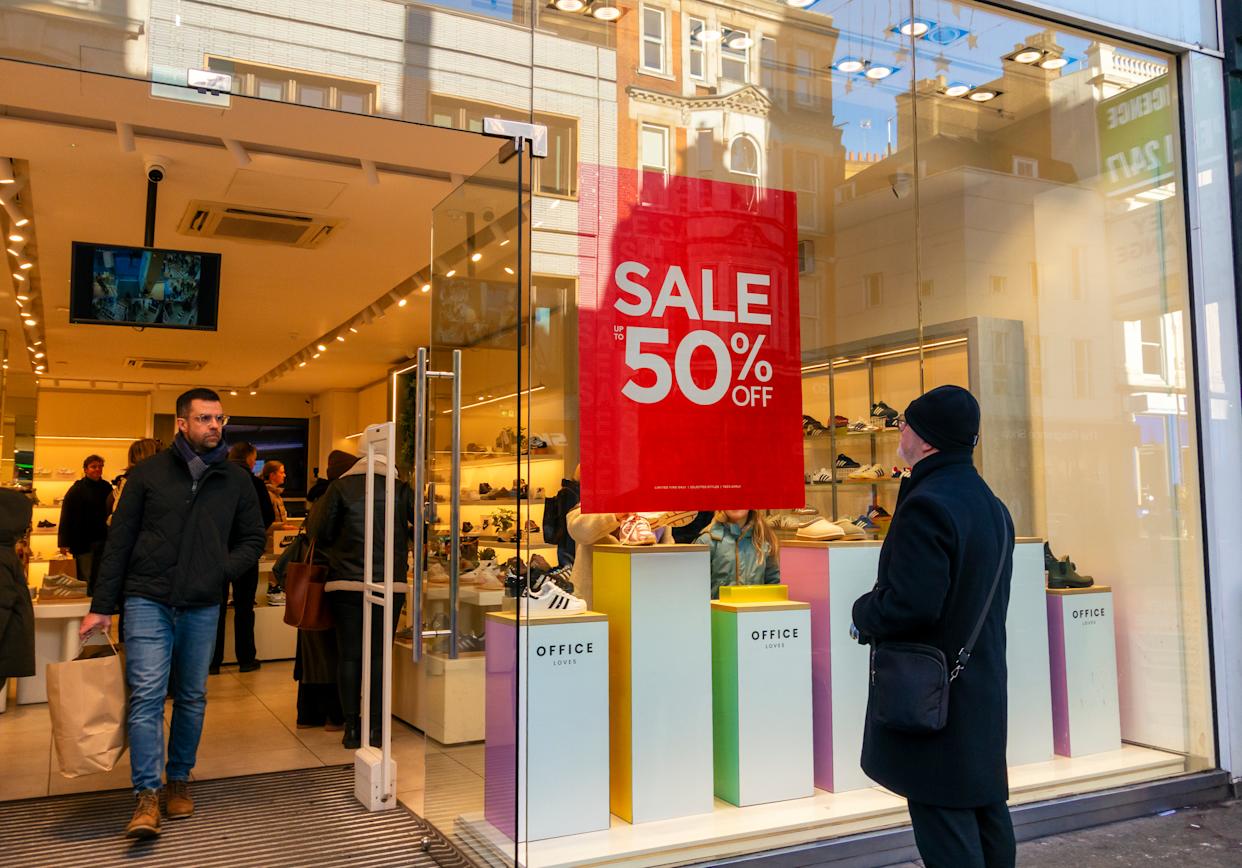
Underlying consumer demand across the retail sector weakened heading into the January sales period, according to ONS data.
(whitemay via Getty Images)
This declining interest in traditional discount periods has sharpened attention on whether younger shoppers, particularly Gen Z, are simply tuning out January sales altogether.
A growing generational divide
Jacqueline Windsor, head of retail at PricewaterhouseCoopers (PwC), one of the “big four” global professional services firms, believes there may be a “loyalty gap”, developing where Gen Z consumers are less loyal to fixed-discount periods such as the January sales, and instead favour year-round product discovery via social and digital platforms.
Speaking to Yahoo Finance UK, Windsor pointed to two overlapping trends. Firstly, she noted that the importance of January sales had been “diluted” by the earlier start of Black Friday and extended Christmas promotions. Secondly, the widespread shift to online shopping has removed the urgency and event-based excitement that once led to long in-store queues in the weeks after Christmas.
Read more: Shop price inflation ‘defies expectations’ to jump to 1.5% in January
This behavioural shift highlights how younger consumers are moving away from time-sensitive, in-store promotions and toward more flexible, digital-first shopping habits.
TikTok sales tick upwards
Social media is fast becoming a dominant force in retail. PwC’s UK Consumer Survey 2025 found that 31% of TikTok users in the UK made purchases on the app over the past year. Of those, 62% shop at least monthly, and 55% make unplanned purchases, spending an average of £30.
Windsor noted that TikTok and similar platforms are particularly effective at converting engagement into low-ticket “hero product” purchases. More significantly, 73% of people who had shopped on TikTok intended to do so again, while 56% of non-shoppers on the platform expressed a willingness to try it in the future.
The data showed that social commerce has moved beyond a trend to a high-impact channel that directly rivals traditional sales events. Millennial entrepreneur Mehera Quadir, co-founder of health supplement brand Superbotanic, has seen the generational shift in buying habits up-close.
Read more: How staying ‘dry’ beyond January could be a big boost to your finances
“As a consumer, I still enjoy going to the shops, but I’ve noticed most of our Gen Z customers order online,” she told Yahoo Finance UK “People still shop in-store at places like Holland & Barrett to purchase our products, but the younger generation clearly prefers digital convenience.”
Challenging backdrop
Data from the Centre for Retail Research showed UK retail contraction accelerating. Major retailers shut down hundreds of branches across the UK in 2025.
Against this backdrop, the central challenge for retailers in 2026 is adapting their business models to remain relevant to younger consumers, who expect brands to engage with them on their own terms.
“Retailers are looking to optimise their store estate – reducing overall footprint, selectively opening new stores and launching more experimental formats,” said Windsor. Improving the process of ordering and delivering is also a big focus area, she added.
There is no question that some people will still hold out for a bargain in January, but customers more attuned to social-driven trends, retail pop-ups and influencer-led campaigns may consider such traditional sales events to be long past their shelf life.
Read more:
Download the Yahoo Finance app, available for Apple and Android.