The centre is a huge cluster of nine faculties and institutes and performing arts spaces that contains the world’s first Passivhaus concert hall, too. The list of facilities that it accommodates – even in the briefest terms – is extraordinary. Nine faculties and institutes, seven libraries and collections, a concert hall, theatre, cinema, broadcasting studios, museum of musical instruments, exhibition gallery, learning centre, rehearsal and studio spaces, bar and café. The centre has just received Passivhaus accreditation (as of last week), making it the largest Passivhaus university building in Europe.
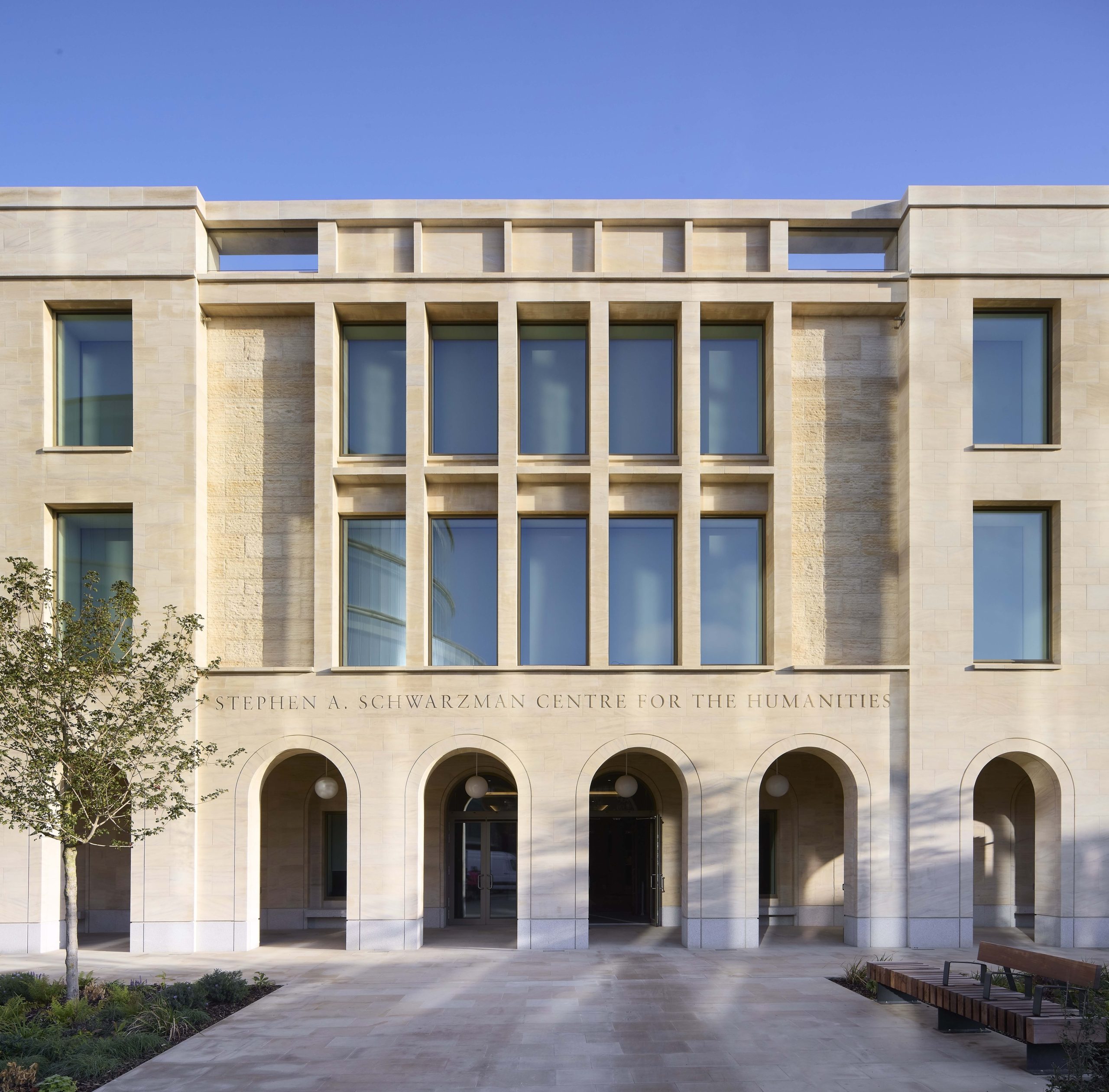
External view
It’s also the biggest single building project ever undertaken by the University of Oxford, with the majority of its funding coming from the single largest donation the University has ever received: £185 million given by Stephen A Schwarzman, CEO of private equity firm Blackstone, the world’s largest asset management firm.
This is the latest building to complete on the 10-acre site north of the city centre between Woodstock Road and Walton Street, a site freed up by the closure of the Radcliffe Infirmary Hospital in 2007, which moved its services out to a new RTKL-designed hospital in Headington east of the city centre. The Radcliffe Observatory Quarter, as the site is now known – named after the neo-classical, Grade I-listed Radcliffe Observatory which sits at its northern edge – was masterplanned in 2009 and has provided a key central Oxford site for the expansion and consolidation of University departments. Subsequent developments have since included Rafael Viñoly Architects’ 2013 Andrew Wiles Building, which houses the Mathematical Institute, and the Blavatnik School of Government, designed by Herzog & de Meuron, which opened in 2015.
Hopkins’ Schwarzman Centre, which opened to students in October, is on a different scale even to these two significant buildings: sitting on the largest central plot of 14,200m2.
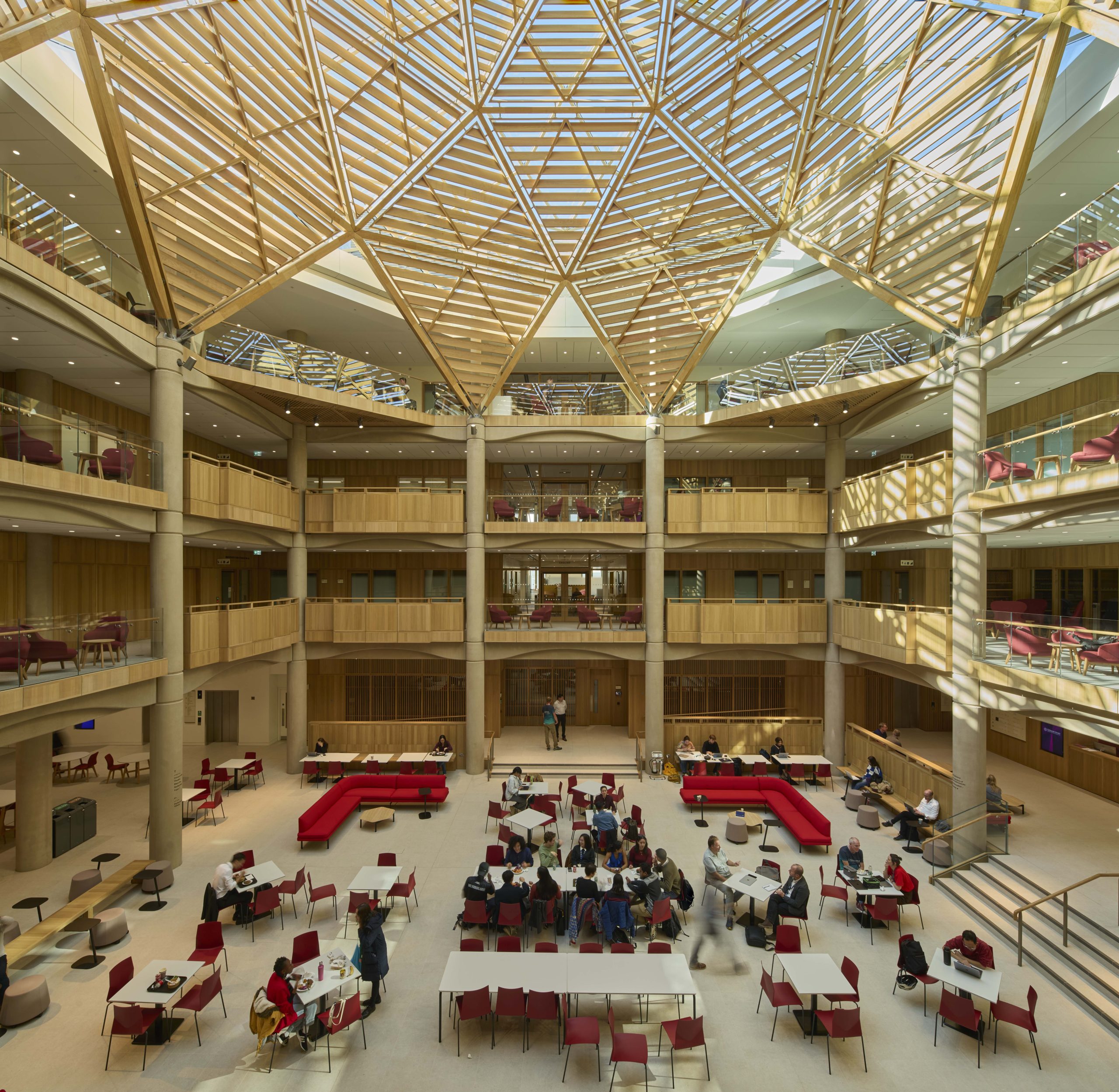
Great Hall
The practice won the commission in 2020 after an invited competition against rival bids believed to have been from WilkinsonEyre and Stanton Williams. The complex brief was to bring together seven humanities faculties on one site – English, History, Linguistics, Philology and Phonetics, Medieval and Modern Languages, Music, Philosophy, Theology and Religion – alongside an Institute for Ethics in AI, the Internet Institute and the new Bodleian Humanities Library.
In addition there was the need to rehouse seven libraries and collections: English, Film, History of Medicine, Music, Philosophy, Theology and Religion, and the Bate Collection of Musical Instruments. On top of this, the building also had to accommodate a series of arts and performance spaces – from a 500-seat concert hall to digital sound studios: making this the first major building in the University specifically designed as an arts venue openly accessible by the public (the public cultural programme is due to start this April).
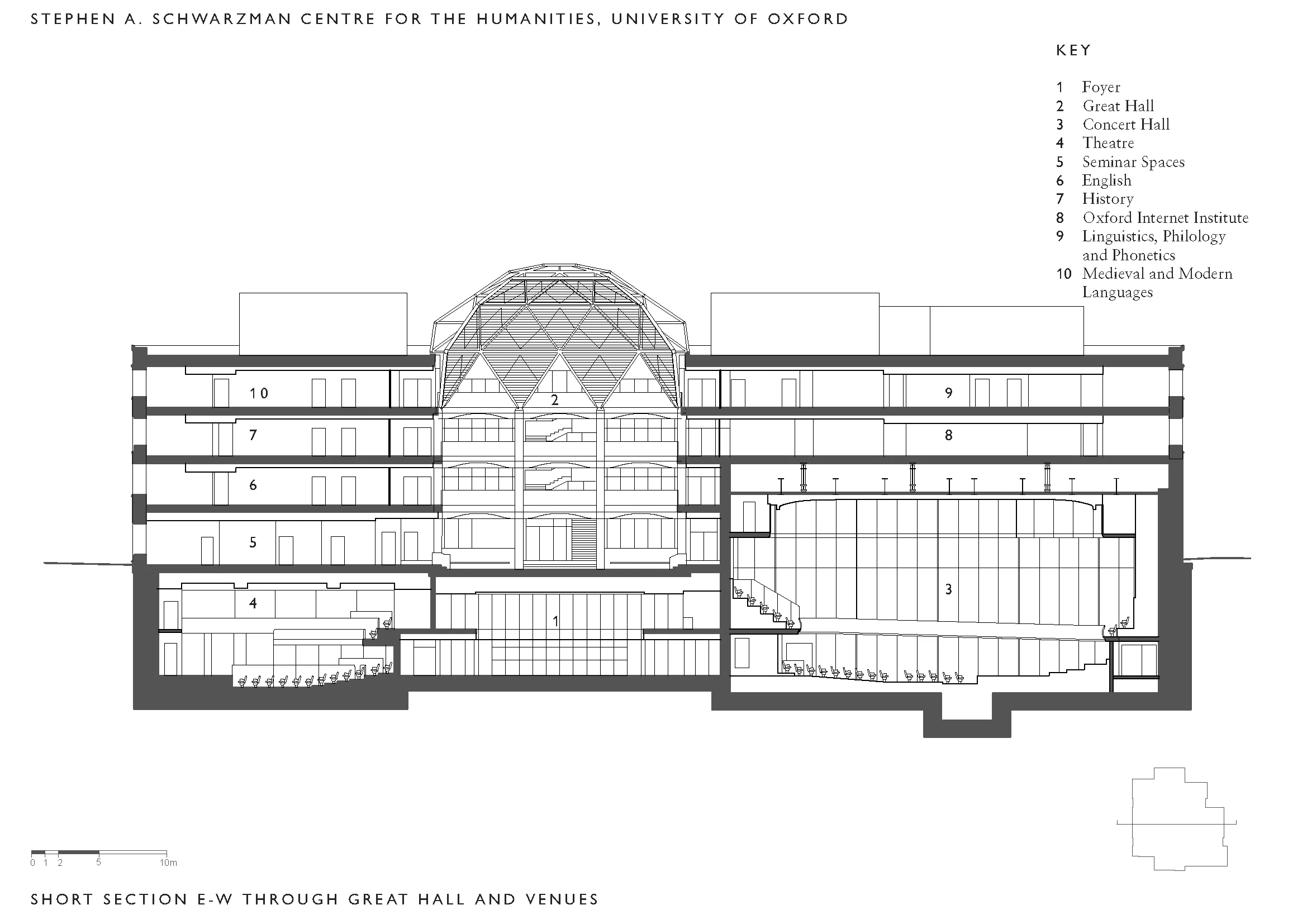
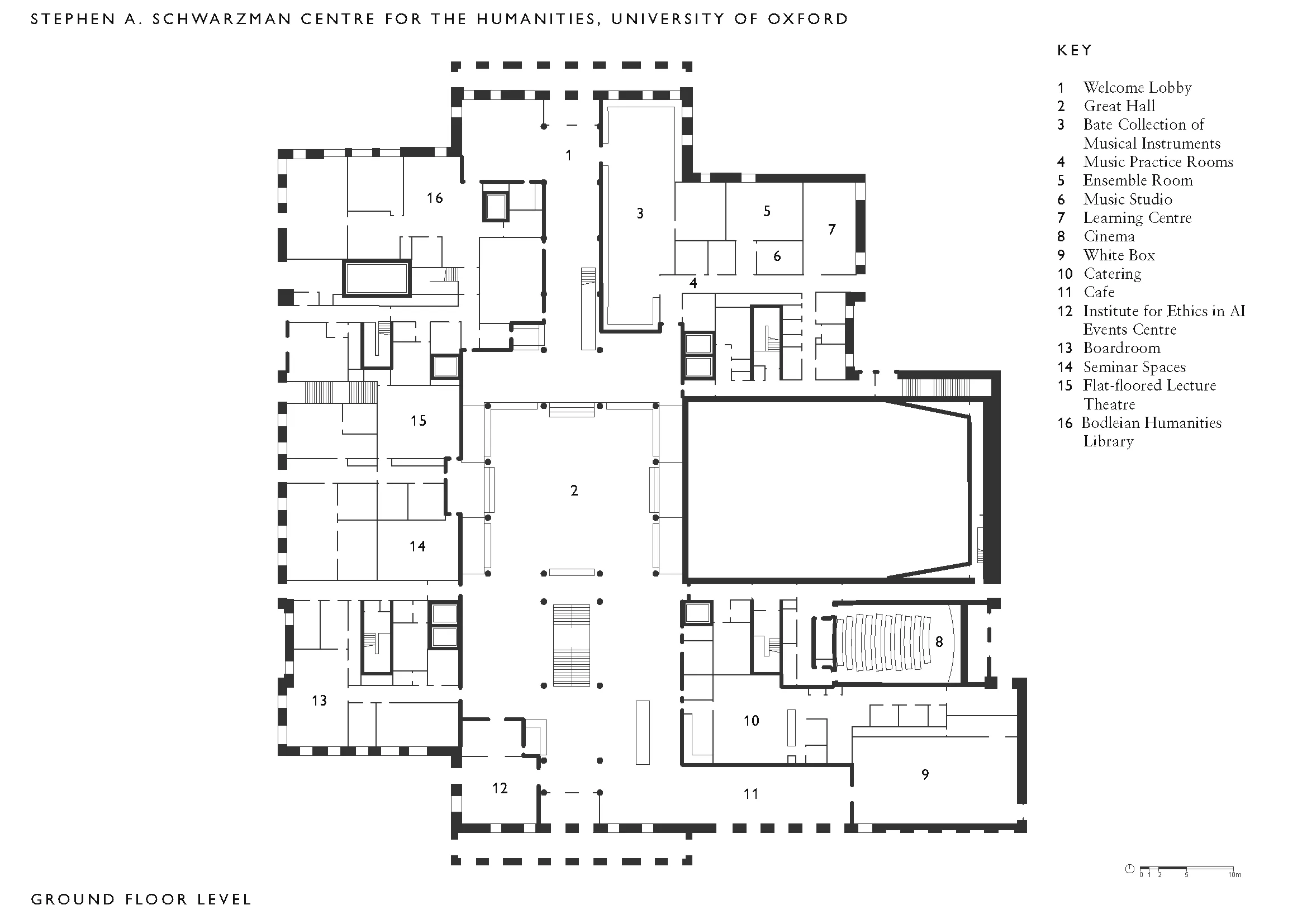
In order to accommodate this extensive list of functions, the Hopkins scheme stacks the nine faculties and seven libraries across four-storeys – across deep floor-plates laid out with staff offices, lecture and teaching spaces or stacks and study spaces around the perimeter. Meanwhile all the performance spaces have been placed below ground in two storeys of basement.
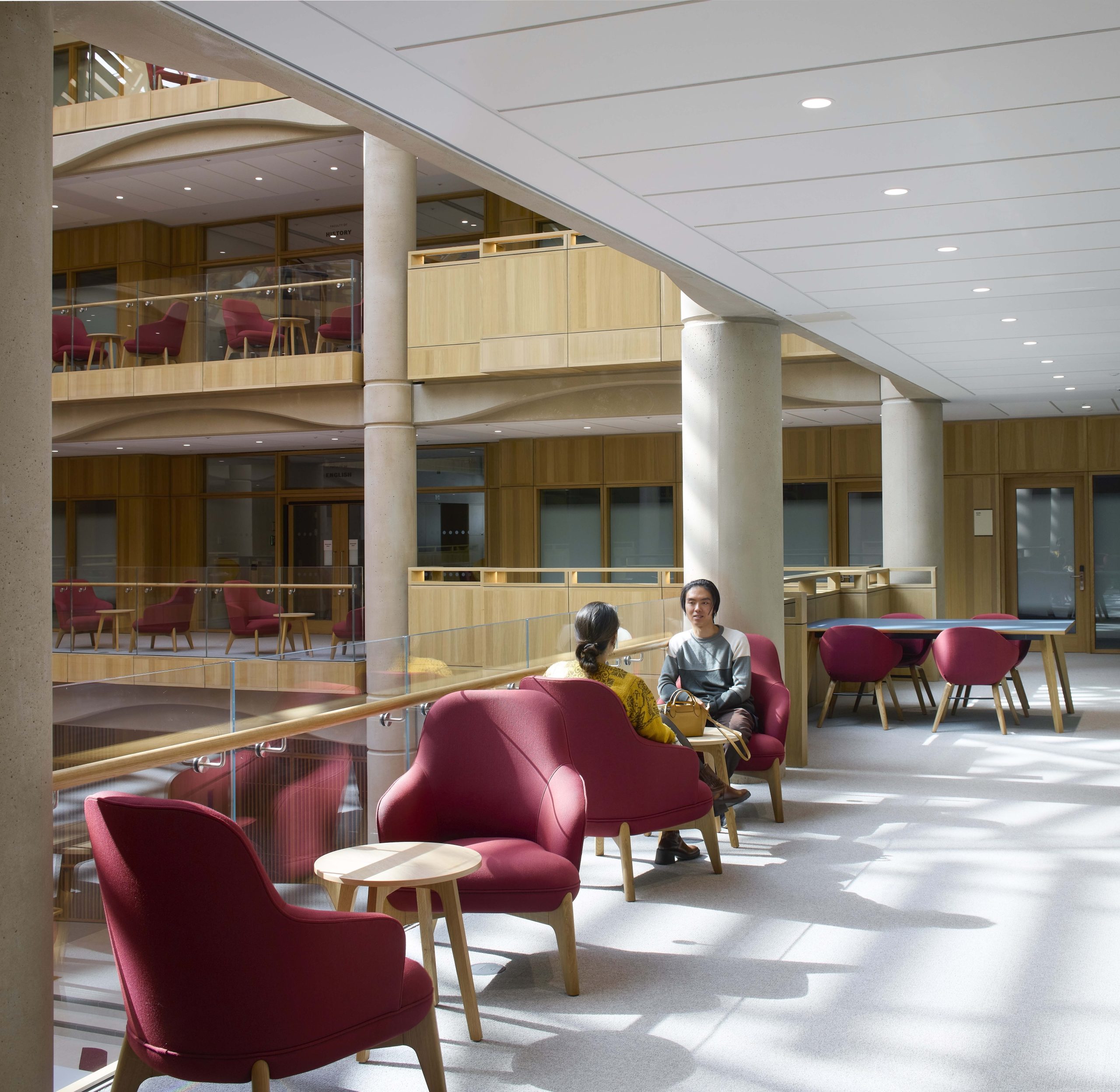
A reading space
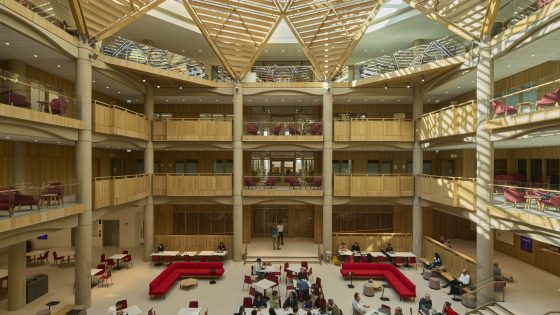
In plan the whole is organised around a central route north-south – off which more public-facing functions and facilities such as an exhibition space, a learning centre for schools and public engagement and café sit – and which opens up at its centre into a lofty top-lit space topped by a filigree dome, formed of steel, timber and glazing. This ‘Great Hall’ is the central crossing and social meeting point of the scheme, ringed in turn on each floor above by deep galleries designed for informal study and meetings which sit outside the entrances to faculties – in all creating an open unprogrammed hub at the heart of the highly specialised research and teaching spaces that surround it.
The practice points out that the rotunda of the Great Hall is around the same diameter as that of the Radcliffe Camera library, the celebrated 18th century James Gibb-designed building which sits on a central route through the University, surrounded by the orthogonal Old Schools Quad. In plan too the Hall’s central position on the route through this city-block-sized building is like an internalised version of the arrangement of Gibb’s building – intended as a new hub for the University.
Hopkins says that they decided purposely to eschew the traditional Oxford college model here – of college walls presenting hard, closed-off urban edges to surrounding streets while opening up internally into green quads – by inverting it. So new green public spaces have been created as threshold to the entrances of the building, which sit behind a strip of landscaping incorporating seats and planting, which softens its face to its surroundings.
This inversion was dictated in part too, one assumes, for environmental reasons, allowing the whole block to be encapsulated as a single envelope in the push for Passivhaus certification which, engineered by Max Fordham, has been impressively achieved through high levels of insulation and airtightness, all-electric heat pump heating and cooling, MVHR and a roof-full of PVs.
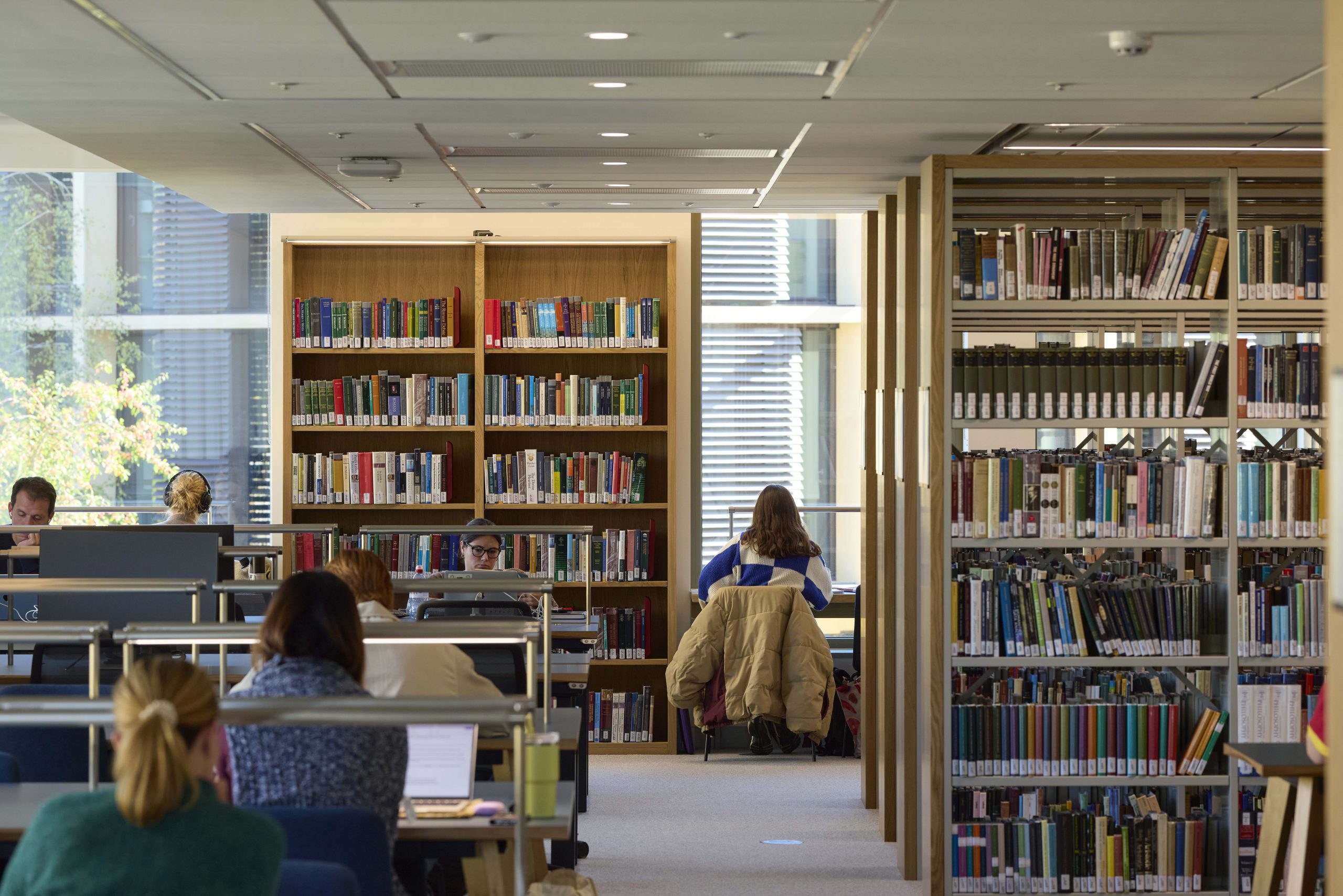
New Bodleian humanities library
From the outside the building’s form does echo the traditional texture of Oxford colleges – the brief called for a contemporary version of a traditional Oxford building – its four-storey façade wrapped sedately in warm Clipsham stone in stark contrast with the more self-consciously look-at-me architecture favoured by adjacent University buildings like the Blavatnik School by Herzog & de Meuron, with its cantilevering glazed curves channelling the Starship Enterprise.
In detail, the façades opt for a sort of soft Classicism-infused modernism – with a precise but rather bloodless use of stone reflecting how it is composed of prefabricated panels – MMC fabrication being chosen to ensure the most thermally-efficient envelope in the push for ultra-low operational carbon.
But the sheer scale here – something more akin to a city block than a building – sets up problems for the ordering of the architecture – which would need something more gutsy and expressive to hold its length, for all the fine stonework. Even the entrance, marked by a colonnade – reading more as courtyard cloister than entrance arch – is surprisingly downplayed, given this is a building designed to welcome the public in – with huge carved letters needed to confirm its role. (Tellingly, a friend observed on seeing a picture of the building that it looked a bit like the Pentagon – huge but somewhat inviolate.)
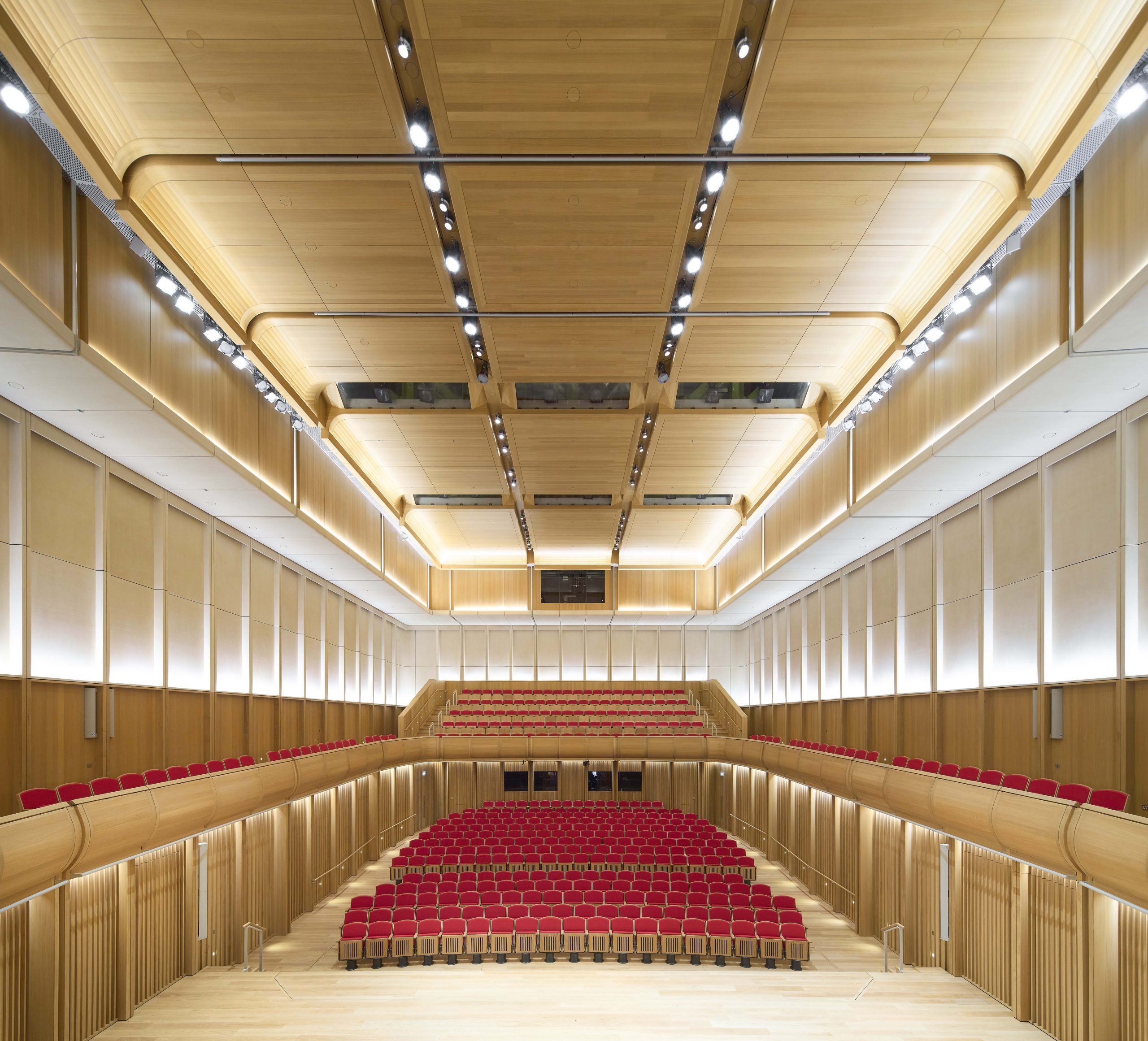
Sohmen Concert Hall
The building’s eastern elevation in particular is oddly unresolved – composed of differently projecting blocks of façade jostling horizontally, the architecture neither successfully drawing a unifying veil over the volumes behind nor fully expressing them.
Internally, too, the spaces have a somewhat static BIM-designed spirit, given the scale of spaces – all in a tasteful tenor of blond oak and pale plaster.
You enter through a very deep undercroft-like lobby space, which leads through to the Great Hall but also contains the main public entrance to the performance arts centre, a wide stair on axis dropping down to this below.
Here things hot up a bit, with a large double-height foyer and deep theatrical red carpet, around which sit an exceptional array of performance spaces: the 500-seater Sohmen Concert hall; a 250-seater theatre, 100-seater cinema and black box lab, as well as a host of multimedia digital TV, broadcasting and sound studios, rehearsal rooms and studio spaces – providing an incredible new resource for the University and City. But even here everything has a tendency to the orthogonal – not a theatrical swish in sight – with all the gymnastics happening invisibly in the highly-engineered acoustic design and engineering – box-in-box structural and state-of-the-art acoustic isolation, rather than the architecture.
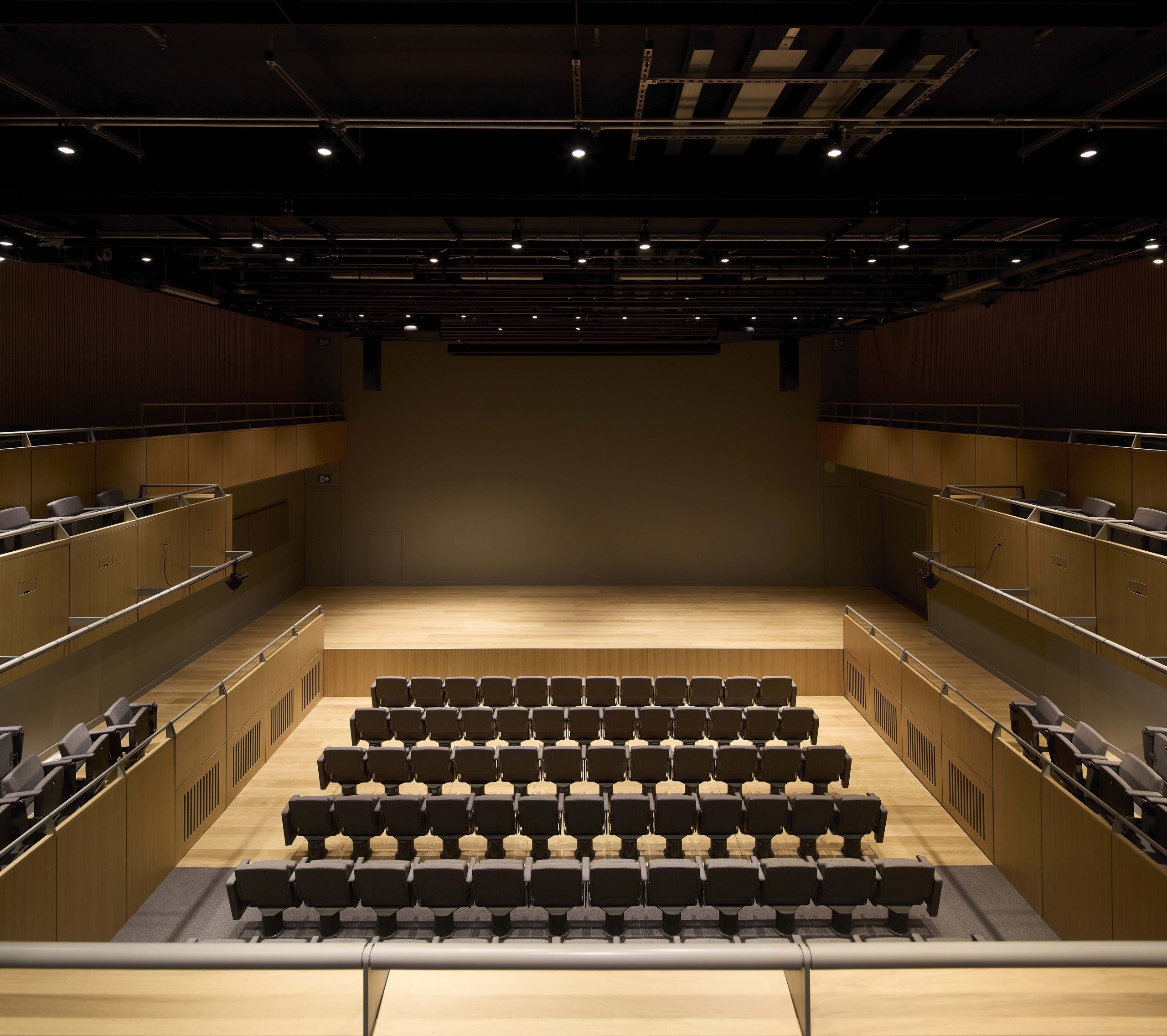
Theatre
In some ways this could be seen as symptomatic of the whole: impressive and incredibly engineered and marshalling a plethora of functions very effectively, it’s somehow over-controlled in the architecture – which is not given licence to express anything other than the enclosure of space. Given the Schwarzman Centre is in scale a half-way-house between standalone building and city block, one might have hoped for from more variety and drama in the handling of spaces. Where once – think the spider-frame of Hopkins’ Schlumberger Research Centre or the Piranesian heft of their Portcullis House – architecture drew form and energy from its engineering, here the environmental engineering in particular seems to have constrained it – a case, perhaps, of Passivhaus syndrome.
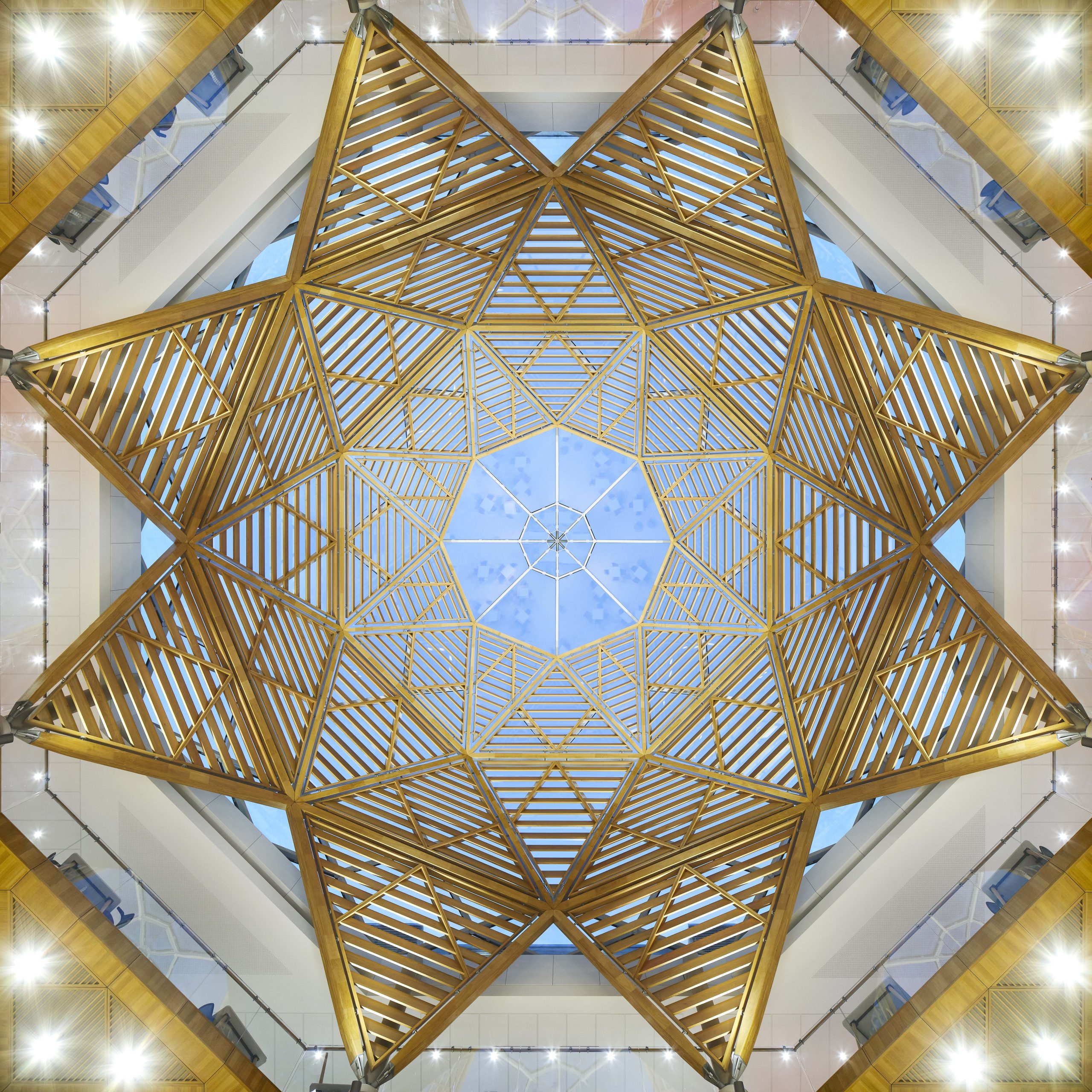
Great Hall dome
Architect’s view
The Stephen A Schwarzman Centre for the Humanities marks a step-change for Oxford, consolidating the Humanities into a critical mass of teaching, research, and outreach. For the city, it introduces within the building, a new public ‘street’ and a major cultural venue, embodying collaboration as a foundation of its design.
Oxford’s global reputation in the Humanities drove the project’s ambition: to enhance models of learning, while embracing environmental and social sustainability and inclusivity. The Centre has been certified as England’s largest Passivhaus scheme and the world’s first Passivhaus Concert Hall.
The brief was shaped through extensive consultation with academics, librarians, students and staff. Previously dispersed across 26 buildings, seven Humanities faculties, six Bodleian libraries, the Oxford Internet Institute, and a new Institute for Ethics in AI are now united in a central location opposite the Radcliffe Observatory. This physical academic proximity was specifically designed to encourage interdisciplinarity and collaboration.
At the heart of this fundamental collaborative drive across both academe and outreach, is the Humanities Cultural Programme, centred on a world-class 500-seat Concert Hall, three other performance venues, and exhibition and film spaces. This creates a virtuous cycle of ‘research as performance’ and ‘performance as research’, strengthening ties between
The design prioritises openness. The public route through the building avoids conventional barriers to entry and is punctuated by public spaces of differing scale and character. At its centre lies the Great Hall, a four-storey atrium with faculty entrances at its cardinal points, study carrels above, and a domed timber-and-glass skylight bringing light into the space.
Flexible enough for exhibitions, lectures, performances, or banquets, it resonates with Oxford’s tradition of civic ‘rooms’, and recalls Hawksmoor’s original vision of a Forum Universitatis.
Below, performance spaces cluster around a foyer that doubles as an informal venue. Alongside the concert hall are a 250-seat theatre, black-box experimental space, rehearsal facilities, and music studios. Together, these expand Oxford’s cultural reach, drawing in chamber orchestras, which might ordinarily omit Oxford from their itineraries, and enabling diverse artistic expression from opera to electronic performance.
Architecturally, the 25,300m2 building’s scale is modulated by a composition of smaller Clipsham stone and brick blocks, articulated to respond to the highly varied immediate context while still signalling formal entry points. Colonnades, landscaping, and external ‘rooms’ blur the boundary between building and city. Internally, meticulously crafted details, recalling a contemporary response to historic collegiate materiality, balance modern prefabrication techniques with durability, tactility, and gravitas.
Advanced modern methods of construction and prefabrication provided both speed and quality. BIM and VR tools ensured precision across the design team, contractor, and supply chain, embedding the golden threads of fire safety, sustainability and regulatory compliance.
The Schwarzman Centre unites Oxford’s Humanities in a welcoming, sustainable landmark. It strengthens interdisciplinarity, opens the university to the city, and provides a new cultural hub, creating an inspiring, flexible, and enduring home for dialogue, research and performance.
Hopkins Architects
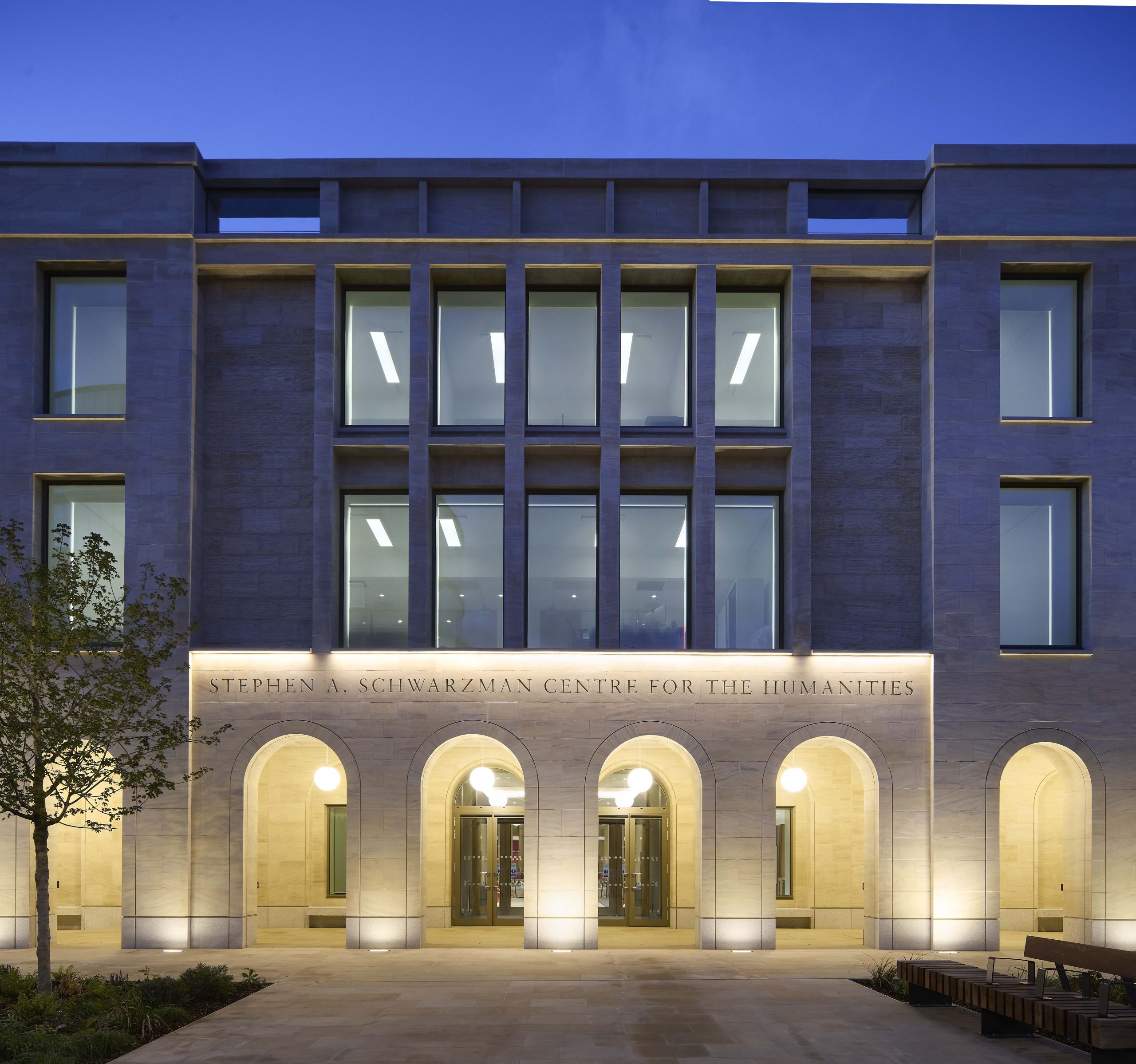
External view
Engineer’s view
The Schwarzman Centre for the Humanities is the largest Passivhaus scheme in England and the only Passivhaus concert hall in the world.
As MEP engineers, acoustic and lighting designers, and contractor-side Passivhaus advisors, we worked closely with the design team to bring together ultra-low energy servicing solutions for the huge variety of functions, from the concert hall right down to individual academics’ studies.
Our all-electric design ensures ultra-low energy use and resilience to climate change through demand-controlled ventilation with heat recovery and all-electric heat pump-based heating and cooling. Key features of the sustainable design include solar power generation on the roof, zero fossil fuel consumption throughout the building, very high levels of insulation and airtightness to reduce the heating demand, and materials and equipment which were chosen for longevity and high performance. All of this contributes to the as-designed building meeting the university and Passivhaus targets for space heating demands and operational carbon emissions.
The high-performance acoustic design for the theatre, cinema, music studios, music ensemble and practice rooms, and ultra-quiet linguistics and phonetics research facilities employs box-in-box strategies and isolated floors to provide superior sound insulation for key rooms.
Our approach for lighting the key spaces was to integrate the lighting into the architecture to enhance its impact. Elsewhere we employed a simple palette of high efficiency fittings, controlled in real time across the site, to deliver appropriate light levels with minimal energy consumption.
Nick Brown, principal MEP engineer, Nick Cramp, lighting director, Neil McBride, principal acoustic engineer and Gwilym Still, Passivhaus director, Max Fordham
Project data
Location Oxford
Start on site May 2024
Completion August 2025
Gross internal floor area 25,300m2
Gross site area 14,200m2
Construction cost Undisclosed
Architect Hopkins Architects
Contractor architect Purcell
Client University of Oxford
Structural engineer AKT II (novated)
Piling and structure Expanded Piling
Building services designer Max Fordham (novated)
M&E consultant Services Crown House
QS Arcadis
Theatre consultant CharcoalBlue
Landscape consultant Gillespies
Passivhaus consultant Etude
Acoustic consultant Arup and Max Fordham
Fire engineer Fire Ingenuity
Façades Vetter
Windows and doors Britplas
Hybrid steelwork Severfield
Dome Novum
Performance space fit out James Johnson
Timber linings WJL
Joinery Quest
Project manager CPC Project Services
Main contractor Laing O’Rourke