
Don’t have nightmares, but some horrible creatures come out on to your face at night – and doctors can’t agree whether they are friend or foe
This is Everyday Science with Clare Wilson, a subscriber-only newsletter from The i Paper. If you’d like to get this direct to your inbox every week, you can sign up here.
Hello, and welcome back to Everyday Science.
As someone used to writing about medical matters, I’m not usually squeamish. But with this week’s topic, I may have reached my limits.
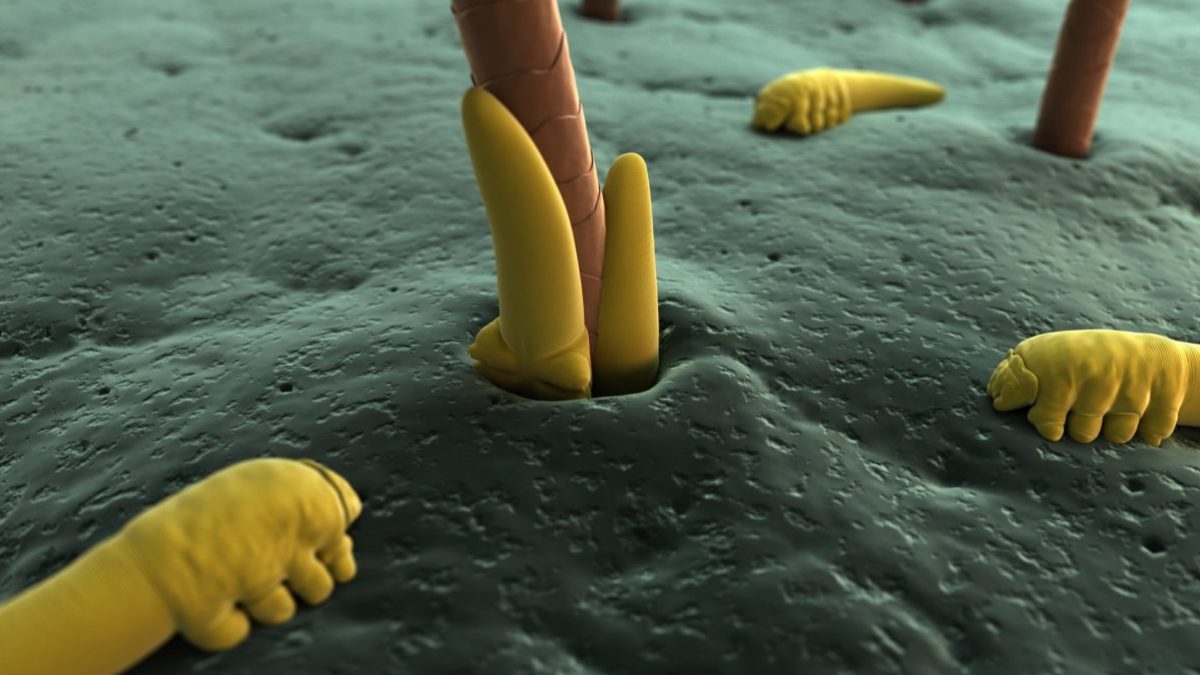
It concerns a microscopic mite that lives on the human face. It dwells in hair follicles, such as those of the eyelashes and other facial hairs, or inside tiny skin glands.
New FeatureIn ShortQuick Stories. Same trusted journalism.
Conventional wisdom is that these mites, called Demodex, are usually harmless, and probably do us a favour by eating up dead skin cells and oil.
But dig a little deeper and it seems that these creatures might be the unsuspected cause of a host of medical conditions, including itchy eyes, dry eyes and facial rashes and spots.
Read on only if you have a strong stomach, because the more you learn about Demodex, the more unfair it seems that we put up with them.
“They really are disgusting,” said Professor Alex Müntz, head of the Institute of Optometry at the University of Applied Sciences and Arts Northwestern Switzerland.
Face parasites that emerge at night
Demodex mites have been known about since the 1800s. But they were long thought to be just one of the larger members of the diverse ecosystem of microscopic organisms that live on us and in us, which also include bacteria, viruses and fungi.
The mites are sensitive to light and so spend daytime burrowed deep in the skin’s glands or hair follicles.
At night they emerge, feed and mate, before scurrying back under cover. As the adults have no anus, they simply get bigger as they age, before dying after a few weeks. Then, their bodies disintegrate and release their waste.
Unpleasant as this sounds, in most people, the mites seem to be harmless passengers. But in some, for reasons that are not clear, they grow too numerous – and that’s when the problems start.
When there is overgrowth of mites in the eyelash follicles, it can cause itchy and inflamed eyelids, known as blepharitis.
Optometrists look out for crusty material on the lashes, which is the remains of their dead bodies and undigested food. The telltale sign of Demodex is that this waste forms stubby cylinders around individual lashes, presumably caused by the debris slowly elongating down the lash over time.
If there are too many mites in glands within the eyelids, this blocks their release of oil that normally helps keep the eyes moist. That’s why dry eyes can be another impact of mite overgrowth.
 Rosacea can be a distressing condition, and it might be caused by mites (Photo: Olga Shefer/Getty)
Mites within glands on the skin, particularly on the cheeks, can be a cause of rosacea, when skin becomes red, dry and inflamed. Severe cases can involve pimples and over time, fine “broken” veins develop.
Rosacea is usually said to be caused by stress, sun exposure or alcohol. But a decade ago, research showed that people with rosacea have 10 times as many mites on their face as those without the condition.
The symptoms may result from the immune system reacting to the mites, or bacteria they carry, or just from them blocking up skin pores.
While it is still unclear if Demodex are a cause of rosacea or are just able to multiply more easily in damaged skin, dermatologists are increasingly recommending treatments that target the mites for people with rosacea.
There is a wide range of options for killing off these creatures – they include ointments or tablets of anti-parasitic drugs, including ivermectin – once thought able to prevent Covid.
If optometrists suspect someone’s eye problems are caused by Demodex, they may first recommend eyelid wipes containing tea tree oil, a substance that is toxic to the bugs – although they can sting.
The key is to use them just before sleep, so when the mites come out at night, it gets on their feet, said Professor Etty Bitton, chief of the dry eye clinic at the University of Montreal. “They bring it back to the follicle, and it affects them and their friends,” she said.
People should never try to make their own eye wipes from tea tree oil, because if not diluted enough, it can burn the eyes, she added.
Overlooked cause of medical conditions
You might think these treatments make Demodex a problem that is easily fixed. But people who are plagued by rosacea or dry eyes, for instance, may treat the symptoms without seeking help for the problem’s root cause.
Some health staff aren’t yet aware that the mites may cause or contribute to so many conditions. The NHS website on rosacea, for instance, doesn’t mention them.
Even Demodex experts aren’t sure just how often such problems are caused by overgrowth of the mites – as so much is still unclear. For instance, published estimates for how common it is for people to have any Demodex on their face range from 10 to 90 per cent.
The mites are harder to study than other microorganisms. Gut bacteria can be grown in a dish in the lab, and their numbers easily measured in stool samples. Demodex, by contrast, don’t live for long when off the body, and there is no standardised way of gauging how many are present on someone’s eyes or face.
“We don’t know the range of infestation in the human population. It’s very difficult to quantify how much somebody’s Demodex burden is,” said Professor James Coulson, a pharmacologist at Cardiff University.
One option is to pull out eyelashes to examine them, but this often leaves mites behind or flicks them in the air.
Optometrists can view the eyes through a special microscope called a slit lamp, but remember, the tiny beasts disappear under bright light. Instead, the distinctive cylinders of waste material can be counted, but this is a crude proxy for mite numbers, and might also depend on how often someone washes their face.
Müntz has recently reported a way to see the tail ends of the mites sticking out of the follicles.
While viewing the eye through a slit lamp, he gets rid of the cylinders of waste by pulling them down the lash with tweezers and then gently pulls the lash sideways. “I was able count the number of butts sticking out,” he said. “That was the first direct, objective method of diagnosing Demodex.”
There are claims the mites may contribute to other conditions. A pharmacist in Cardiff, Diana Senior-Fletcher, has recently proposed they may also cause conditions such as rhinitis, when people have a blocked or runny nose with no obvious cause, and asthma.
She says the inflammation involved in these conditions may be caused by the immune system reacting to the mites. They are being overlooked as a potential cause of disease, she said.
Your next read

Senior-Fletcher recently published a series of cases of people who had cured themselves of conditions such as dry eyes and rhinitis, in the journal, Frontiers in Allergy. They used an unorthodox method of killing Demodex – applying Vaseline to the eyelashes every night for four weeks, thought to work by trapping the creatures in goo.
But randomised trials are still needed to prove the approach is safe and effective, and anyone suspecting they have a Demodex problem should seek help from a health professional, said Senior-Fletcher.
On the bright side, Müntz says that for most, basic hygiene measures are probably enough to keep the creatures under control – like washing our face in the morning with soap and water. “It’s surprising how many people don’t do that,” he said.
I’ve been watching
If you like Stranger Things, you might also like a dark sci-fi TV series called, appropriately, Dark. It is set in a German town, whose economy and landscape is dominated by a nuclear power plant, which may or may not be connected to some mysterious disappearances.
That’s not the only similarity with Stranger Things – several of the key characters are teenagers, and it is set in two time periods – the present day and the 1980s. In the earlier timeframe, the frequent 1980s cultural references, like Rubik cubes and Sony Walkmans, can feel a little forced, but that’s my only gripe – apart from just how scary it is for a wimp like me. I can’t watch this without a cushion at the ready.