
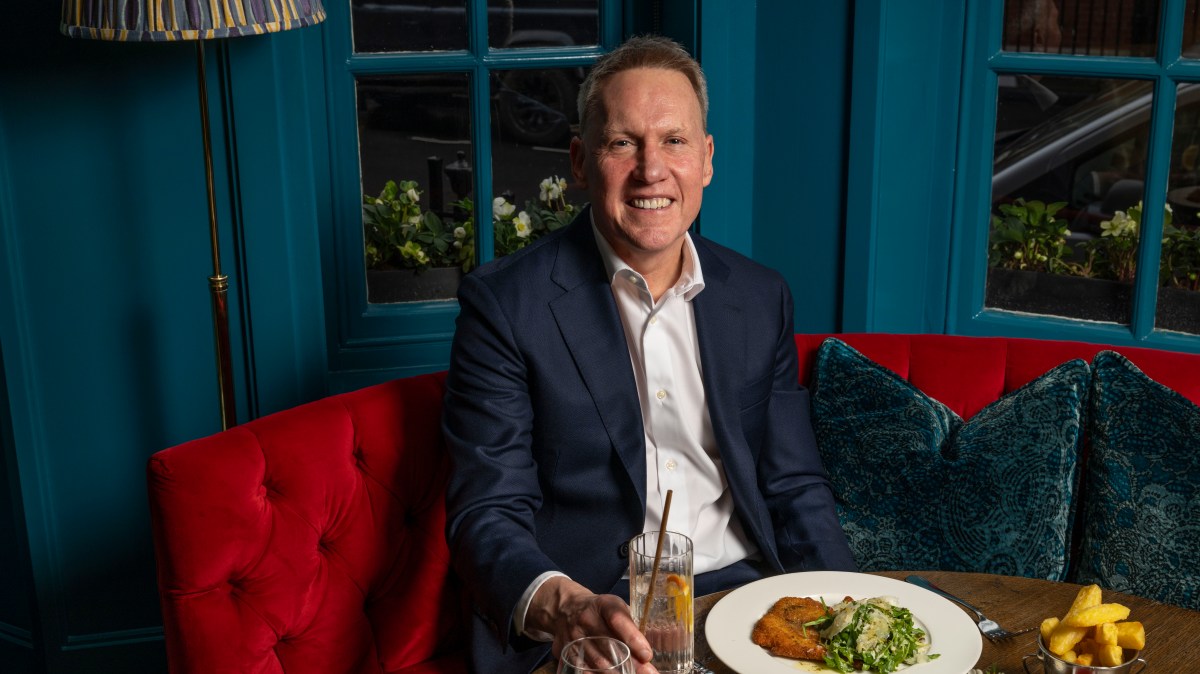
At a corner table at 108 Brasserie in the Marylebone Hotel on the fringe of the Howard de Walden Estate, Mark Kildea, the chief executive of one of London’s old family estates, meets for lunch.
The brasserie is among a number of stylish restaurants and boutiques that the estate, encompassing about 800 buildings on 95 acres of land between Oxford Street and Regent’s Park, has in recent years become renowned for, alongside its roots as a healthcare district stemming from Harley Street.
Kildea, 60, sitting down to an Angostura orange bitters and tonic water — “a phenomenal thirst-quencher” — has made developing the district as a hub for health tech innovation a central part of the strategy since he was promoted to chief executive during the first year of the Covid-19 pandemic after nine years as its finance chief.
“It’s got this history,” Kildea says. “I would argue, if you think about London, how many districts are still famous for that same trade or profession? I can only think of the City because even places like Covent Garden or Smithfield, famous for the butchery trade, they’ve changed over time.”
He adds: “That’s been one of the things that has been successful about the Harley Street health district. But it’s actually as important today, or even more important today than it was in the Victorian period when it was created, in essence, because healthcare is changing quite dramatically.”
Its connection with healthcare can be dated at least as far back as 1850 when the Establishment for Gentlewomen During Temporary Illness opened on Harley Street. In 1853 Florence Nightingale was appointed resident superintendent but left shortly afterwards to treat wounded soldiers on the battlefields of Crimea.
Amid today’s advent of artificial intelligence and medtech innovation, the estate has been more actively managing its portfolio, investing “hundreds of millions of pounds” in renovating and repurposing Victorian and Georgian buildings to build a cluster of health tech tenants and private sector-NHS partnerships, which, Kildea says, can ultimately help the country avoid “health bankruptcy”.
“There’s plenty of innovation. It’s the adoption of it and the scaling up of it [that’s a challenge],” he notes.
“The fact is you’ve got regulation that holds that back. Funding holds that back … The NHS is massive. If it can get its act together and act as one whole spire, then it’s incredibly attractive, not just to businesses in the UK, but probably attractive to businesses from elsewhere too.”
Kildea is familiar with the brasserie’s menu and the hotel’s general manager, who comes over to the table to greet us.
For starters we both order crispy tiger prawns with spicy cocktail sauce from the set menu. Kildea, who enjoys walking in the Cotwolds with his wife, where he has a home, and is off for some “proper trekking” at the end of January in Patagonia — part of what he quips is a “goal to manage decline” —opts for water.
Despite primarily being a hub for private healthcare, Kildea says the estate can help alleviate pressures on the NHS, including from an ageing population, and showcase and introduce technologies.
“We’re all living longer but it comes with challenges, so you’re always going to get, I call them the ageing conditions, from cancer, cardiac, ophthalmology, orthopaedics and cognitive decline.”
He adds: “We realised that healthcare was changing quite dramatically. It’s gone through the challenging period of Covid. There’s a workforce shortage. There’s a funding shortage. The government just doesn’t have enough money to spend on healthcare. There’s a societal shift as well towards wellbeing, preventative healthcare. So we wanted to make sure that Harley Street was in a position to respond to that.”
Healthcare is the largest part of its portfolio, accounting for almost 40 per cent of both its property income and value. Healthcare income increased 4.8 per cent to £63.8 million in the year to the end of March 2025 and that part of the portfolio was valued at £1.58 billion, an increase of 3.5 per cent. At the turn of the century, 40 per cent of income was from office tenants.
The estate’s healthcare district also represents 40 per cent of London’s independent market and 10 per cent of the UK’s, partly due to an increase of NHS private patient units.
The portfolio was 98.8 per cent let at the end of its 2025 financial year, excluding buildings under refurbishment.
It includes Hale House on Portland Place, launched last year in partnership with Spacemade. Initially two buildings totalling 29,000 sq ft created through about £25 million of investment, Hale House is designed as a flexible workspace for health tech start-ups and investors.
The anchor tenant is UCLPartners, a large health innovation network working with NHS hospitals. It was partly created in response to market research that found prospective tenants concerned about the cost and availability of space on the estate.
“We are already connecting innovators to some of our largest hospitals and clinics. One of our largest hospitals is very close to trialling with some health innovators with support from UCLPartners.”
Hospitals on the estate include the King Edward VII’s hospital, which was acquired by Bupa last year and the London Clinic, which partnered with America’s Northwestern Medicine two years ago.
“We have a lot of lovely townhouses here, which work for some specific healthcare and medical needs. But in terms of having that appropriate building [Hale House] that would create that energy and that vibe and bring the innovators here, that was something that was missing. And it was really important.”
At 1 Harley Street, a 25,000 sq ft healthcare space due to complete in March after a £25 million refurbishment, the estate is in late-stage letting discussions.
“It’s the gateway for Harley Street. It’s number one. So it’s important that we get the right type of occupier that adds something to the area.”
For a main course, Kildea has chicken Milanese with lemon zest, capers, rocket and parmesan, plus a side of hand-cut chips.
“I feel quite guilty talking about healthcare and having chips on the table,” he says.
I have Thai massaman curry with baby potatoes, mange tout, baby corn, toasted coconut and sticky rice.
Brasseries like this one at the Marylebone Hotel are what Kildea believes distinguish the estate from other healthcare clusters, particularly those in out-of-town science and business parks.
“You have this proper ecosystem. But also it’s within a lovely setting. It’s not on some city fringe … It’s culturally interesting … You have the experience economy here.”
Conversely, he recognises that because of the challenges of developing historical buildings, some listed, you would not necessarily start a healthcare hub here.
“Because it would probably be more cost effective to do that in Maidenhead or on some biomedical campus. But where are you going to find your patients? Where are the nurses going to come from? It just doesn’t happen. So we manage that well within the constraints.”
As well as securing quality tenants, the challenge is also to retain the investment confidence of the family.
The Howard de Walden family have controlled the estate since 1879, when the death of the childless 5th Duke of Portland resulted in the land being passed to his sister, Lucy Joan Bentinck, widow of the 6th Baron Howard de Walden. The family is currently led by Peter Czernin, the film producer, who became the 11th Baron Howard de Walden in 2024 after the death of his mother, Hazel.
The family received dividends totalling £50.3 million last year, up from £44.1 million in the previous 12-month period.
“There are probably 60 beneficiaries”, says Kildea, who hosts an annual shareholder meeting at the nearby King’s Fund thinktank on Cavendish Square.
“It’s my job as a chief executive to stand up there every year and tell them: ‘This is a great investment. This is something you should continue to be associated with. It will provide you with a good stable return and there’s some really exciting stuff happening in healthcare.’”
The estate, which traces its history to the Domesday Book in 1086, is a world away from Kildea’s “very working class” upbringing in a council house in Scotland.
But after university at Strathclyde he worked in the City of London during the 1980s deregulation boom when “finance was the sexy place to be”. After periods on banking and trading floors, he went on to become group treasurer for 17 years until 2011 at Capital Shopping Centres, later called Intu, which collapsed in 2020.
With time running out, suitably we skip dessert and order quick coffees — Kildea an Americano with warm milk and I have an espresso — before we say goodbye.
CV
Age: 60
Education: University of Strathclyde – BA, economics 1983-1987
Career: Howard de Walden Estate, chief executive since September 2020 and finance director from 2011 to 2020. Before this, group treasurer at Capital Shopping Centres for 17 years. Fellow of the Association of Corporate Treasurers.
Family: Married. No children
Receipt
Kingsdown still water £6
Kingsdown sparkling water £6 x 2
London Essence tonic water £4.50
Starters: Crispy tiger prawns x 2 £18 x 2
Set menu two courses £30 each:
Thai Massaman curry x1 (plus chicken £8)
Chicken milanese
Side of chips £7
Americano coffee £6.25
Espresso coffee £5.25
Service charge £13.63
Total: £122.63