
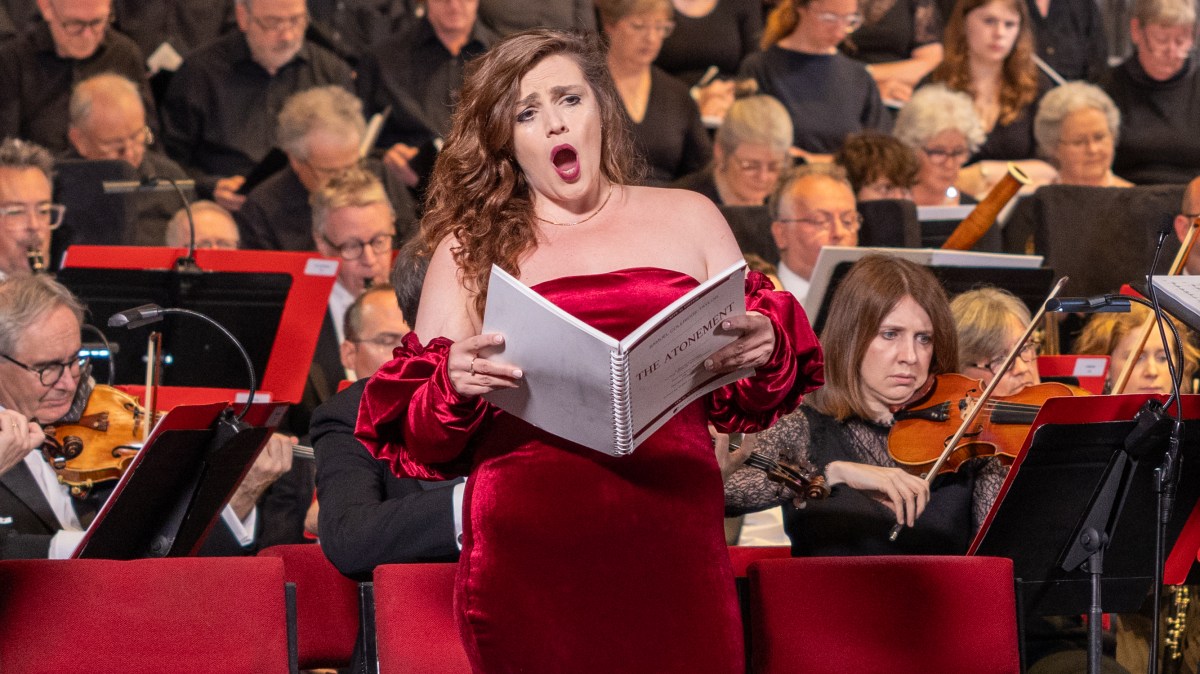
A work of great interest and merit: that was this paper’s polite assessment when Samuel Coleridge-Taylor’s sacred cantata The Atonement was premiered in Hereford Cathedral in 1903 during that year’s edition of the already venerable Three Choirs Festival. Other views at the time weren’t nearly as kind and this epic retelling of the gospel story, pinned to an often fusty libretto by a local author, Alice Parsons, soon disappeared from view. Fetched from its cupboard, it has now been revived in the same cathedral at the 297th Three Choirs Festival in the year of Coleridge-Taylor’s 150th birthday.
Truth to tell, it was easy to find audible reasons why the previous century didn’t rush to revive it. Stretches, especially in the early stages, sounded as if Coleridge-Taylor, hot from the success of his first Hiawatha cantata, had played safe by purchasing rolls of musical carpet labelled Pious Oratorio, Late 19th Century, and had tacked them down without much flair over Parsons’s rather worn floorboards. Atmospheric use of lower brass, winds and timpani aside, much of the orchestration retained the colour of porridge. Harmonies were predictably cosy.
• The best classical concerts and opera: our reviews
Happily the six soloists, the Three Choirs Festival Chorus and the Philharmonia Orchestra, persuasively conducted by Worcester Cathedral’s Samuel Hudson, displayed plenty of vim. Coleridge-Taylor himself became livelier and more imaginative the closer the narrative moved toward Christ’s crucifixion. Exchanges between Mark Le Brocq’s Pontius Pilate and the chorus of onlookers were genuinely dramatic. This portion was also enlivened by the surprise appearance of Pilate’s wife, whose solo singing (thank you, Rebecca Hardwick) was so adroit, I was sorry that Hudson followed the composer’s second thoughts by cutting Mr and Mrs Pilate’s duet, even though it was heavily criticised in 1903 as an intrusion.
• Read more classical reviews, guides and interviews
The words of Christ, eloquently conveyed by David Stout, never seemed to inspire Coleridge-Taylor in quite the same way: possibly he felt penned in by reverence. The choral writing had much greater spirit. Orchestral details perked up as well, from the beautiful violin phrase leading into the procession towards Calvary to the dark rumbling storm marking Christ’s last moments on the cross. So there were fine moments and performers with gusto; an appreciative audience too. However, let’s get the perspective right: this was an interesting and useful revival but The Atonement is not a neglected masterpiece.
★★★☆☆
Festival runs to Aug 2, 3choirs.org
Follow @timesculture to read the latest reviews