
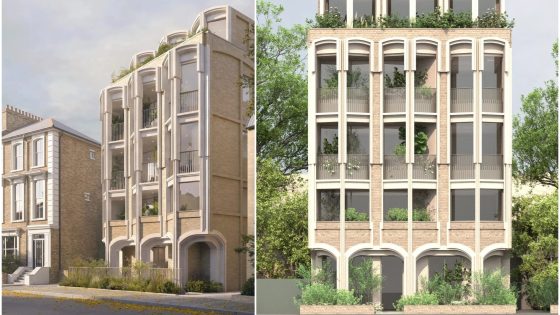
Camden Council’s planning committee rejected the five-storey, five-flat scheme at a meeting last night (29 January), heeding objections from local residents, including celebrities and architects.
The north London borough’s planning officers had recommended approval of the infill scheme on a brownfield site, which would have involved the demolition of an existing four-bedroom 1930s house to make way for the new block.
However, councillors on Camden’s committee voted against that recommendation in their decision, which had been scheduled for 15 January but was postponed due to technical fault.
Speaking at the meeting, councillor Heather Johnson said: ‘We’ve been impressed by the huge number of concerns raised by our constituents [and] on this application the views of the community are close to unanimously against.’
She continued by calling into question the scheme’s benefits, with it offering no affordable or social units out of the five homes. The same councillor also said the design of the proposed windows was ‘more corporate’ than residential and not in keeping with nearby Victorian properties.
Bureau de Change finally submitted plans in spring 2025 for six apartments before amending those proposals last summer to remove the proposed basement apartment and introducing several minor changes to the design.
BAFTA-winning actor Benedict Cumberbatch opposed the plans, as did the founders of local practice van Heyningen and Haward Architects, and Justine Thornton, a High Court judge married to energy secretary Ed Miliband.
Objectors said the scheme would be ‘out of keeping with the architectural style of the area and disrupt the aesthetic of the street’, while architects Joanna van Heyningen and Birkin Haward criticised its height, façade design and proximity to other homes.
However, Camden’s planning officers described Bureau de Change’s plans for developer HGG London as ‘well designed’, ‘high-quality’, and ‘inventive, enjoyable, and potentially exciting’ ahead of the meeting.
They also noted that the proposal was ‘more strongly related to the surrounding context’ than designs first put to Camden’s design review panel in 2023. As part of the scheme, an existing two-storey detached single dwellinghouse built in the late 1920s or early 1930s would be flattened.
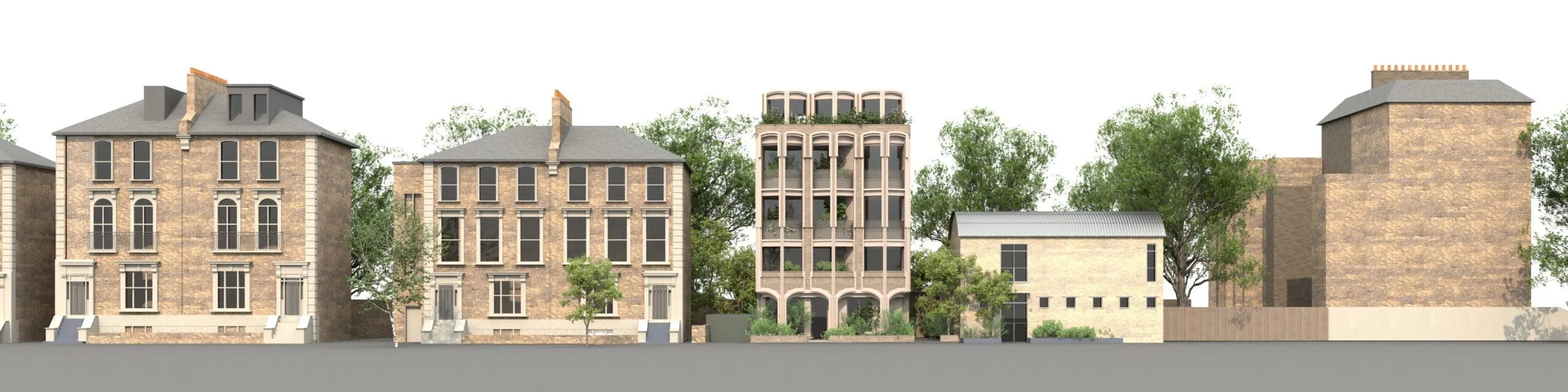
Bureau de Change’s plans for Dartmouth Park Road in north London (as amended August 2025) – front elevation and street context
Last summer, in a bid to allay concerns, Bureau de Change reworked its original proposal and introduced ‘Victorian-inspired’ balcony balustrades and a traditional brick boundary wall, which it says would ‘reduce openings and better integrate [the scheme] with the streetscape’.
The practice pointed out that the building’s height remains lower than the tallest of the neighbouring houses and says its proposed building would have a façade which is ‘aligned with the rhythm of the Victorian frontage’.
‘These revisions to the project strengthen the commitment to neighbour privacy and sustainability,’ it added.
Billy Mavropoulos, co-founder and director at Bureau de Change, said: ‘We are disappointed by the planning committee’s decision.
‘Our design for Lamorna was developed through extensive dialogue with Camden Council and the Design Review Panel to ensure it complements the local streetscape and meets planning policy. We believe the scheme provides real value to the borough and remain committed to the project.’
He told the AJ last year: ‘Our approach to Lamorna has been rooted in a deep respect for the architectural language of Dartmouth Park.
‘Throughout this process we have worked collaboratively with Camden Council to add clarity and refinement to the scheme. The result reflects our dedication to designing homes that are sustainable and sensitive to their surroundings.’