
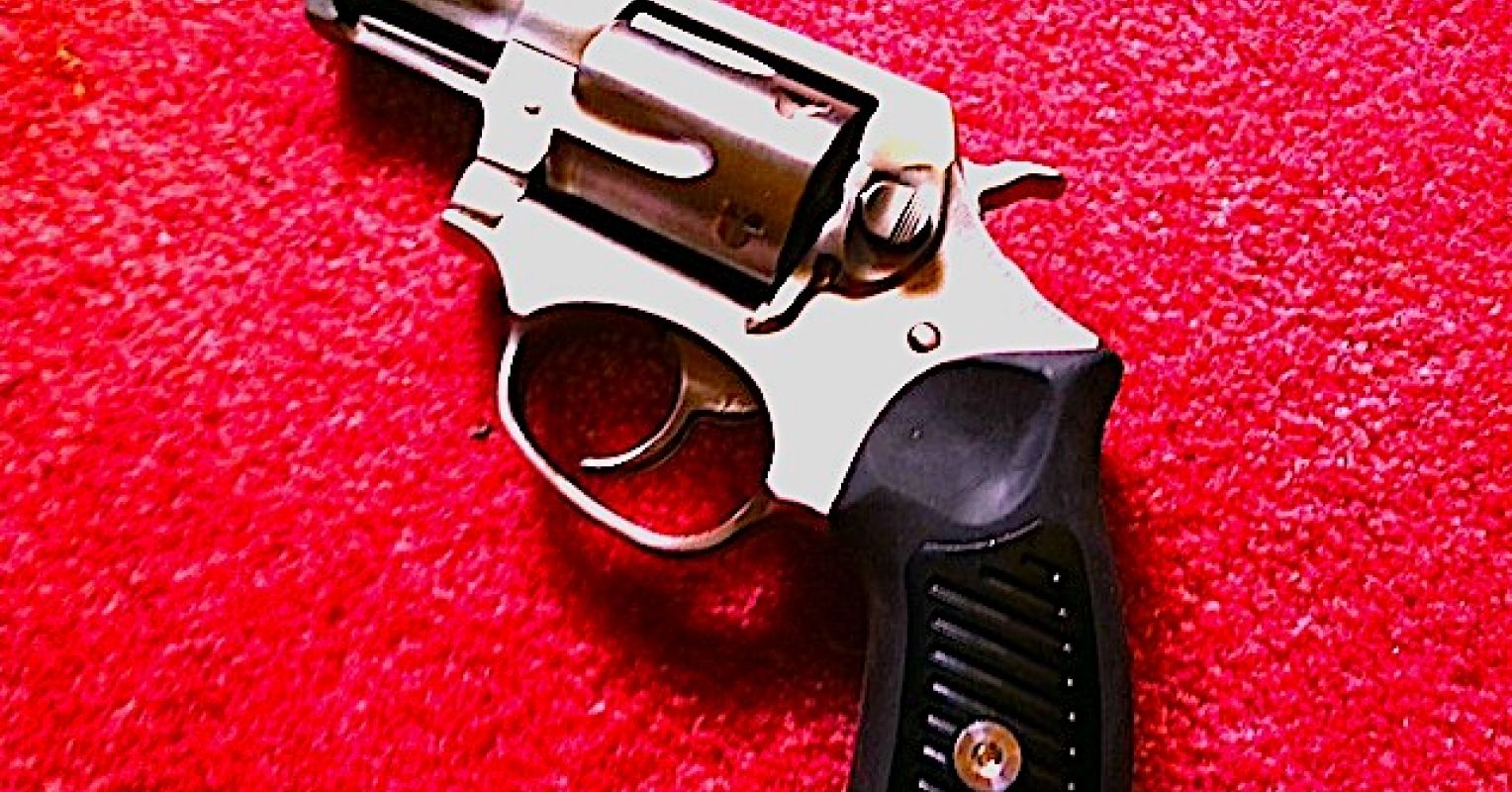
One October morning in 2019 in Hays, Kansas, Colby Trickle reported that his 26-year-old wife, Kristen, had shot herself. The responding officer was suspicious of Colby’s account. The weapon used, a .357 revolver, seemed too large for Kristen to handle, her phone alarm kept sounding, and she’d shot herself in the face—rare for women. Still, there were no signs that she’d fought back. The coroner ruled the death a suicide. Investigators continued to watch Colby’s behavior.
He took payments from two insurance policies and quickly purchased an expensive sex doll, video games, and music equipment. Investigators also found that he’d lied about his military deployments. In addition, those who knew Kristen well provided ample reasons why she wouldn’t take her life. Some said Colby had been controlling, had debts, and had been flirting with someone online, giving him motive to stage a suicide. Photos showed that the gun used was his.
Nearly two years after Kristen’s death, Colby was arrested and charged with murder. At his trial, psychologist Ashley Christiansen reported on the results of her psychological autopsy. She’d concluded that suicide was unlikely. The jury listened and found Colby guilty. He received a life sentence.
This was reportedly the first time a psychological autopsy was used in a Kansas case. Colby’s attorney has challenged it on appeal as unreliable. The Kansas Supreme Court’s finding is still pending. There’s reason to think it could be an issue, but this case might also offer the tool a needed breakthrough.
The Method
A psychological autopsy is used in cases where the manner of death is equivocal or ambiguous. An analysis of the decedent’s mental state can better place the death into one of the four primary NASH categories: natural, accident, suicide, or homicide. Mental health experts are often hired for this process, since they have more in-depth training than detectives for mental state assessment. However, despite more than half a century of use and refinement, psychological autopsy has an uneven history in the courts.
While there is peer support from among a subset of experts familiar with suicidology, the method’s protocol hasn’t been universally established. A lack of reliability and validity studies remains a concern. The American Association of Suicidology offers a training and certification program, but even this has been challenged in court. In State v. Guthrie (2001), the judge restricted the testimony of the experienced suicidologist who’d performed a psychological autopsy. He said nearly the same thing as Christiansen in the Trickle case. If the Kansas Supreme Court accepts the method’s use, it will offer hope for future cases.
Similar Case
Let’s look at the Guthrie case. In May 1999, Sharon Guthrie’s husband, Bill, had reportedly found her dead in the bathtub. He believed she’d accidentally taken his prescription medication while she was sleepwalking. But inconsistencies with the scene launched an investigation. It turned out that Bill had a mistress. He’d also filled his prescription at two different pharmacies shortly before Sharon “overdosed.” Mishaps in the home a few months earlier looked as if someone had tried to stage a serious accident. Then Bill “found” a suicide note. But investigators discovered it on his computer, written after Sharon had died.
Bill was arrested. At his trial, a psychological autopsy was used to evaluate Sharon’s mental state and the likelihood that she’d been suicidal. The expert was Dr. Alan Berman, a credentialed suicidologist. In court, he described characteristics of suicidal people and said that Sharon had minimal predisposing factors for suicide and several good reasons not to do it, especially in a bathtub. Research has shown that less than 2 percent of women kill themselves in this manner. Berman concluded that Sharon was an unlikely candidate for suicide. The defense offered a psychologist to attack Berman’s method as unscientific.
On appeal, Guthrie challenged the admission of Berman’s testimony. The court found that providing typical suicide characteristics was acceptable, but applying these items specifically to Sharon had over-reached. This part of the testimony was deemed inadmissible. Since Berman’s testimony was considered nonprejudicial, the conviction was affirmed.
Clinical vs. Forensic Standards
Examples of psychological autopsy can be found in case law dating back to the 1930s, mostly in civil proceedings. However, courts have rejected or restricted it in several criminal proceedings, with a few deciding that the method is similar to a clinical sanity evaluation.
In some ways, it is, but it’s also more. Qualitative narrative analysis, which guides psychological autopsy, is an accepted method for social science data. The real issue for a forensic psychological autopsy is the lack of a certifying body for a standard protocol, but the method’s peer evaluators do look for internal consistency, protocol adherence, completeness, and plausibility. Despite some “soft science” subjectivity, it has general peer acceptance and meets ethical requirements.
While a decedent’s intention can be difficult to determine, the substantial databases for suicidology can assist. Berman demonstrated this in the Guthrie case. The more educated investigators become about psychological autopsy, the more it will be used to assist in legal and investigative contexts. With improved coordination among researchers, more courts could be inclined to accept it as a viable contribution for death determinations.