
Why aren’t the young having sex? In 1962, it was all the rage, with one Dr David Morgan telling parents they had ‘a duty to warn their sons and daughters against promiscuity’.
In his annual report, Chester’s health and education officer added: ‘If not for moral reasons, then for physical ones and for the necessary teaching of self-restraint. Unfortunately, too many parents fail miserably in this duty.’
More than 60 years on and promiscuity among the youth is no longer a concern. If anything, the opposite is true.
It’s not just birth rates across wealthy countries that are hurtling downwards, there is clear evidence that sexual activity itself is also in retreat. We are facing what has been called the ‘Great Sex Drought’ or the ‘Sex Recession’.
According to a YouGov poll this month, 34 per cent of those aged 18 to 24 in Britain are not sexually active. In the same month in 2020, the figure was far lower, at 28 per cent.
The fall-off is repeated wherever you look. Around half of Gen Z Americans – those born between 1997 and 2012 – have never had sex, compared with a quarter of millennials, according to a new report.
In Japan, the pattern is the same. More than half of single people aged 18 to 34 are virgins. Twenty years ago, it was a third. Peter Ueda, a physician in public health who is researching sexual inactivity in the country, estimated in October that within this age group a staggering 60 per cent of Japanese men and 51 per cent of women were sexually inactive.
‘Terms like “soshokukei danshi” (herbivore men) and “sekkusu-banare” (drifting away from sex)… reflect a growing trend and societal acceptance of sexually inactive singlehood,’ he explained.
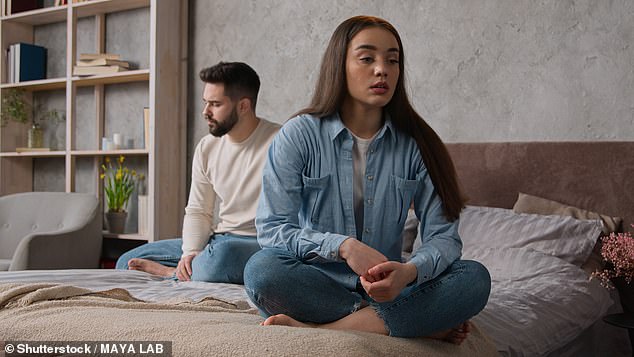
According to a YouGov poll this month, 34 per cent of those aged 18 to 24 in Britain are not sexually active

Peter Ueda, a physician in public health who is researching sexual inactivity in Japan, said: ‘Terms like “soshokukei danshi” (herbivore men) and “sekkusu-banare” (drifting away from sex)… reflect a growing trend and societal acceptance of sexually inactive singlehood’
Why are rates of sexual activity plummeting among the young? After all, we live in an age where sex is ubiquitous. Western countries have never been more tolerant of sex in just about every formulation and as a result mainstream culture is saturated with it.
Dating apps such as Tinder, Hinge and Grindr offer the prospect of casual sex on demand.
We happily talk of ‘hook-up culture’ and use terms like the ‘walk of shame’ to describe the morning after the night before. We are surrounded by sex online, with OnlyFans and the omnipresence of pornography in digital culture.
In fact, we give every appearance of being drunk on sex and sexuality. So why are the young stone-cold sober when it comes to the act itself?
Esme, 23, who works nine-to-five in merchandising, told the Daily Mail: ‘It’s not just that I don’t have time to meet new people. I live with my parents, so that’s an ick. And frankly, I would rather spend more time curled up watching TikToks than having to interact with a random man. No one seems to judge me for never having sex, I just tell them I am voluntarily celibate –which technically is true.’
And according to Maya, a 23-year-old graduate, for huge numbers of Gen Zs, sex is simply off the agenda.
She said: ‘In my experience no one seems to be having casual sex any more. It’s not just that it’s the winter blues, most 20-somethings I know are depressed and “voluntarily celibate”, or the few that are in relationships are also depressed and not having sex either.’
The truth is there is a perfect storm of different causes behind the trend for celibacy, causes that seem to be specific to Generation Z, ranging from their addiction to the internet and pornography, to the lingering effects of Covid lockdowns and a mental-health crisis among the young.
What is clear is that the internet has had a cataclysmic effect on sexual activity.
In December 2025, a report from Ofcom found that the average Briton spends 4.5 hours on their smartphone each day, with those aged 18 to 24 scrolling for a staggering six hours and 20 minutes online.
Professor Jean M Twenge, from the Department of Psychology at San Diego State University, said: ‘Although internet sites and social media should theoretically make it easier to find new sexual partners, time spent online has also displaced time once spent on face-to-face social interaction.
‘Put simply, there are now many more choices of things to do in the late evening than there once were.’
Meanwhile, a study published in 2016 in the Journal of Population Economics examining broadband influences on fertility found that the internet’s arrival explained between 7 per cent and 13 per cent of the decline in the teenage birth-rate from 1999 to 2007.
As for online porn, rather than encourage people to seek partners, it has had the opposite effect.
Its availability has created instant access to sexual gratification and acted as a disincentive to entering a confusing quagmire of real-world encounters fraught with pitfalls and rejection.
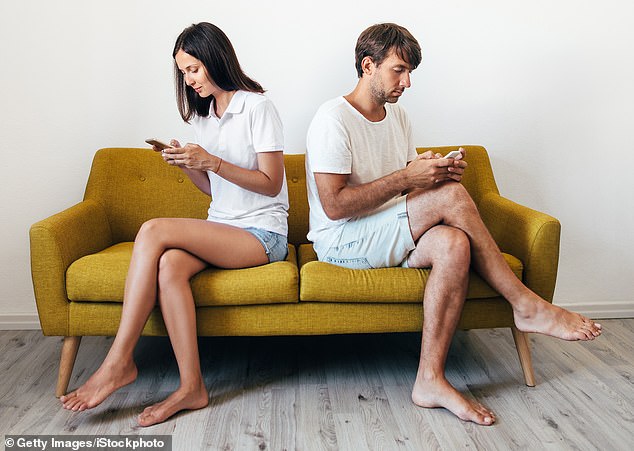
Between 7 per cent and 13 per cent of the decline in the teenage birth-rate from 1999 to 2007 stems from the arrival of the internet
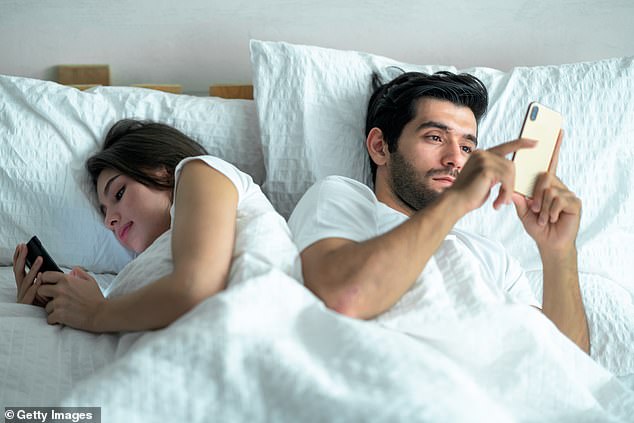
An Ofcom report found that the average Briton spends 4.5 hours on their smartphone each day
According to a Children’s Commissioner report last year, more than a quarter of those aged 18 to 21 said they had seen porn online by the age of 11, with some exposed to it ‘aged six or younger’.
David, a 24-year-old graduate, said this meant fewer people seek relationships, adding: ‘For young people who are watching loads of porn, which let’s face it is practically most young men I know – single or not, sex has steadily become a digital experience conducted on your own, not a social one.
‘As soon as people begin to associate their sexuality and desires with a digital, perfectly sterilised environment, the mess and confusion of actual human interactions and real sex appear daunting.
‘Like everything on the internet, it has become a solitary experience, filling the void sexually in the absence of a real person.’
So it is no coincidence that 53 per cent of therapists, surveyed by the British Association for Counselling and Psychotherapy this month, said they had seen a rise in people seeking help for problematic pornography use that interfered with their lives.
This rise of ‘solo sex’ may also explain the increase in the sale of sex toys. A survey this month by the sex-toy brand Rocks Off found that nearly 50 per cent of participants (all UK adults) own between seven and nine sex toys, while some reported collections of 20 or more.
The toxic combination of sustained consumption of both social media and porn has had the added effect of decreasing people’s body confidence, reducing even further the likelihood that people will look for romance.
A medical review from 2019 examining the relationship between women’s body image and sexual behaviour suggests those with greater body confidence tend to report more positive sexual experiences. Conversely, not feeling comfortable in your own skin complicates sexual encounters.
Jonah Disend, the founder of the branding consultancy Redscout, explained that young people are so lacking in confidence in their bodies that they ‘don’t like to get naked’ even if wearing a towel.
‘If you go to the gym now, everyone under 30 will put their underwear on under the towel, which is a massive cultural shift,’ he said.
With less incentive to go out and meet potential partners, it inevitably means there will be fewer people in relationships. Which is why, since 2010, the proportion of people living alone has risen in 26 out of 30 rich countries.
Increasingly, these solitary individuals are not even leaving the house. A study last year revealed that 67 per cent of Gen Z and more than half of millennials don’t go outside for days at a time.
This intensely solitary, seemingly paranoid existence is understood by Joseph, 19, who told me how difficult he finds it to go out and strike up an acquaintance, adding: ‘There aren’t spaces to meet girls that are casual. If you want to hang out with someone you have been chatting to on the phone, you would have to walk around outside – and what happens if it has been raining?’
What about introducing yourself in a pub or with friends in a public place? ‘What?’ he asks me. ‘As in go up and ask a random girl out? Absolutely not, I don’t want to catch a case [be accused of harassment].’
Even for those young adults who are perfectly well adjusted and eager to get out to meet partners, there is another hurdle. According to the Institute for Fiscal Studies, in 2006 some 13 per cent of Britons aged between 25 and 34 lived with their parents. By last year that had risen to 18 per cent, or 450,000 more young adults still living in the family home.
In Italy, half of those aged 25 to 34 live with their parents, making it far trickier to bring a partner home or engage in routine casual sex without prying questions.
In turn, all this has led to another calamity for Gen Z. Nearly nine in ten 20-somethings say they are lonely – the highest proportion of any generation.
Which brings us to the health crisis that has come to define a generation. In 2025, 25 per cent of 16 to 24-year-olds said they had a mental health condition.
Anxiety and depression suppress desire for many people, with studies finding that up to 50 per cent of those with untreated major depression experience some type of sexual dysfunction.
Worse still, some professionals say that the antidepressants used to treat a variety of mental health issues can reduce sexual interest.
Professor Katherine Twamley, a sociologist at University College London, said: ‘There are huge increases in mental ill health, and while part of that is more diagnoses, even when you look beyond that, people are increasingly reporting on feelings of distress.
‘It’s global and could be to do, in part, with Covid and the climate crisis. It can create feelings of vulnerability. And as the saying goes, you must look after yourself before you can look after and be in relationships with other people.’
Professor Twamley highlighted the malign effects of Covid and the lockdowns, when young teenagers were banned from meeting up at a formative age, let alone getting within kissing distance.
These youngsters, she said, didn’t have the ‘social lubricant’ of going out or getting drunk at parties. Instead, a whole generation migrated online.
Once on the internet, growing numbers of frustrated young men have found refuge in the pernicious ‘manosphere’, joining the ‘incels’ – men who claim to be involuntarily celibate and who blame women for plummeting sex statistics. It is perhaps unsurprising that, according to Swansea University, half of incels live with their parents or grandparents.
The tragedy is that the decline in sex paints a picture of Gen Z floundering when faced with the prospect of personal and sexual relationships, and retreating into a joyless world devoid of human interaction.
Dr David Morgan, of Chester, who warned local parents of the dangers of promiscuity, might approve of their moral restraint.
But most of us see the quiet tragedy of a generation of young people becoming so socially paralysed that they are unable to act out even their most basic wants or desires.