
An international research team has confirmed the earliest known genetic diagnosis in an anatomically modern human, identifying a rare skeletal disorder in a prehistoric adolescent female who lived more than 12,000 years ago. The findings show how ancient DNA can reveal rare diseases and offer insights into social care in Stone Age communities.
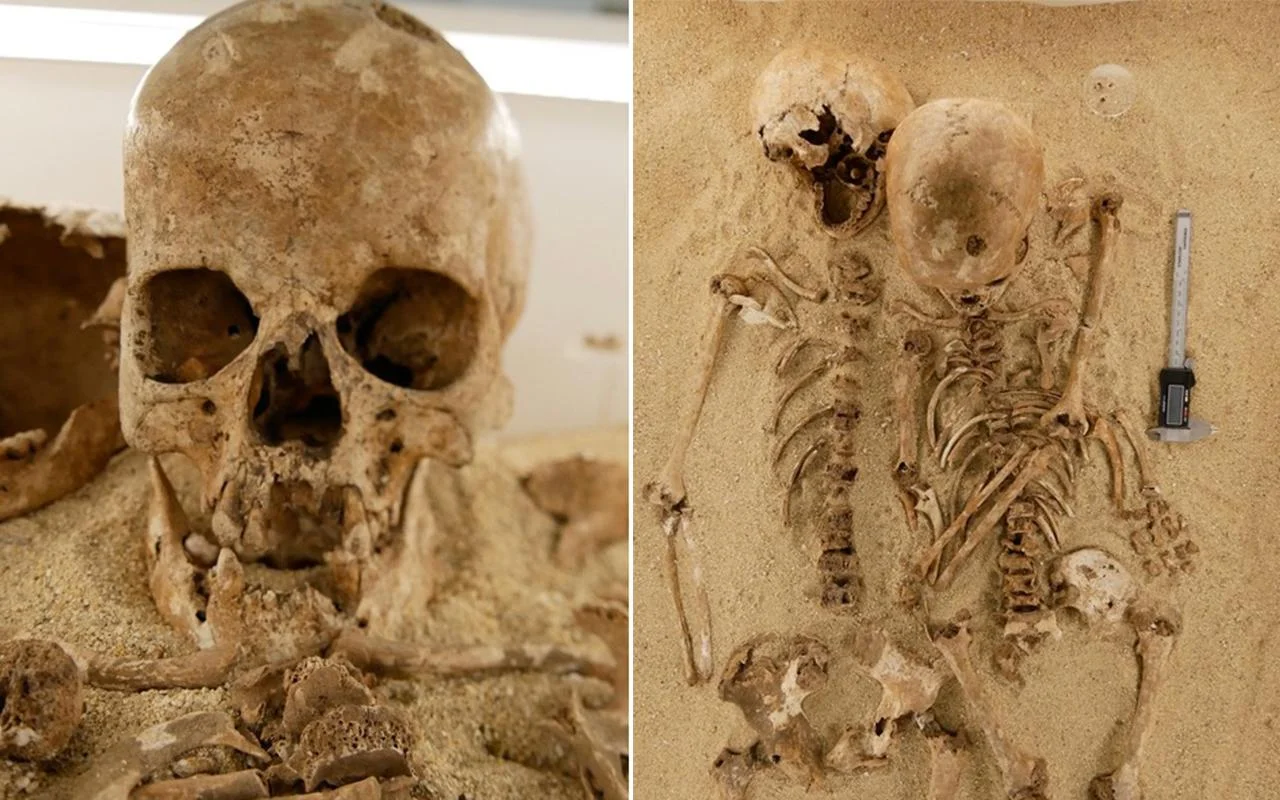 Double burial discovered in 1963 at Grotta del Romito, a limestone cave in southern Italy. Credit: Image courtesy of Dr. Adrian Daly
The focus of the study is a double burial uncovered in 1963 at Grotta del Romito, a limestone cave in southern Italy. Two individuals were buried in an embrace. One, previously thought to be male, was a teenage girl nicknamed Romito 2. Her skeleton showed severe limb shortening and short stature, measuring 110 centimeters, or about 3 feet 7 inches tall. The adult, Romito 1, was 145 centimeters, or 4 feet 9 inches, shorter than the estimated average for adults at the time. Both skeletons showed no signs of trauma.
DNA extracted from the inner ear provided key answers. Both Romito 1 and Romito 2 were female and first-degree relatives, most likely mother and daughter. Genetic analysis revealed that Romito 2 had a homozygous mutation in the NPR2 gene, confirming a diagnosis of acromesomelic dysplasia, Maroteaux type, a rare inherited condition that causes severe limb shortening. Romito 1 carried a single copy of the mutated gene, explaining her moderately reduced stature. These findings match the clinical features observed in modern patients with one or two abnormal copies of NPR2.
From a medical perspective, the results show that rare genetic diseases were present throughout human history. Study co-author Dr. Adrian Daly of Liège University Hospital Centre noted, “Our clinical research focuses on identifying the causes of abnormal growth today. These results underline that rare genetic diseases are not a modern phenomenon but have been present throughout human history. Patients today with severe short or tall stature still face many obstacles in their daily lives.” He added, “Thankfully, potential treatments for disorders affecting NPR2 and other genes are emerging,” and concluded, “ancient DNA genome analyses can identify other rare genetic diseases, including many that have remained largely hidden until now.”
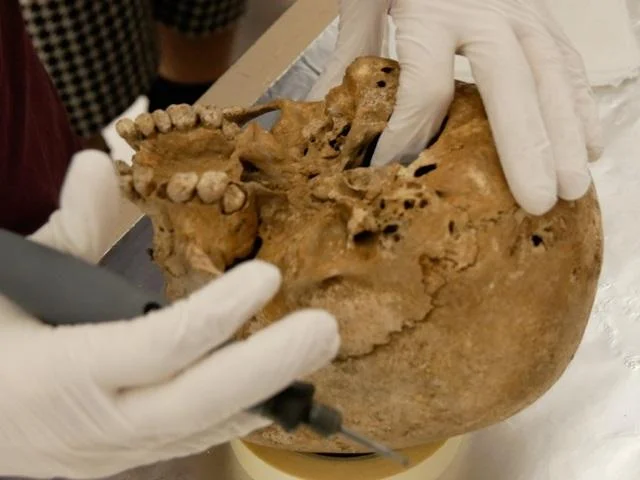 Researchers identified a rare form of dwarfism in the Stone Age skeleton using DNA analysis. Credit: Image courtesy of Dr. Adrian Daly
The study also linked both individuals to the Villabruna genetic cluster, a population of hunter-gatherers that expanded from southern Europe into central and western Europe around 14,000 years ago. Despite severe physical limitations, Romito 2 survived into adolescence, suggesting her community provided support for food acquisition and mobility. Researchers highlighted that her care demonstrates social cooperation in a prehistoric family group.
This research combined expertise in paleogenomics, clinical genetics, and physical anthropology, involving teams at the University of Vienna, Austria, Sapienza University of Rome, Italy, and Liège University Hospital Centre, Belgium. The findings illustrate how tools developed for modern medicine can illuminate human history and reveal how rare diseases have shaped human lives for thousands of years.
More information: Fernandes, D. M., Llanos-Lizcano, A., Brück, F., Oberreiter, V., Özdoğan, K. T., Cheronet, O., … Daly, A. F. (2026). A 12,000-Year-Old Case of NPR2-Related Acromesomelic Dysplasia. New England Journal of Medicine, 394(5), 513–515. doi:10.1056/NEJMc2513616