
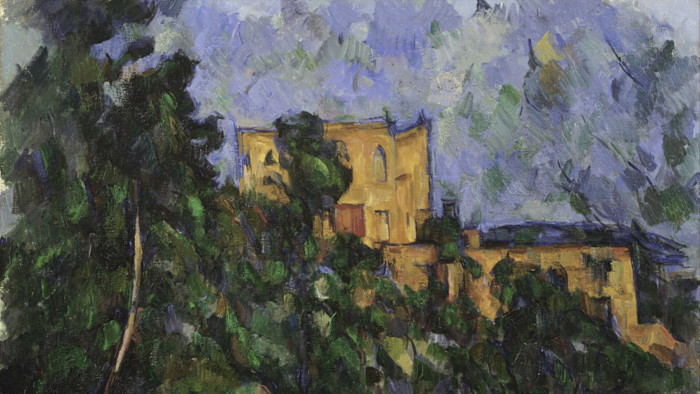
“I must tell you,” Cezanne in Aix-en-Provence wrote to his son in Paris in September 1906, “I’m becoming more clear-sighted in front of nature, but the realisation of my sensations is still very laboured. I can’t achieve the intensity that builds in my senses.” Nevertheless, “motifs multiply, the same subject from a different angle provides a fascinating subject . . . so varied that I think I could occupy myself for months without moving, leaning now more to the right, now more to the left”.
It was in this familiar Aix countryside, painting “Jourdan’s Cabin” during a rainstorm, that Cezanne collapsed on October 15 1906. Found unconscious and taken home by a laundry van driver, he rallied next day to paint his elderly gardener Vallier, fainted, and within a week was dead from pneumonia.
“The Gardener Vallier” in his straw hat, sitting by a climbing plant, the contours between the man and the world disappearing, is a trembling form but mighty presence in three portraits in Fondation Beyeler’s Cezanne, an exceptionally rewarding exhibition of the late paintings. In the prismatic watercolour especially, where white paper constitutes the gardener’s clothes and sunlight flows around and through him, Vallier is more spirit than matter: transcendent.
 ‘The Gardener Vallier’ (c1906, in oil)
Bare paper also delineates “Jourdan’s Cabin”, its pointed chimney balanced by a canopied tree, arabesques of branches and lush green vegetation lightly sketched: a clear structured landscape evoked with minimal means.
If “Vallier” is Cezanne at his most expressive, in “Jourdan” the master-builder employs cubes, cylinders, cones. In both, Cezanne goes beyond imitation of nature to show the painting’s construction, how he converts coloured impressions into taches, touches of paint, to create an image that stands on its own: not mimesis but “a harmony parallel to nature”.
Abstraction was a step away, and through 80 masterpieces gathered from across the globe — half from private collections — the Beyeler exuberantly tells how, without fully relinquishing the motif, Cezanne set paint free to play to its own rhythms and surface patterns.
 ‘Rocks and Branches in Bibémus’ (1900-04)
His long influence began in 1895, when Ambroise Vollard staged his first exhibition. The dealer did not always understand the works — faced with a bluish tracery of trees, thick interplay of emerald green foliage and an ochre quarry sharply cut into cubes, he repeatedly rotated “Rocks and Branches at Bibémus” to decide which way up to hang it — but looking at them he felt “as though I had been punched in the stomach”.
At the show’s opening we meet Cezanne in 1895 in a little-known “Self-portrait” head: wily expression, eyebrows arched like a visual question mark, deep eye sockets, penetrating gaze at once outward and inward, chin jutting determinedly forward from a vivid scumbled ground. Cezanne, then 56, had turned his back on Paris and abandoned too his elegant Jas de Bouffan estate as a motif, in favour of wild, remote sites at Bibémus, its weathered, cubic forms an abstraction in waiting, and at Château Noir’s forests and rocks: primeval and timeless.
In Philadelphia’s architectonic “Millstone in the Park of the Château Noir” (1892-94), visiting Europe for the first time, the rugged disorder of ancient rocks and bowed branches is emphasised in contrast with the pristine man-made sphere. By the 1900s, the light-pierced jumble of stones, trees and shadowy crevices in “Rocks Near the Caves above Château Noir”, formerly owned by Matisse, is almost abstract, while MoMA’s majestic “Château Noir”, which once hung in Monet’s bedroom, is essentially a spangled web of colour, rich dense foliage, loosely brushed sky and ruined facade gleaming golden.
 ‘Millstone in the Park of the Château Noir’ (1892-94)
By 1906 in “Garden at Les Lauves”, broad bands of colour with vibrant mauve, rose, blue and green patches amid white ground render an expansive yet abbreviated panorama of Aix seen from the terrace of Cezanne’s final studio, where he worked from 1902. This canvas has, said Duncan Phillips, who acquired it for Washington in 1955, “the painterly excitement and sense of adventure to which our best, our most poetic abstract expressionists aspire”.
Most of Cezanne’s last, luminous “Mont St Victoire” pictures, 1902-06, were painted from the Lauves hill — the exhibition has seven examples — in mosaics of large taches, varying darker and brighter greens, violets, ochres, shimmering blues, brushstrokes opaque and translucent, vertical, diagonal, horizontal. Close up you confront a tangled mass; at a distance the view coheres. Radically, colour modulations, not linear perspective, give depth.
 Cezanne in his studio in Les Lauves, Aix-en-Provence, photographed by Bernard Emile
Complementing these, a “Mont St Victoire” watercolour, whose ethereal washes seem to float weightlessly yet conjure trees, houses and vegetation unfolding in a vast space beneath the soaring peak, suggests how Cezanne learnt from watercolour’s limpidity and freedom in constructing these final canvases.
Displayed in ample galleries giving on to the Beyeler’s park and surrounding cornfields, vineyards and Tüllinger Hills, the landscapes are the show’s heart, but the same grandiose, sumptuous, concentrated vision illumines every genre. The frieze of male “Bathers”, virile, robust, achingly nostalgic — Cézanne swam in the river Arc in his boyhood with Zola and their geologist friend Antoine-Fortuné Marion — roots landscape in felt memory. The female “Bathers”, often in static pyramidal arrangements, blend into nature or imitate her forms: Cezanne wanted “to marry the woman’s curves to the shoulders of the hills”.
 ‘Apples and Oranges’ (c1899)
Tilting table-top still lifes, led by Musée d’Orsay’s agitated/melodic “Apples and Oranges” (c1899), with contrasting cascading draperies and stark fruit on a white cloth, share the landscapes’ monumentality, profuse nuanced colour, compositional complexity. By the end Cezanne saw the apples and oranges as characters who suffer and age like men: “Fruit likes to pose for a portrait. It sits there as if asking your forgiveness for discolourations.”
Among towering figure paintings is Vollard, instructed to remain unmoving as an apple: his domed head like St Victoire’s coned peak, lustrous touches highlighting his broad brow, his face expressing exhaustion from 115 sittings. Matching him in sombre, still absorption, and arresting in their strange chromatic contrasts and irregular lighting, the stoic “Card Players” (1892-96) pursue their individual strategies in games of rules and chance — surely a mirror for the artist’s.
 ‘Boy in a Red Vest’ (1888-90)
Cezanne, though, broke every rule. The “Card Players” may be his stand-ins, but so is the yearning, old-age recollection of listless, melancholy, exquisite youth “Boy in a Red Vest” (1888-90), languid and lyrical against a geometric interior. His crimson waistcoat sings out within a white-grey tonality, in the painting and in two rare watercolours of the sulky adolescent, reunited for the first time since they left Cezanne’s studio. In the painting, the right arm is extraordinarily, unfeasibly long, yet “so beautifully painted, it can’t be long enough”, quipped the German artist Max Liebermann. As this eloquent show demonstrates, Cezanne’s late paintings follow their own internal logic, sensations, structure: the liberation that opened the door to modern art.
To May 25, fondationbeyeler.ch
Find out about our latest stories first — follow FT Weekend on Instagram, Bluesky and X, and sign up to receive the FT Weekend newsletter every Saturday morning