
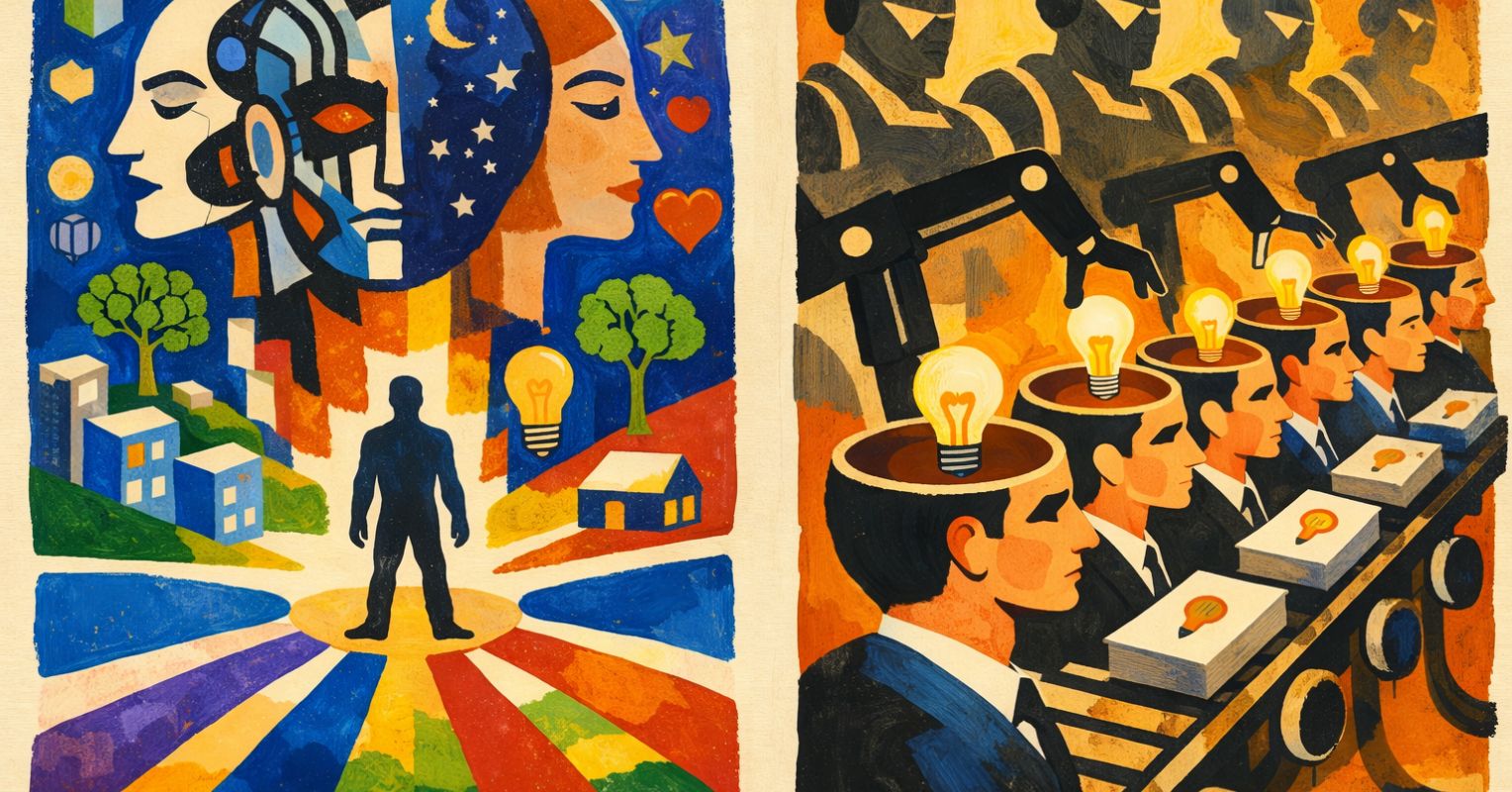
We stand at an inflection point where artificial intelligence reshapes what we do and who we become in the process. The debate around AI typically oscillates between two poles: augmentation, where machines enhance human capability, and automation, where they gradually replace it entirely. But there’s also an alternative emerging, amplification, where AI becomes a mirror and multiplier of what makes each of us irreducibly human. That distinction matters.
Does Augmentation Open the Door to Automation?
New research analyzing millions of job postings reveals a striking paradox: there’s a 0.87 correlation between roles experiencing the greatest automation effects and those experiencing the greatest augmentation effects. The jobs most vulnerable to automation are simultaneously those most empowered by AI. Tasks are disappearing and intensifying at the same time, within the same roles. Skills most exposed to AI automation saw demand decline by 16% compared to baseline, while skills most exposed to augmentation saw demand increase by 7%.
Meanwhile, other research shows that while generative AI enhances individual creativity, it simultaneously narrows collective diversity. Stories written with AI assistance scored higher on creativity metrics, yet became sadly similar to one another, a creative convergence where everyone becomes slightly better while becoming slightly more alike.
Driven by our desire for efficiency, we are walking eyes wide shut into an automation trap thinly veiled by augmentation’s clothing. When we outsource ideation to the same algorithms trained on the same datasets, fed the same prompts, optimized for the same type of engagement metrics, we are homogenizing the very spark that makes human contributions, and our respective quirkiness, valuable. AI can make us more productive, boosting creative output by 25% and value by 50%. But productive toward what end? Beyond products, this questions us to re-assess our purpose, as humans and as professionals.
The Algorithmic Self
Consider how identity itself is being reshaped when creation is outsourced. Our emerging “algorithmic self” is a digitally mediated identity where our personal awareness, preferences, and emotional patterns are continuously shaped through feedback from AI systems. Think of Spotify Wrapped, that annual ritual where millions wait eagerly to discover what the algorithm says about who they are. We’ve begun treating machine-generated summaries of our behavior as more authoritative than our own introspection.
This is abdication, not augmentation.
Amplification requires something subtly different: using AI to deepen rather than displace self-knowledge, to expand rather than narrow our range of expression, to scale what’s distinctive rather than what’s derivative.
The Four Dimensions of Our (Amplified) Identity
The path from augmentation to amplification runs through four interconnected dimensions of human experience. Think of them as coordinates for mapping your unique presence in an AI-saturated world.
1. Aspirations (Purpose): What drives you at the deepest level? MIT research identifies features like hope and vision, core markers of genuine leadership, as uniquely human capabilities that AI fundamentally cannot replicate. Long considered as soft skills to be relegated to the periphery, they’re core to work that matters.
AI struggles with the grit required to pursue long-odds ventures, the perseverance needed when data suggests giving up, the initiative to start something that has no precedent. And AI lacks the type of personal value orientation that inspires other humans to follow a human who is determined to pursue a cause that is bigger than their own interests. As work identity becomes increasingly threatened by AI’s growing capabilities, grounding professional identity in intrinsic purpose rather than task performance becomes existential.
2. Emotions (People): Our brains process human presence fundamentally differently than AI presence. When we interact with other humans, neural activity extends far beyond social cognition networks to encompass the entire brain. There’s something irreducible happening in human-to-human connection that defies computational replication.
Artificial emotional intelligence capabilities are an oxymoron, and they create a seductive trap: outsourcing introspection to algorithms that provide predetermined summaries of moods, behaviors, and thoughts. What begins as exploration turns via integration, to reliance and finally addiction. Agency decay strikes as users gradually grow estranged from the richness of their own emotional lives, trusting the algorithm’s interpretation over their own felt experience.
AI-powered journaling tools, emotion tracking platforms, therapeutic chatbots can offer structured prompts and reflective summaries that deepen self-understanding. The key is maintaining the locus of interpretation within yourself.
3. Thoughts (Pursuit): Knowledge work is being transformed, but not uniformly. Certain cognitive tasks resist automation. Creativity and imagination, particularly the visualization of possibilities beyond current reality, remain, so far, very human — humor, improvisation, ethical judgment, and the ability to synthesize disconnected thoughts into breakthrough innovations.
These types of thinking are becoming a precious commodity in an AI age. The challenge is to learn to recognize when AI’s efficiency gains come at the cost of cognitive depth. Over-reliance on AI can fixate the mind because once we acknowledge an AI-generated idea, it becomes harder to think of alternatives. Yet our unique intellectual contribution lies precisely in the tangents, contradictions, and illogical leaps that algorithms smooth away.
4. Behavior (Practice): Action crystallizes intention into reality. But in an AI-augmented workplace, the relationship between intention and action grows complex. How people conceive of their relationship to AI fundamentally shapes their behavior and effectiveness.
Those who view AI as a tool they can and do deliberately control maintain agency. Your behavioral signature, the distinctive ways in which you approach problems, interact with others, grow beyond failure, becomes more valuable as it becomes more visible against AI’s standardization.
This is Part 1 of a series. In Part 2, we’ll explore a practical ABCD framework for cultivating your personal amplification practice and maintaining authentic identity in an AI-saturated world.