
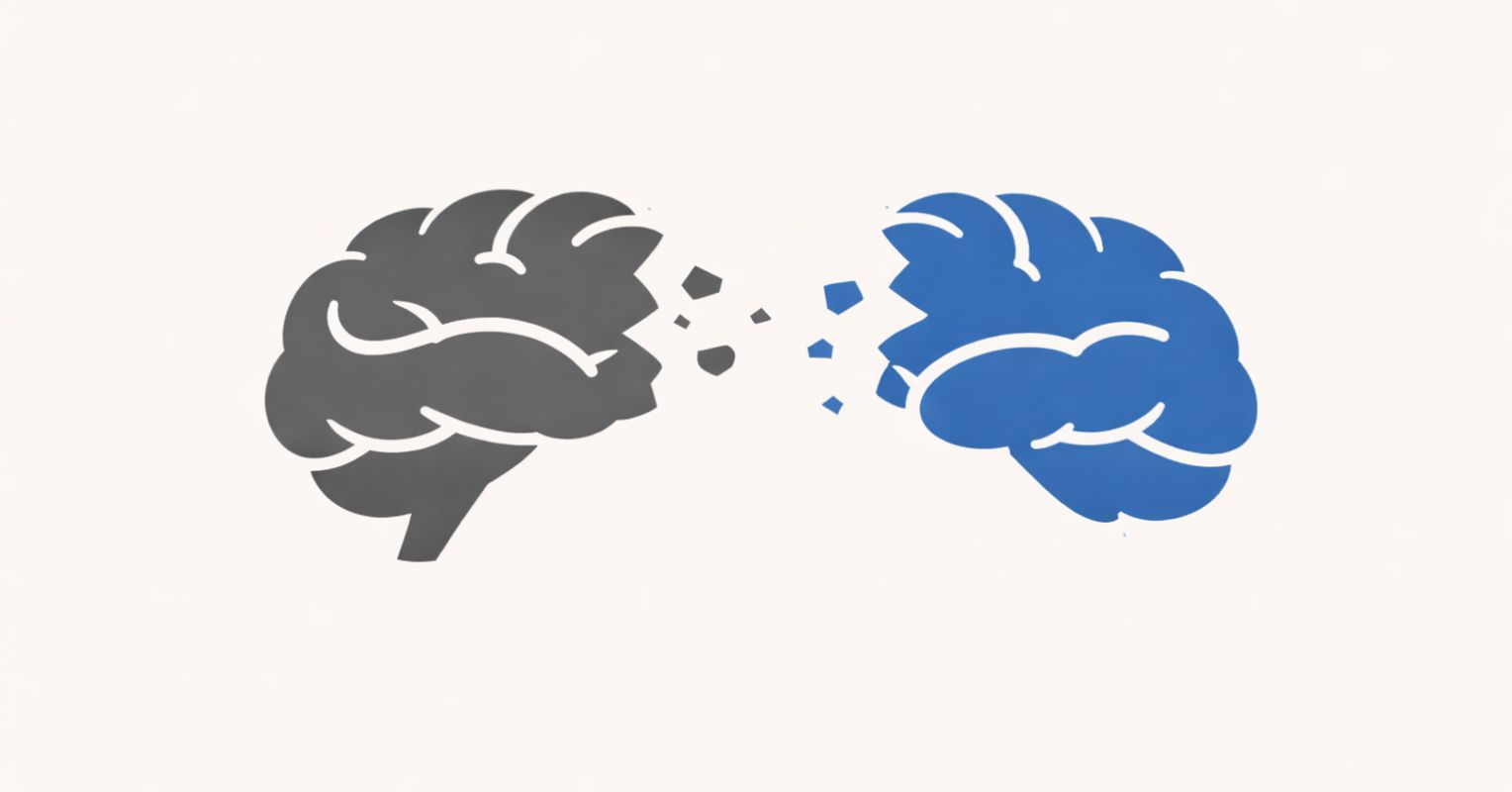
It seems that nearly every post and comment I’m seeing on social media is brilliant—but in a twisted way. Reading these expectorations, I’ve begun to experience something uneasy and perhaps even disingenuous. People “speak” with confidence and coherence that initially feels reassuring and rather impressive. Yes, the language is glib, the POV sounds settled and authoritative. Yet too often, this fluency fails to stand up when the conversation evolves and moves deeper. A simple follow-up question lands and the cognitive ground beneath the words begins to soften if not crumble. As more language appears, less understanding follows. And this, when addressed directly, can result in a sort of “cognitive antagonism” that further compromises the discourse.
It’s not a theatrical performance, and it is rarely deliberate deception. Something more basic is happening. Expression, which for most of our intellectual history moved in close alignment with understanding, is beginning to separate from it.
For me, expression carries a natural or intrinsic constraint. What we argue or defend is tethered to our internal cognition and capabilities. Fluency matters because it comes with the cost of intellectual work. It reflects time spent inside uncertainty rather than around it. “You don’t know what you’re talking about” carries impact.
Large language models now allow people to produce language that is brilliant without having traversed the cognitive path that was once required in everyday discourse. Today, arguments arrive fully formed and can be summoned on demand. Of course, this is genuinely useful. AI can extend an existing mind, helping articulate ideas already present but not yet fully shaped. But alongside extension, something else is emerging.
My sense is that the separation between expression and understanding doesn’t behave gradually. It follows a different logic that can resemble the inverse square rule of a gravitational field. Closeness holds things together. Distance weakens the bond faster than intuition expects. Several properties of this type of “cognitive gravity” might help explain why disconnection feels sudden rather than slow.
Change outruns our intuition. We assume small steps away from understanding are harmless. But they rarely are, as the earliest distance matters most. People often sound confident and fluent right up until something gives. When the break comes, it doesn’t feel gradual, it feels sudden.
You don’t have to drift far to disconnect. A little reliance on generated language can be enough to loosen the tie to understanding. From the inside, it feels continuous. From the outside, it shows up fast. A simple follow-up question often reveals whether the words are still anchored or already functionally disconnected.
Fluency lasts longer than ownership. Language survives the fall better than judgment does. Linguistic polish stays intact even as depth diminishes. That’s why decoupling is hard to spot socially. What disappears first isn’t eloquence, but the ability to adapt.
Cognitive safety comes from closeness, not intention. This isn’t about laziness or bad faith. People don’t drift because they mean to, they drift because expression gets easier and distance grows. Good intentions don’t prevent this, staying close does.
Cognitive grit is about stability, not toughness. Grit isn’t heroism, it’s maintenance. Sitting with uncertainty and keeping thought tethered to understanding is essential. They aren’t relics of an older way of thinking, they’re what keeps things from coming undone.
When failure shows up, it feels abrupt and personal. Decoupling isn’t experienced as slow decline. It often arrives as confusion or antagonism, particularly when challenged. That moment marks the gap when emotions follow the break, not the other way around.
Seen through this lens, the risk isn’t the misuse of tools, but misjudgment of distance. When expression breaks free from intellect, it doesn’t drift far before gravity lets go. And when it does, the loss is not immediately visible in language, but in what language can no longer support. Gravity diminished gravitas.
We’re not watching the disappearance of intelligence, but a change in its cognitive physics. Understanding has become easier to simulate, and easier to lose track of when it is actually present.
For more, see my forthcoming book, The Borrowed Mind: Reclaiming Human Thought in the Age of AI.