
 Samuel Corum / Getty Images
Moneywise and Yahoo Finance LLC may earn commission or revenue through links in the content below.
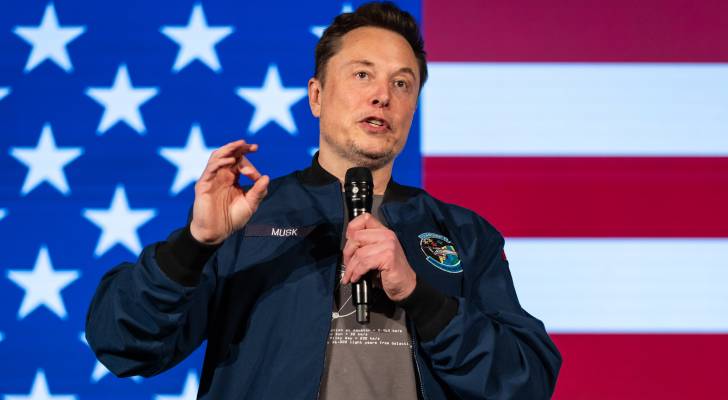
America’s ballooning debt burden has become impossible to ignore — and Tesla CEO Elon Musk, who took a stab at tackling government waste earlier this year, is sounding the alarm again.
On an episode of The Joe Rogan Experience podcast, Musk outlined what he believes is — and isn’t — possible when it comes to fixing the U.S. national debt crisis (1).
“You can make it directionally better, but ultimately you can’t fully fix the system,” Musk said. “Unless you could go super draconian — like Genghis Khan level on cutting waste and fraud — which you can’t really do in an aspirationally democratic country, then there’s no way to solve the debt crisis.”
Musk called the debt “insane” — and the numbers support his concern. U.S. federal debt has now surpassed $38.5 trillion and continues to climb (2).
But it’s not just the debt itself that’s concerning. It’s also how the government deals with it.
What really set off alarm bells for Musk wasn’t just the total — it was the cost of servicing it.
“The interest payments on the debt exceed our entire military budget … that was one of the wake up calls for me … this is crazy,” he said.
He’s not wrong. Treasury data shows the U.S. government spent $1.22 trillion on net interest in fiscal 2025. To put this in perspective, the government spent $355 billion on interest expenses just one month into 2026 (3).
Musk’s conclusion? Spending cuts alone won’t solve it.
“Even if you implement all these savings, you’re only delaying the day of reckoning for when America goes bankrupt,” he said. “So I came to the conclusion that the only way to get us out of the debt crisis and to prevent America from going bankrupt is AI and robotics. We need to grow the economy at a rate that allows us to pay off our debt.”
Read More: Approaching retirement with no savings? Don’t panic, you’re not alone. Here are 6 easy ways you can catch up (and fast)
Musk was initially appointed by President Donald Trump to head the Department of Government Efficiency (DOGE), which aimed to reduce the federal deficit by $2 trillion. But the number was soon slashed to $150 billion by December 2025 (4).
Before Musk’s departure from the political sphere, he butted heads with the incumbent President over the One Big Beautiful Bill Act (OBBBA) — claiming it undermined all the work DOGE had done.
“I was disappointed to see the massive spending bill, frankly, which increases the budget deficit,” Musk said in an interview with CBS in June last year (5), adding that it “undermines the work the DOGE team is doing.”
The OBBBA is projected to add $4.1 trillion to the national debt by fiscal 2034 and boost the deficit by 1.1% of GDP, according to the Committee for a Responsible Federal Budget (CRFB), based on Congressional Budget Office estimates (6).
If the tax provisions are made permanent, the CRFB estimates the OBBBA will add $32 trillion to the national debt over 30 years.
Musk isn’t the only one sounding alarms over America’s debt.
Ray Dalio, founder of the world’s largest hedge fund, Bridgewater Associates, has warned that the U.S. is heading toward a “debt death spiral,” where the government must borrow simply to pay interest — a vicious cycle that feeds on itself (7).
But unlike Musk, Dalio doesn’t foresee a formal bankruptcy.
“There won’t be a default — the central bank will come in and we’ll print the money and buy it,” he said. “And that’s where there’s the depreciation of money.”
In other words, the government may never technically run out of dollars — but those dollars can lose value fast.
As the hosts of the Words & Numbers podcast put it: “Technically speaking, the government can’t go bankrupt because it only promised to hand over a certain number of dollars; it didn’t promise what the value of those dollars would be (8).
Because the value of the dollars was never specified, the government can print enough to render the dollars nearly worthless. To the rest of us, the effect is the same as the government going bankrupt.”
David Solomon, CEO of Goldman Sachs, also echoed this sentiment.
“We have to find people to buy and finance our debt,” he said while speaking at the Economic Club of Washington in October 2025 (9), adding, “Ultimately, it’s not going to other people around the world if it keeps growing, it’s going to turn to us, and that crowds out investment that ultimately slows growth and it can become a problem.”
Many economists share that concern: High debt levels can fuel inflation, eroding the dollar’s purchasing power — something Americans are already experiencing (10). According to the Federal Reserve Bank of Minneapolis, $100 in 2025 has the same buying power as $12.05 did in 1970 (11).
The good news? Savvy investors have long found ways to protect their wealth — regardless of Washington’s fiscal missteps.
To shock-proof your investments, Dalio emphasized the value of diversification — and highlighted one time-tested asset in particular.
“People don’t have, typically, an adequate amount of gold in their portfolio,” he said. “When bad times come, gold is a very effective diversifier.”
Gold is considered a go-to safe haven. It can’t be printed out of thin air like fiat money and because it’s not tied to any single country, currency or economy, investors flock to it during periods of economic turmoil or geopolitical uncertainty, driving up its value.
Dalio noted that central banks themselves are “acquiring gold now as a diversifier” — and says it’s “prudent” for individuals to consider allocating “somewhere between 10% or 15%” of their portfolios to the precious metal.
The market’s performance has reinforced that view. Gold prices have more than doubled in value over the past year — hitting an all-time high of $5,344.30 on Jan. 29 (12). However, Trump’s Jan. 30 announcement of Kevin Warsh to replace Jerome Powell as chair of the Federal Reserve triggered a sharp market contraction, according to CNBC (13).
However, other prominent voices see further potential. JPMorgan CEO Jamie Dimon recently said that in this environment, gold can “easily” rise to $10,000 an ounce (14).
One way to invest in gold that also provides significant tax advantages is to open a gold IRA with the help of Priority Gold.
Gold IRAs allow investors to hold physical gold or gold-related assets within a retirement account, thereby combining the tax advantages of an IRA with the protective benefits of investing in gold, making it an option for those looking to help shield their retirement funds against economic uncertainties.
When you make a qualifying purchase with Priority Gold, you can receive up to $10,000 in precious metals for free. Just keep in mind that gold is best used as one part of a well-diversified portfolio.
Musk has also shared thoughts on how individuals can protect themselves when the dollar is losing value.
“As a general principle, for those looking for advice from this thread, it is generally better to own physical things like a home or stock in companies you think make good products, than dollars when inflation is high,” he wrote on X back in 2022 — shortly before U.S. inflation spiked to a 40-year high (15).
Musk had a point about “physical things like a home.” Consider this: The S&P Cotality Case-Shiller U.S. National Home Price NSA Index has climbed by 47% over the past five years (16).
In fact, real estate is known as a classic hedge against inflation. As the cost of materials, labor and land rises, home values often increase in tandem. Rental income also tends to move higher, providing landlords with a cash flow that adjusts with inflation.
If diversifying into multifamily rentals appeals to you, you could consider investing with Lightstone DIRECT, a new investing platform from the Lightstone Group, one of the largest private real estate companies in the country with over 25,000 multifamily units in its portfolio.
Since they eliminate intermediaries — brokers and crowdfunding middlemen — accredited investors with a minimum investment of $100,000 can gain direct access to institutional-quality multifamily opportunities. This streamlined model can help reduce fees while enhancing transparency and control.
And with Lightstone DIRECT, you invest in single-asset multifamily deals alongside Lightstone — a true partner — as Lightstone puts at least 20% of its own capital into every offering. All of Lightstone’s investment opportunities undergo a rigorous, multi-stage review before being approved by Lightstone’s Principals, including Founder David Lichtenstein.
How it works is simple: Just sign up with your email, and you can schedule a call with a capital formation expert to assess your investment opportunities. From here, all you have to do is verify your details to begin investing.
Founded in 1986, Lightstone has a proven track record of delivering strong risk-adjusted returns across market cycles with a 27.6% historical net IRR and 2.54x historical net equity multiple on realized investments since 2004. All told, Lightstone has $12 billion in assets under management — including in industrial and commercial real estate.
As such, even if multifamily rentals don’t appeal to you, Lightstone could still serve you well as an investment vehicle for other real estate verticals.
Get started today with Lightstone DIRECT and invest alongside experienced professionals with skin in the game.
Musk also highlighted “stock in companies you think make good products” as a smarter alternative to holding cash when inflation is high.
That idea resonates with many seasoned investors — but it naturally raises a question: how do you choose the right companies?
But for most investors, it can be difficult to identify value stocks with precision.
Even Wall Street veterans like Warren Buffett missed out on investing in tech giants like Amazon and Google back in the day, saying he was “too dumb to realize” their potential at the time (17).
That didn’t stop the Oracle of Omaha from climbing the ranks. He’s now the 10th-richest person on the planet with a net worth of over $140 billion (18).
For those just starting their investing journey and unsure how to pick the right stocks, platforms like Moby can help.
Moby’s team of former hedge fund analysts and experts spend hundreds of hours each week sifting through financial news and data to provide you with breaking stock recommendations. And if you sign up for Moby Premium you get one free top-stock.
Moby’s success speaks for itself. The platform’s stock picks have outperformed the S&P 500 index by about 11.9% over the past four years.
Even better, Moby offers a 30-day money-back guarantee so you can see if the service is right for you.
Warren Buffett’s advice for most investors is to skip the stock picking and simply own the S&P 500.
“In my view, for most people, the best thing to do is own the S&P 500 index fund,” Buffett has famously stated (19).
This approach gives investors exposure to 500 of America’s largest companies across a wide range of industries, providing instant diversification without the need for constant monitoring or active management.
The Oracle of Omaha practices what he preaches. He even laid out clear instructions for how his wife’s inheritance should be handled.
“One bequest provides that cash will be delivered to a trustee for my wife’s benefit,” he wrote in a letter to shareholders back in 2013 (20). “My advice to the trustee could not be more simple: Put 10% of the cash in short-term government bonds and 90% in a very low-cost S&P 500 index fund.”
The beauty of this approach is its accessibility — anyone, regardless of wealth, can take advantage of it. Even small amounts can grow over time with tools like Acorns, a popular app that automatically invests your spare change.
Signing up for Acorns takes just minutes: link your cards and Acorns will round up each purchase to the nearest dollar, investing the difference — your spare change — into a diversified portfolio.
With Acorns, you can invest in an S&P 500 ETF with as little as $5 — and, if you sign up today with a recurring investment, Acorns will add a $20 bonus to help you begin your investment journey.
But stocks and real estate are only a few examples of alternative assets you can use to diversify your portfolio. Typically, the goal with taking on assets like these is to insulate yourself somewhat from any market shocks or dramatic dips in the value of fiat currency.
If you want to diversify outside of these assets, while putting distance between yourself and the market, you could instead look towards a globally recognized asset class with near-zero correlation to the S&P 500.
The asset in question? Art.
In retrospect, it’s easy to see why great works of art tend to appreciate over time. Supply is limited, and many famous pieces have already been snatched up by museums and collectors. That scarcity also makes art an attractive option for investors looking to diversify and preserve wealth during periods of high inflation.
For example, in 2022, a collection of art owned by the late Microsoft co-founder Paul Allen sold for $1.5 billion at Christie’s New York, making it the most valuable collection in auction history (21). Billionaires like Jeff Bezos and Bill Gates have carved out a portion of their portfolios for assets that behave differently from the market.
Until recently, this world was off-limits.
Now, with Masterworks, you can buy fractional shares in multimillion-dollar works by icons like Banksy, Picasso and Basquiat. While art can be illiquid and typically requires a long-term hold, it offers unique portfolio diversification.
Masterworks has sold 25 artworks so far, yielding net annualized returns like 14.6%, 17.6%, and 17.8% among assets held for longer than a year.
Moneywise readers can get priority access to diversify with art: Skip the waitlist here
Past performance is not indicative of future returns. Investing involves risk. See important Regulation A disclosures at Masterworks.com/cd
We rely only on vetted sources and credible third-party reporting. For details, see our editorial ethics and guidelines.
@joerogan (1); Treasury.gov (2), (3); Fortune (4); CBS (5); Committee for a Responsible Federal Budget (6); @CNBCInternationalLive (7); US News (8); @TheEconomicClub (9); PBS (10); Federal Reserve Bank of Minneapolis (11); APMEX (12); CNBC (13), (17), (18); KITCO (14); @elonmusk (15); S&P Global (16); Forbes (19); Berkshire Hathaway (20); Christie’s (21)
This article provides information only and should not be construed as advice. It is provided without warranty of any kind.