

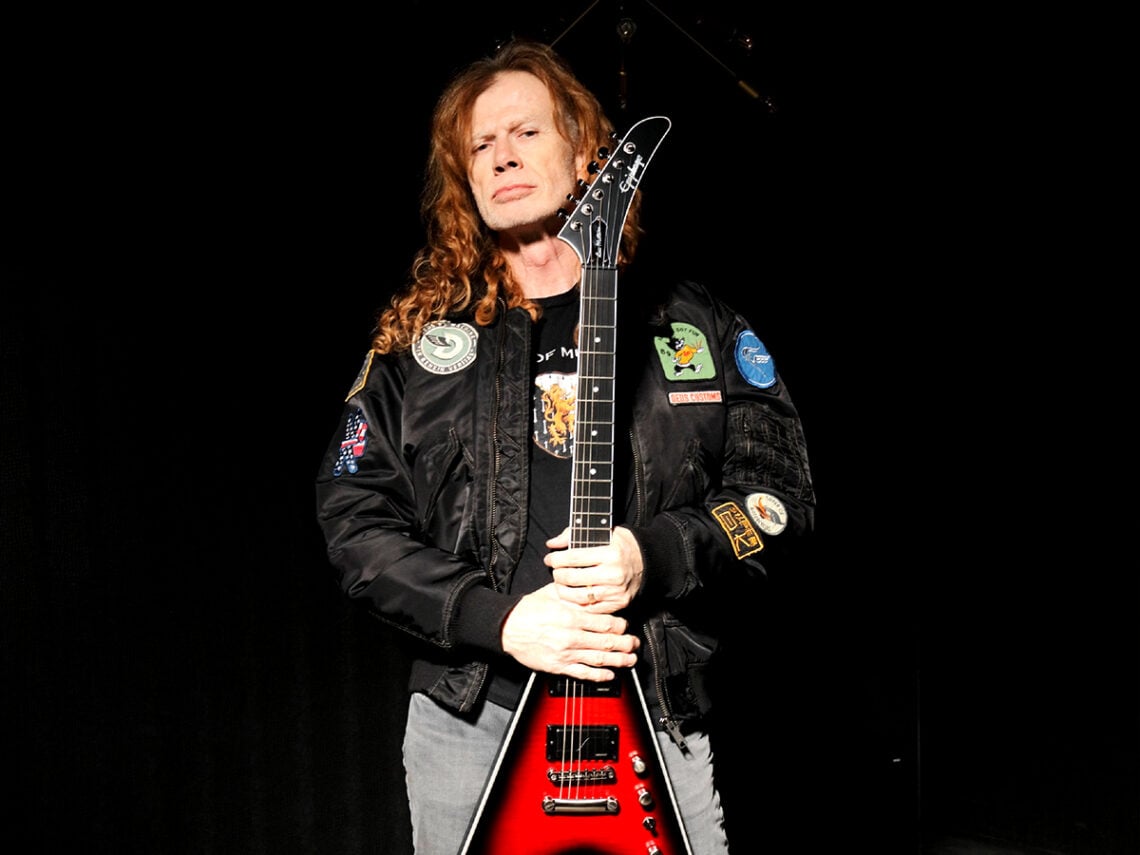
(Credits: Far Out / Press)
Mon 2 February 2026 2:00, UK
While the existence of the ‘big four’ of thrash metal that emerged in the 1980s would have you believe that there were multiple acts responsible for the genre’s rise to prominence, Megadeth’s Dave Mustaine would probably choose to insinuate otherwise.
Alongside Megadeth in this quadrumvirate were Anthrax, Slayer and Metallica, the latter of which he was also a founding member of, but despite his role in having formed the band, he would end up falling out with the rest of the band in a significant and impactful way that meant they were constantly at odds with one another throughout this period.
Of course, all of these groups played their own significant parts in helping thrash metal become a cultural phenomenon, but Mustaine often claims that without his input, there wouldn’t have been such prominence. His argument against Metallica, and to a lesser extent, their other contemporaries, was that they were ripping off something that he was an innovator of, and that he believed he was the true reason for its rise to prominence.
Regardless of who can rightfully claim to have coined this novel approach, thrash metal’s rise was unlike anything else that had happened in the genre prior, where multiple bands were emerging at once as major proponents of a new style. Heavy metal’s initial rise wasn’t as sudden, and it took several years for bands to emerge as major proponents of the genre, whereas thrash metal was immediately thrust into the spotlight as a result of these bands and their output.
However, similarly to the rise of thrash in the early ‘80s, the early 2000s saw a rise of a new force in metal, rather aptly known as ‘nu metal’. While it was still easy to see the link between this nascent incarnation and the original ethos of metal, nu metal seemed to be focused more on incorporating elements of rap, with significantly less emphasis on musical showmanship.
Nu metal was massive at the time, but we often look back on it now as something of a punchline and a sign of the times where metal was in the creative wilderness and struggling to hold any relevance, and it’s fair to say that Mustaine never looked favourably upon it in the first place.
During a 2025 interview with Lifeminute, he took the opportunity to lambast this stylistic shift and insinuated that the work of bands such as Korn, Linkin Park and Limp Bizkit was nowhere near the levels of creativity that he brought to metal with Megadeth.
“There was a period in 2000 where we had these bands called, I think it was nu metal, and they didn’t do any solos,” he argued. “Well, why didn’t they do any solos? They couldn’t do solos. And thank God that genre went away. People started to learn how to do solos.”
While he was clearly incensed by the fact that the art of the guitar solo had been all but eviscerated by the emergence of nu metal, it shouldn’t be the be-all and end-all of whether a genre has any artistic merit. “I would say, if you’re in a nu metal band, you probably would be challenged even playing ‘Johnny B Goode’,” he added. “So I’m glad that went away.” Perhaps he’s right to be thankful for its disappearance, but the fact that there were no solos is the least of nu metal’s myriad problems as a genre.
Related Topics