
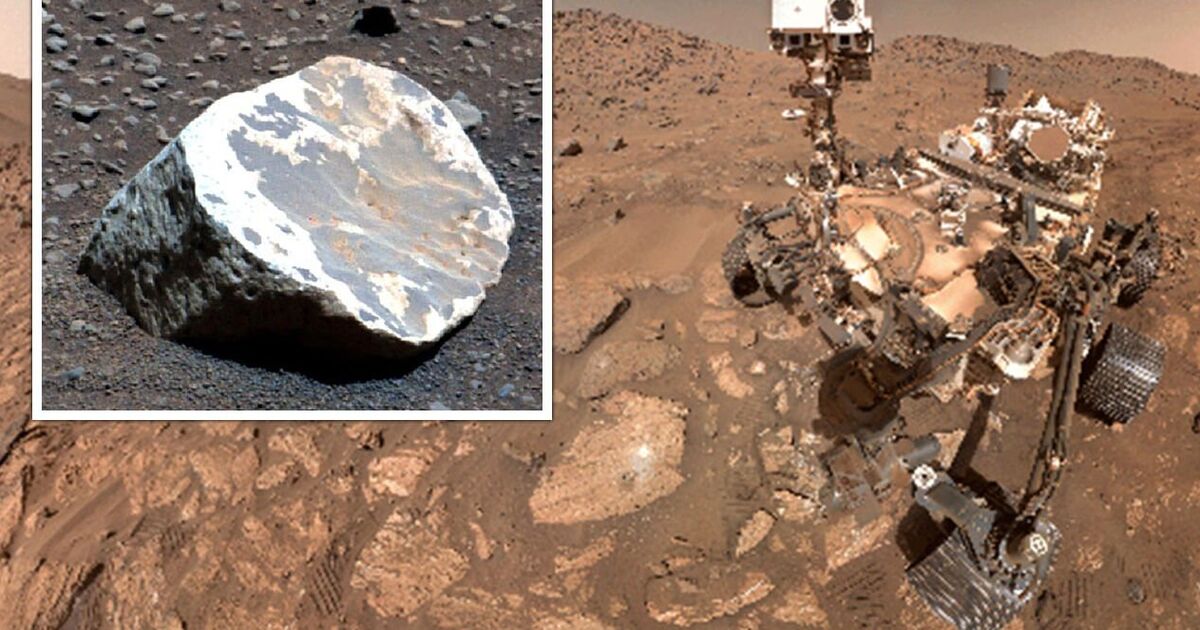
The white rocks have provided tantalising hints about Mars’ history (Image: NASA)
Small, pale rocks scattered across the surface of Mars may be offering the most compelling clues yet that the Red Planet was once far wetter—and potentially more habitable—than it is today. NASA’s Perseverance rover has identified these unusual stones in Jezero Crater as kaolinite clay, a white, aluminium-rich mineral.
On Earth, this mineral typically forms only after millions of years of persistent rainfall in warm, humid environments. The discovery, detailed in a study published this week in Communications Earth & Environment, suggests that parts of Mars may once have supported tropical-like climates, complete with heavy, sustained rainfall.
Read more: Bombshell new map shows what sits below Antarctica’s icy surface
Read more: Trump and China in deadly space race – but it’s not to the Moon

Mars infographic (Image: Express)
Briony Horgan, a planetary science professor at Purdue University and a long-term planner for the Perseverance mission, said: “Elsewhere on Mars, rocks like these are probably some of the most important outcrops we’ve seen from orbit because they are just so hard to form.
“You need so much water that we think these could be evidence of an ancient warmer and wetter climate where there was rain falling for millions of years,” reports Communications Earth & Environment.
Elon Musk excited about possible Mars mission after Trump inauguration
Analysing the Martian surface
The kaolinite rocks, ranging in size from pebbles to boulders, were analysed using the rover’s SuperCam and Mastcam-Z instruments. Researchers compared their chemical signatures with similar samples collected on Earth, including in South Africa and near San Diego, California. While kaolinite can also form through hydrothermal activity, the Martian samples lacked the distinctive chemical patterns left by this process, strongly pointing to rainfall as the driving force.
Adrian Broz, a postdoctoral researcher at Purdue and lead author of the study, explained: “On Earth, kaolinite is common in rainforests, where constant heavy rainfall strips rocks of other minerals over long periods. So when we see kaolinite on a barren, cold planet like Mars, it tells us there was once far more water than there is today.”

Most scientists now agree that Mars did once have the necessary conditions for life (Image: Getty)
The Mystery of Jezero Crater
Despite the significance of the find, the origin of these rocks within Jezero Crater remains a mystery. Ms Horgan suggested they could have been washed into the crater’s ancient lake by rivers forming its delta, or scattered there by an impact. Satellite imagery has shown larger kaolinite deposits elsewhere on Mars, but the rover has not yet reached them, leaving these small rocks as the only on-the-ground evidence for now.
Jezero Crater, which once contained a lake roughly twice the size of Lake Tahoe, has long been a focus for scientists studying Mars’ habitability. The presence of water is central to the search for life, as all known life depends on it.
Mr Broz said: “All life uses water. So when we think about the possibility of these rocks on Mars representing a rainfall-driven environment, that is a really incredible, habitable place where life could have thrived if it were ever on Mars.”

Mar’s Jezero Crater (Image: Getty)
A Window into the Past
The discovery feeds into decades of speculation about life on the Red Planet. From the “canals” imagined by 19th-century astronomers to recent findings of ancient riverbeds and salty lake deposits, scientists have long debated whether Mars could have supported microbial life. While no direct evidence of past life has yet been found, the new kaolinite rocks provide a window into a time when conditions may have been right.
For decades, Mars has been portrayed as a frozen desert, with water mostly trapped in polar ice or underground. However, these white rocks point to a radically different environment billions of years ago: one that may have been warm, wet, and capable of sustaining life for extended periods.
The Perseverance rover, which landed in Jezero Crater in February 2021, continues to explore the region, analysing the mineral composition of the Martian surface. Scientists hope that as the rover approaches larger kaolinite deposits, it will provide more definitive evidence of Mars’ climate history.
Ms Horgan said: “Every rock tells a story. And these rocks are whispering that Mars was once a much more Earth-like world than we ever imagined.”