
For years people have wondered if the big AI players would ever target legal tech. Well, now they have. LLM giant Anthropic has launched new capabilities for its agentic Cowork facility for finance, sales, marketing, and….legal, via a range of plugins.
As the pioneering AI company explained in a statement sent to Artificial Lawyer: ‘Anthropic is releasing plugins for Cowork that extend Claude’s agentic capabilities beyond general tasks into specialized business functions. Plugins bundle skills, connectors, slash commands, and sub-agents that make Claude work like a domain expert for specific roles and teams, sales, finance, legal, data analysis, marketing, customer support, and more.’
As you can see below, there are a range of skills, including for contract review.
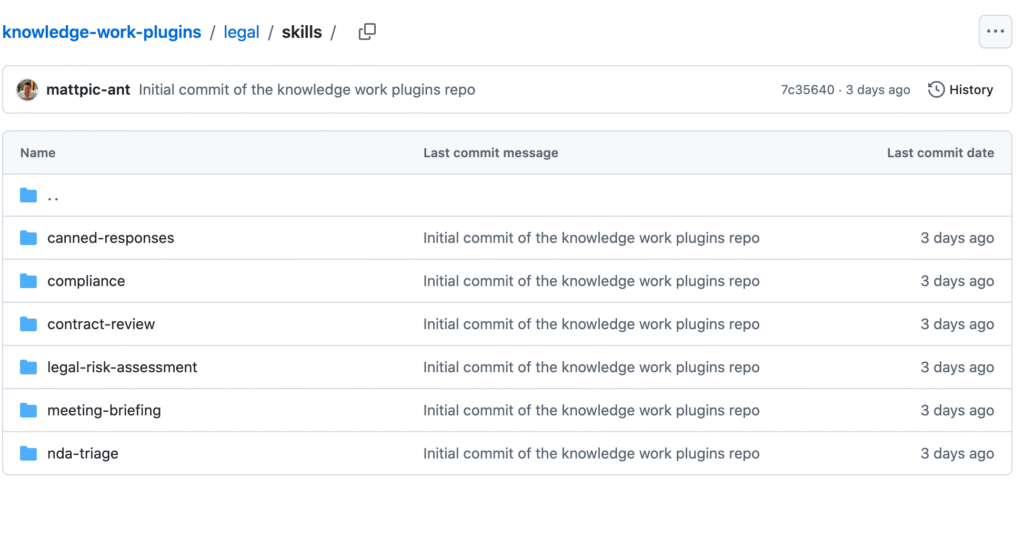 Note: these are from the official Anthropic Github.

For contract review it sets out the master prompt, then sub-prompts for different needs.
‘Playbook-Based Review Methodology

Loading the Playbook
Before reviewing any contract, check for a configured playbook in the user’s local settings. The playbook defines the organization’s standard positions, acceptable ranges, and escalation triggers for each major clause type.
If no playbook is available:
Inform the user and offer to help create one
If proceeding without a playbook, use widely-accepted commercial standards as a baseline
Clearly label the review as “based on general commercial standards” rather than organizational positions
Review Process
Identify the contract type: SaaS agreement, professional services, license, partnership, procurement, etc. The contract type affects which clauses are most material.
Determine the user’s side: Vendor, customer, licensor, licensee, partner. This fundamentally changes the analysis (e.g., limitation of liability protections favor different parties).
Read the entire contract before flagging issues. Clauses interact with each other (e.g., an uncapped indemnity may be partially mitigated by a broad limitation of liability).
Analyze each material clause against the playbook position.
Consider the contract holistically: Are the overall risk allocation and commercial terms balanced?
Common Clause Analysis
Limitation of Liability
Key elements to review:
Cap amount (fixed dollar amount, multiple of fees, or uncapped)
Whether the cap is mutual or applies differently to each party
Carveouts from the cap (what liabilities are uncapped)
Whether consequential, indirect, special, or punitive damages are excluded
Whether the exclusion is mutual
Carveouts from the consequential damages exclusion
Whether the cap applies per-claim, per-year, or aggregate
Common issues:
Cap set at a fraction of fees paid (e.g., “fees paid in the prior 3 months” on a low-value contract)
Asymmetric carveouts favoring the drafter
Broad carveouts that effectively eliminate the cap (e.g., “any breach of Section X” where Section X covers most obligations)
No consequential damages exclusion for one party’s breaches.’
There are several other aspects to explore, for IP, data, and more.
And it also includes instructions on ‘Redline best practice’ – see here:
‘Redline Generation Best Practices
When generating redline suggestions:
Be specific: Provide exact language, not vague guidance. The redline should be ready to insert.
Be balanced: Propose language that is firm on critical points but commercially reasonable. Overly aggressive redlines slow negotiations.
Explain the rationale: Include a brief, professional rationale suitable for sharing with the counterparty’s counsel.
Provide fallback positions: For YELLOW items, include a fallback position if the primary ask is rejected.
Prioritize: Not all redlines are equal. Indicate which are must-haves and which are nice-to-haves.
Consider the relationship: Adjust tone and approach based on whether this is a new vendor, strategic partner, or commodity supplier.’
As can be seen these seem to favour NDAs and related documents, but one can assume they are hoping to expand this.
–
In short, they are really thinking about this and thinking especially in terms of how a lawyer might approach the subject.
Why are they doing this?
AL would guess there is one main reason: the need for a lot more revenue. Anthropic and OpenAI both want and need to increase their revenues very quickly. They’ve taken on billions in funding and want to do IPOs. But, to get there they need more cashflow, hence more business users. And legal is one area to target.
This is their reasoning:
‘The core challenge with AI agents in the enterprise is that general assistants can’t handle specialized work. Plugins solve this by combining domain expertise with the tools teams already use—CRMs, document systems, data platforms—so Claude can handle routine work while professionals focus on higher-value decisions. It’s a meaningful step from AI as a chatbot to AI as a capable teammate across business functions.’
What’s available at launch:
‘Plugins for job/team roles: 11 open-source plugins built by Anthropic, spanning Productivity, Enterprise Search, Sales, Finance, Data, Legal, Marketing, Customer Support, Product Management, and Biology Research—with more to come. The full collection is available on GitHub.
Ready to go out of the box: Each plugin comes loaded with domain-specific capabilities. A sales plugin connects Claude to your CRM and knowledge base, helping with everything from prospect research to call follow ups. A legal plugin adds document review and contract analysis. A data plugin links to dashboards to help explore trends faster.
Plugin builder: Users can customize existing plugins or create their own from scratch.
Available today in research preview: Support for plugins in Cowork is available now to all paid Claude users. Plugins are currently saved locally, with broader org-wide support coming in the weeks ahead.’
Will This Impact Legal Tech?
Well, the short answer is: it could.
But, the challenge is that this is not a question of just clicking one button on a desktop and everything is done for you. Law firms and inhouse teams will need some tech skills to deploy these plugin tools, and no doubt will want reassurances around data security.
That said, most large law firms and legal teams at global corporations will be able to leap that hurdle very quickly with their tech teams and move to deployment.
The question is: how many law firms and teams will go this way? Given the rise in interest in DIY legal tech tools then it seems likely that some firms will go for this, especially if some of their lawyers are already using Claude.
But, as noted, a quick, generic review with the instructions above is one thing, a super-detailed one that meets your style, that connects to your past data, that can tell you what is market, is something else. So, high quality legal tech tools have little to fear here…for now. Although, perhaps better customisation of what’s on offer could go some way to addressing the limitations of what’s on offer?
As noted before by AL, the real risk is for those vendors selling commoditised legal AI skills. Those indeed face something of an existential threat. Why buy a tool that is no better than the legal plugin above?
And finally, this all goes back to the initial point: we have been waiting for the big AI companies to move into legal. Now, at least via plugins, they have. How long before others do the same? And then what impact will this make?
Plus, will they move beyond this and really provide a clear and separate product division for legal, as OpenAI, for example is now doing for medical diagnosis?
For legal AI companies the message is clear: with vibe-coders on one flank and Big AI now on the other, they need to really show value over and above what can be provided by these two encroaching paths.
You can see more here – Knowledge Work Plugins.
—
Conference News
Legal Innovators Europe – Paris – June 24 and 25 – tickets now available.

Discover more from Artificial Lawyer
Subscribe to get the latest posts sent to your email.