
It can be tempting to wait inside in the warm for spring to cast its golden rays over the landscape, but even the soggiest February day offers an unparalleled and underrated opportunity to enjoy some really beautiful, wild experiences.
Some wildlife is easier to see in winter through the bare boughs and in occasional clear blue skies, and other wildlife can only be spotted at this time of year.
Whatever the weather, our reserves remain really vital refuges for our wildlife. In a world that allots decreasing space solely for nature, nature reserves offer our wild creatures the opportunity to rest, settle and gather themselves to adventure out into the world once again – and we are incredibly grateful to everyone who supports us to keep Yorkshire wild.
Booming bitterns
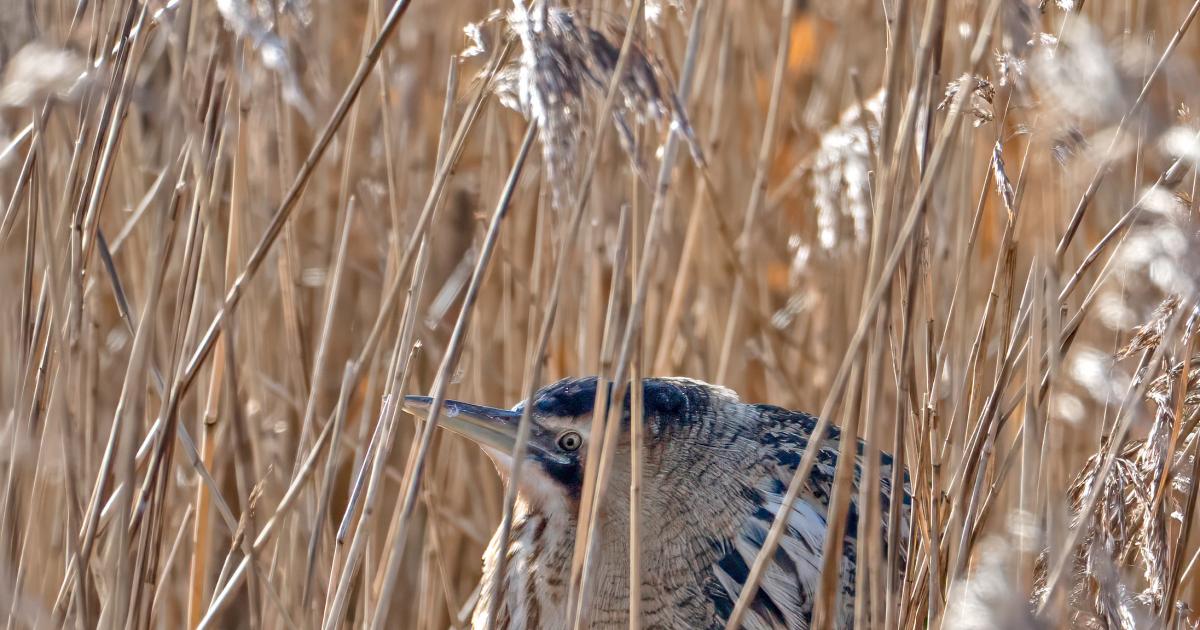
Bittern at North Cave Wetlands. Photo: Keith Allen
Wetlands are some of our most beautiful reserves over winter and early spring. On clear days the pools look like mirrors, reflecting the bright of the sky and fringed by reedbeds – and even on drizzly or cloudy days, there’s a certain atmosphere to the low-hanging mist and patter of raindrops on the water. Bitterns only add to this atmosphere; take a wander around one of our wetland reserves and listen out for the sound of a foghorn, or the noise a bottle makes when you blow across the top.
Bitterns are elusive creatures, part of the heron family and perfectly disguised among the reeds. Once almost entirely lost from the UK, they have made a slow recovery over the last 20 years and have now returned in numbers to the hundreds, with Yorkshire Wildlife Trust reporting their first breeding pair at North Cave Wetlands late last year and Potteric Carr remaining a regional stronghold. While you’re unlikely to spot one, do listen out for its ‘boom’ – which can be heard up to two miles away!
Find them at: North Cave Wetlands near Hull and Potteric Carr in Doncaster.
Drumming woodpeckers
Wander through a woodland in late winter or early spring and you’re likely to hear bursts of rapid, resonant tapping echoing through the trees. This staccato sound is the work of a woodpecker on a mission. Each rattle sends a message to all the other woodpeckers that can hear it – this part of the forest belongs to me.
While some birds sing to attract a mate and intimidate their neighbours, woodpeckers take a different approach. They hammer their beak against a tree trunk at incredibly high speeds – up to 40 strikes per second for the great spotted woodpecker. When a bird finds a branch it likes, it may come back to drum against it again and again. It’s not just trees that attract them – they’ll sometimes use man-made structures, including metal poles.
There are three species of woodpecker that nest in Britain, but you are mostly likely to hear the great spotted woodpecker – our most common species, found in many woodlands and parks. Great spotted woodpeckers are glossy black and white birds with a splash of red beneath their tail – males also have a red patch on their nape. Their drumming is a short, explosive burst of strikes that last less than a second.
Find them at: Yorkshire Wildlife Trust’s Hollinhurst Wood, Adel Dam and Birch Wood nature reserves.
Dancing great-crested grebes
The display of the great-crested grebe is one of the greatest breeding spectacles – and, arguably, one of the most romantic. On early spring mornings, great crested grebes pair up to perform an elegant ritual. It starts with a pair of grebes that have established a territory on a lake calling towards each other across the water, either attracting a new mate or confirming an existing partnership. They will swim towards and away from one another, performing a series of ‘dance moves’ – head bobs and shakes, showing their crest feathers and calling to one another. This dance can go on for several minutes at a time before the grebes head off in their own directions.
Great crested grebe. Photo: supplied
The truly special part is the waterweed dance. Both birds dip under the water and reappear with beaks full of water weed; they rush together, feet frantically paddling until they are upright and chest to chest like penguins, and offer the weed to one another as gifts. Their perfect synchronisation is vital for reinforcing their partnership, and makes some beautiful shapes that have led to the dance being described as almost balletic.
A final head shake, the weed is dropped, and the deal is sealed. It’s certainly a dramatic spectacle worthy of Strictly, and well-worth a watch.
Find them at: Sprotbrough Flash near Doncaster, Bolton-On-Swale Lake near Catterick, and Staveley near Ripon.
Birthday wishes… This year is Yorkshire Wildlife Trust’s 80th anniversary! We’re proud to have been stewarding our wild places in Yorkshire since 1946, and our vision for Yorkshire’s future is a wild one. Help us create a wilder future for Yorkshire’s wildlife by becoming a member or donating to our spring appeal. Find out more at ywt.org.uk.