
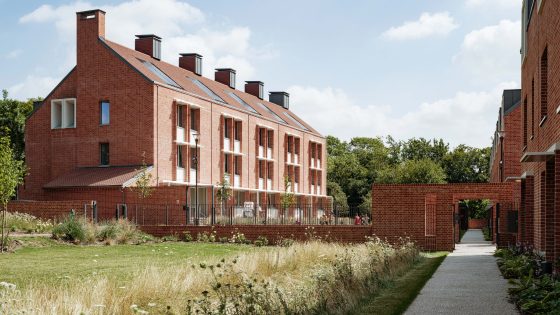
A new cluster of student housing has been completed by Allies and Morrison at Hinsley Lane in Cambridge, comprising 39 townhouses arranged in a succession of terraces in a garden setting.
The eight terraces accommodating a total of 245 student rooms sit on the edge of the leafy West Cambridge conservation area and were commissioned by St John’s for use by several of Cambridge’s colleges.
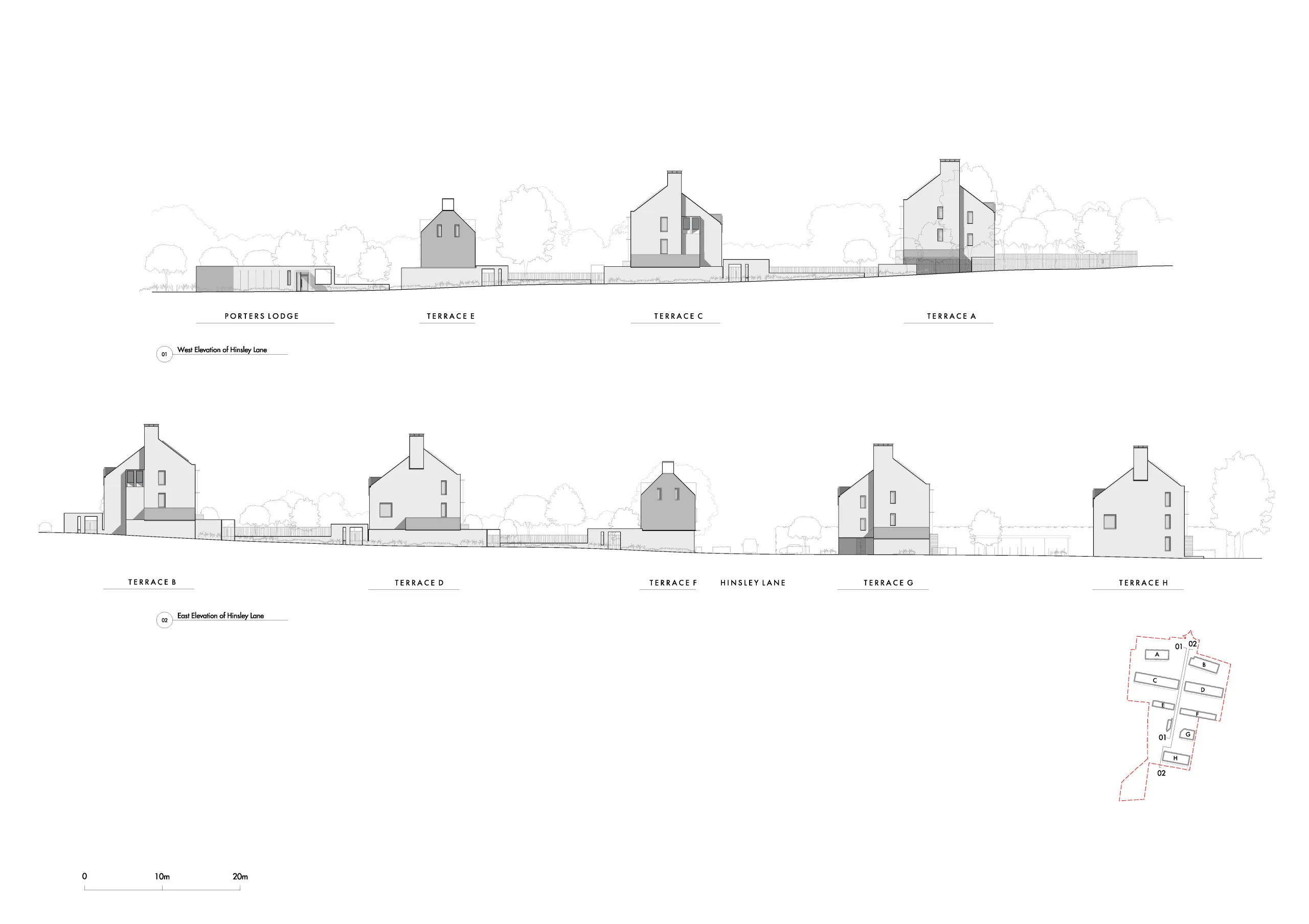
Ranging between two and a half and three storeys, the buildings are scaled to their context. Their positioning on the site is designed to both preserve the landscape setting and optimise the buildings’ orientation to support their environmental performance.
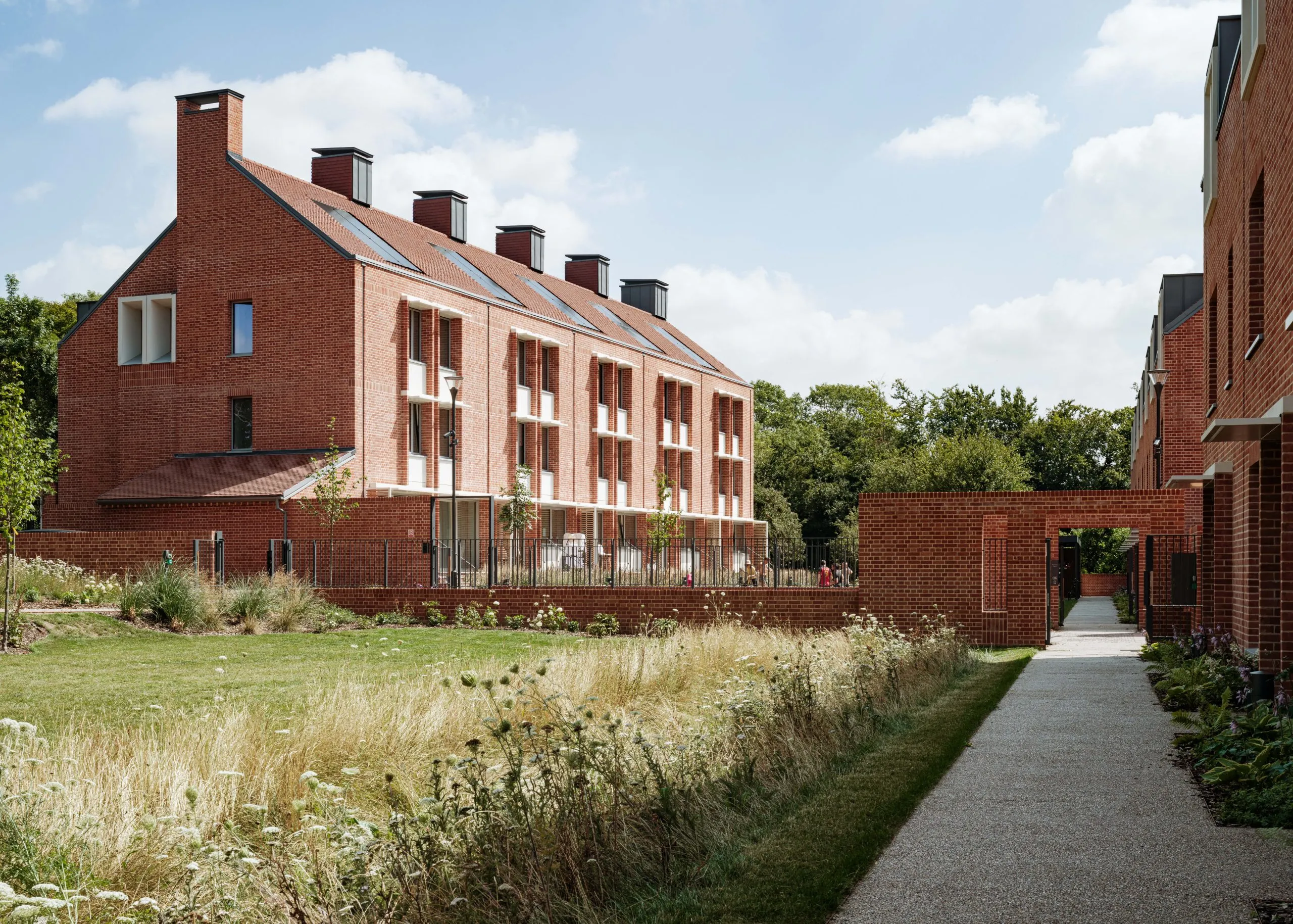
The buildings face north-south, capturing solar gain in winter, while built-in shading via bay windows and openwork screens reduces overheating in summer. Heat pumps and PVs provide additional heating, cooling and power.
Low operational energy is complemented by low embodied carbon, enabled by an all-timber structure. Red brick, hung clay tiles and reconstituted stone characterise the façades. Pitched roofs, gables and large chimneys housing ventilation create an articulated form and silhouette.
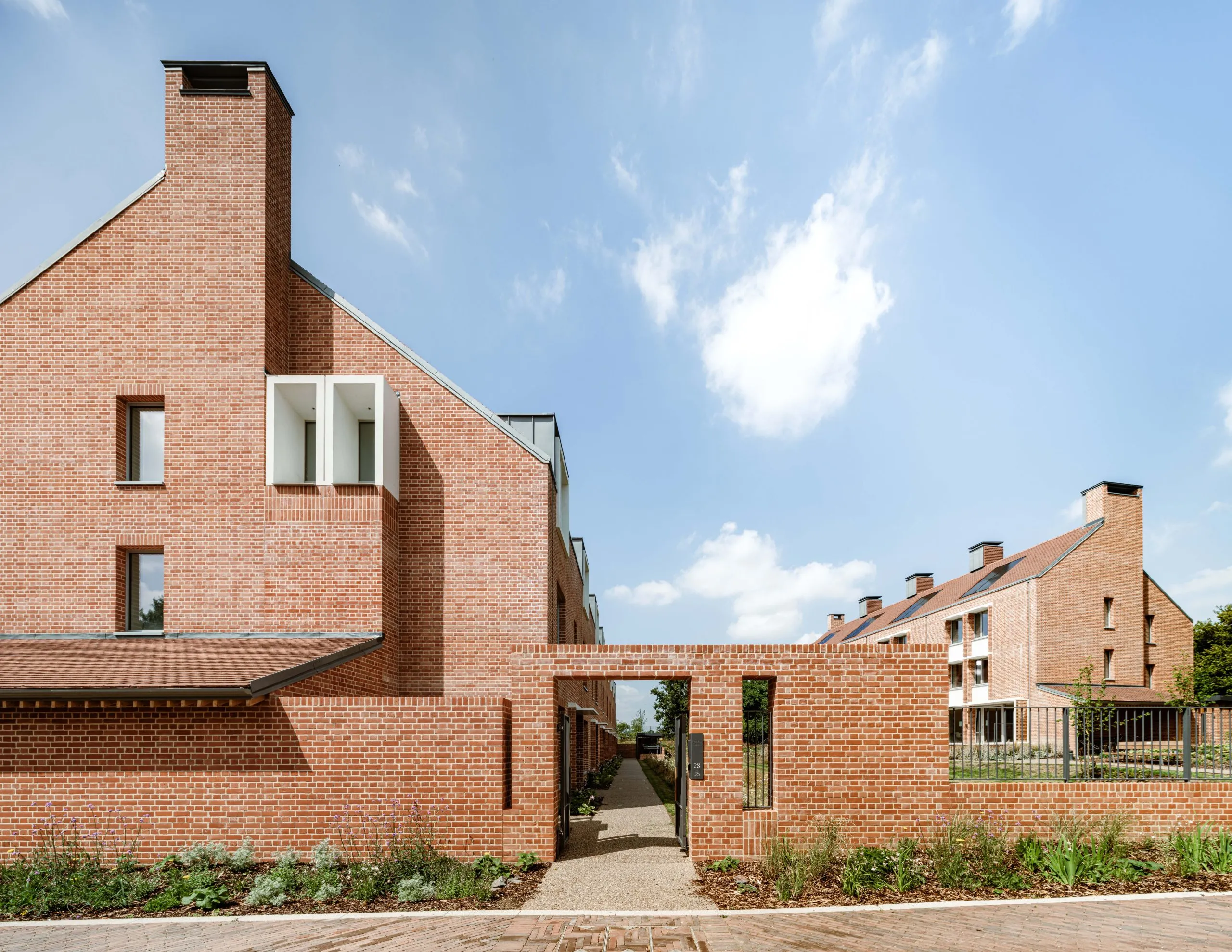
Entrances are arranged off a new lane prioritising pedestrians and cyclists. This runs through the site, connecting Wilberforce Road to Herschel Road with the terraces sitting perpendicular to it.
The setting was already well-planted with mature trees, hedges and patches of woodland, and the scheme looked to help preserve the habitat-rich biodiversity, a key driver being management of rainwater. A neglected orchard was retained and revitalised, the landscape traces of a Roman Road enhanced, and integrated sustainable drainage swales were made into a feature.
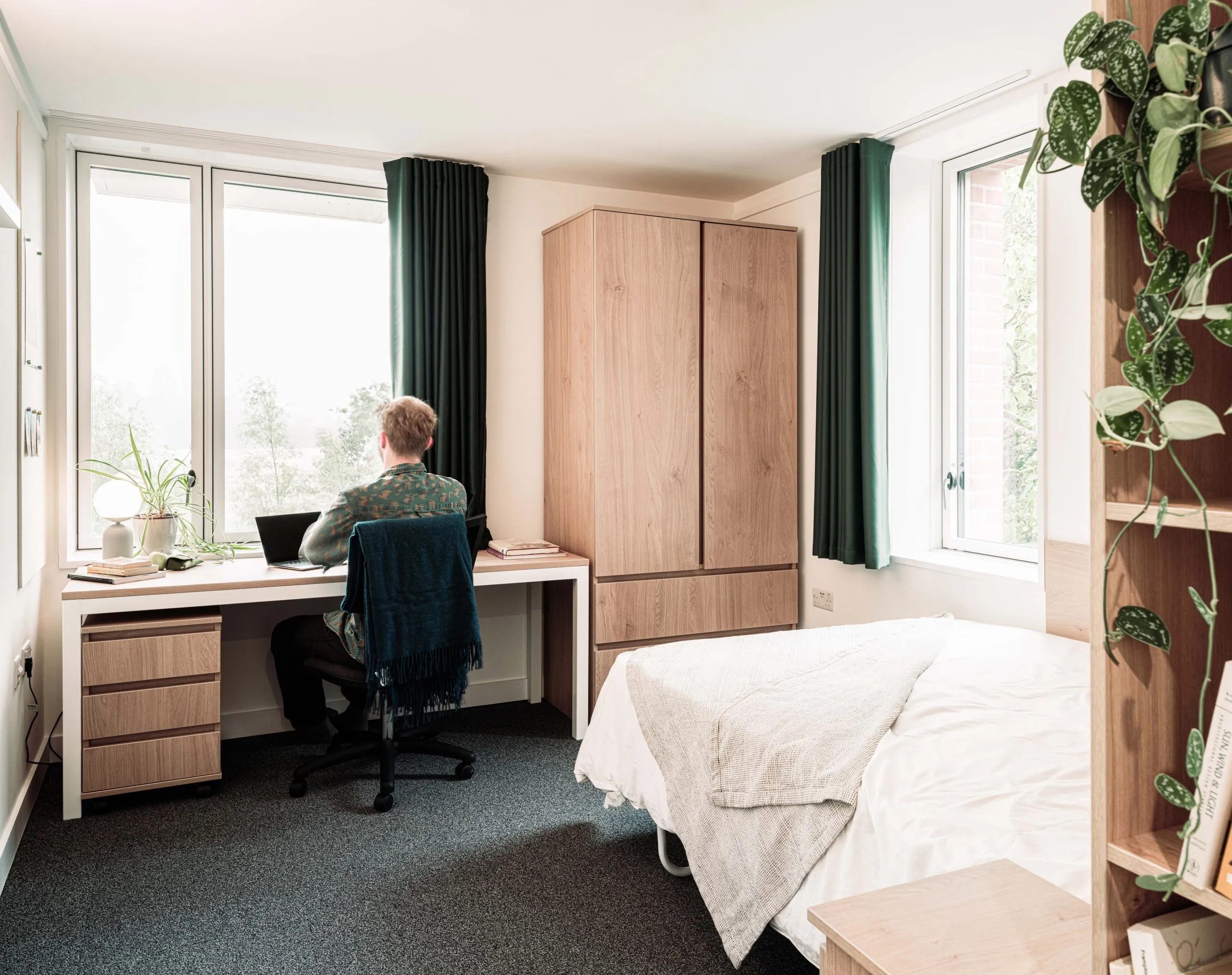
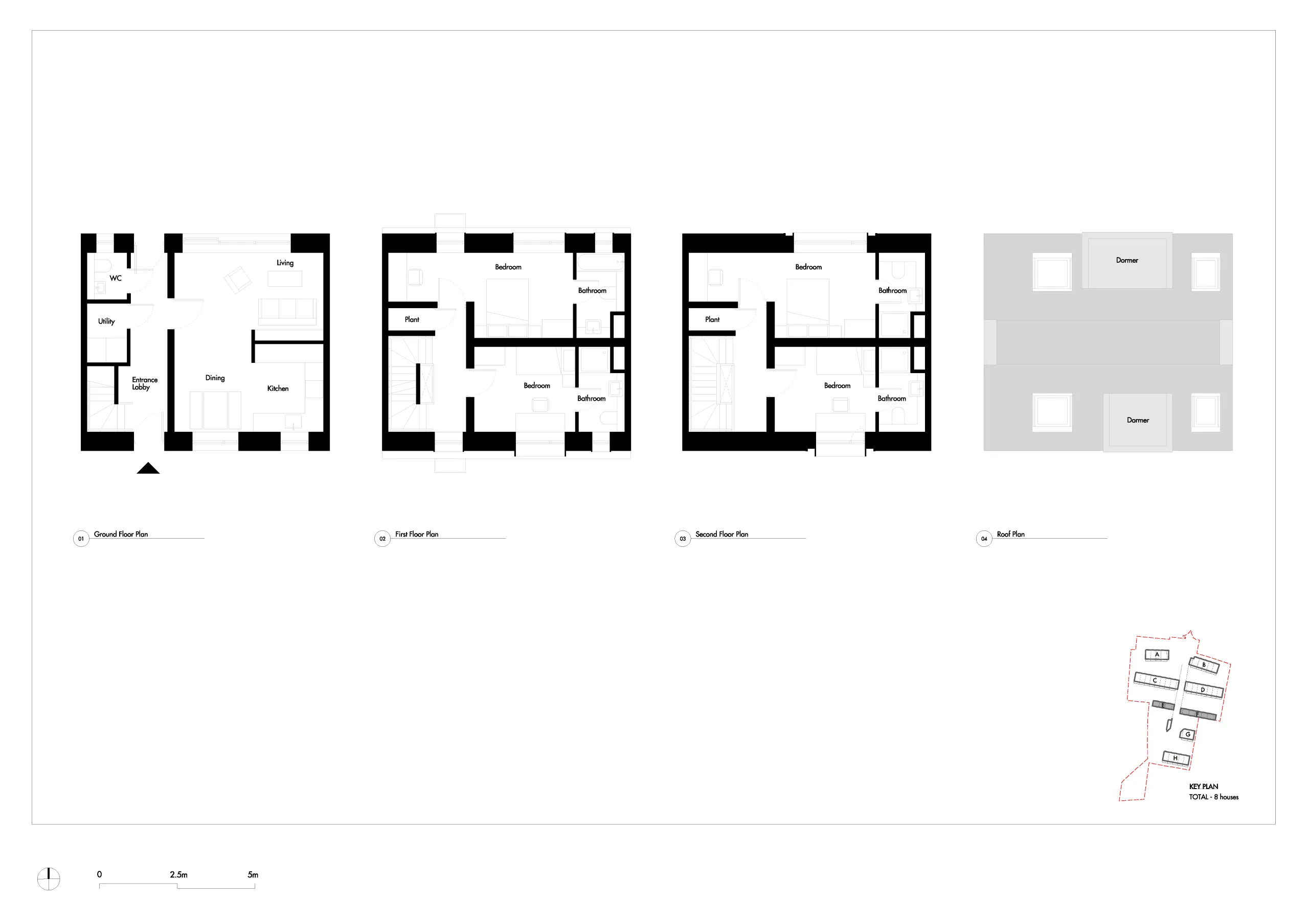
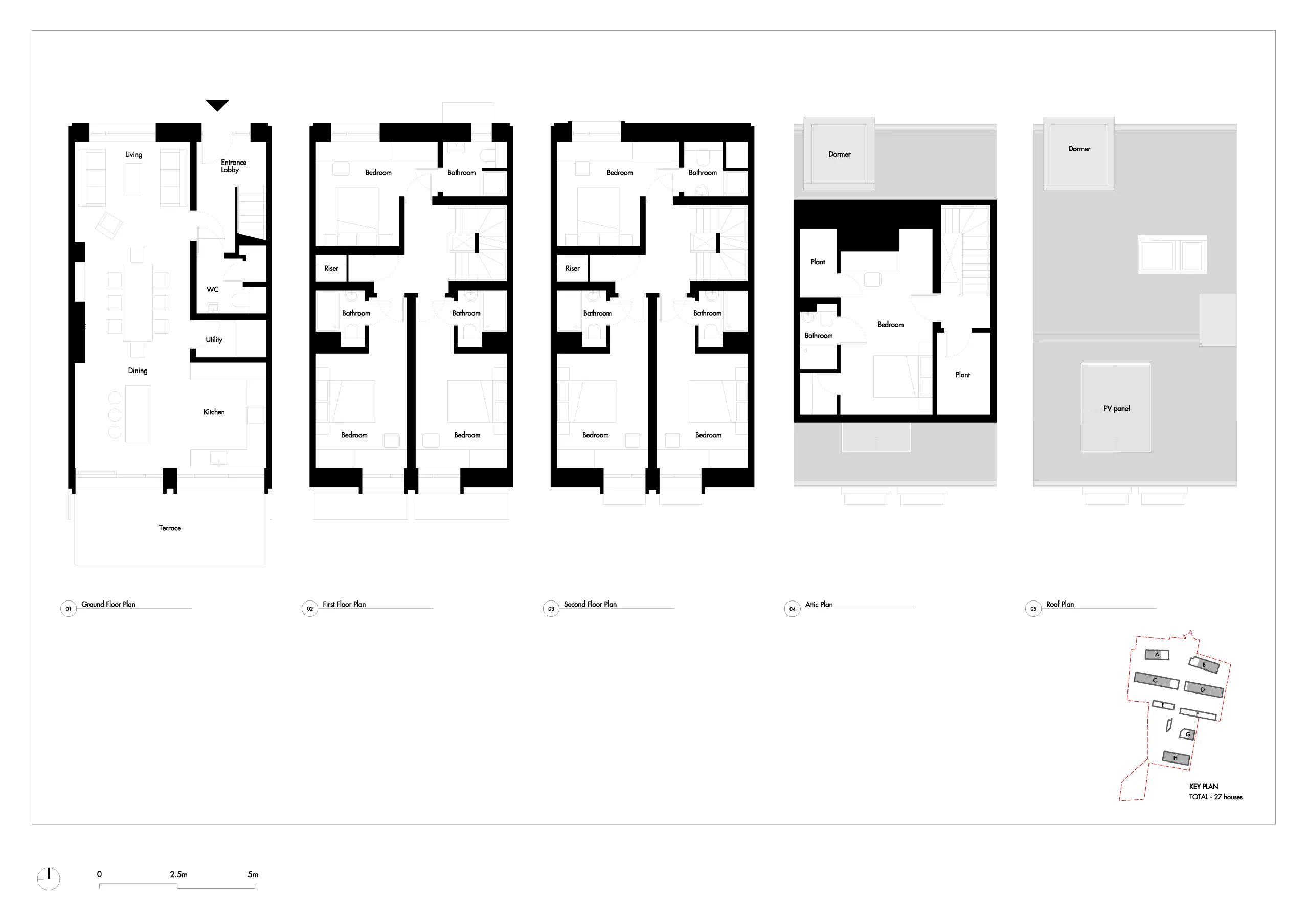
Each house provides accommodation for between four and seven students. Quiet private study bedrooms are complemented by bright, shared living areas around a dining table generous enough for everyone to use at once. Every house opens on to its own private terrace, which steps down to the shared garden.
Architect’s view
Hinsley Lane is a project where sustainability shaped every decision from the outset, influencing orientation, layout, form, façades and landscape. Yet you wouldn’t necessarily guess it from the finished buildings, which sit gently within West Cambridge’s red-brick vernacular. We championed Passivhaus, which wasn’t part of the brief at the start, proving through rigorous analysis that it was both technically and financially viable.
The project is quite unusual because St John’s moved away from a conventional corridor model, choosing a townhouse typology, because the house-share model proved so popular with students. With generous shared living spaces, abundant natural daylight, outdoor terraces and the warmth of exposed timber and natural materials, the houses are truly homely and convivial places to live.
For us, Hinsley Lane embodies everything we love about college projects: environmental ambition, contextual sensitivity and student comfort and wellbeing.
Max Kettenacker, director, Allies and Morrison
Client’s view
St John’s College takes a long-term view and, therefore, it was important from the outset that the designs for the student scheme reflected the high-quality and longevity expected of Cambridge college buildings. The college is delighted with the end result, which embraces our ambitions to create cost-effective accommodation that supports student wellbeing while also being as sustainable as possible.
The Allies and Morrison team embraced the initial brief and has created a neighbourhood truly embedded in its local context. From the intimate new lane framed by stepping townhouses to the verdant gardens in between, it is a place that feels like it has grown out of West Cambridge, rather than being imposed upon it.
Suzie Wood, head of investment property, St John’s College
Project data
Location Cambridge
Start on site August 2022
Completion date June 2025
Gross internal floor area 8,450m2
Gross (internal + external) floor area 11,200m2
Form of contract or procurement route Design and build
Construction cost Undisclosed
Architect Allies and Morrison
Client St John’s College, Cambridge
Structural engineer Smith and Wallwork Engineers
M&E consultant Calfordseaden (pre-tender), Munros Building Services (post-tender)
Quantity surveyor Accertum
Landscape consultant Allies and Morrison
Sustainability consultant Calfordseaden
Fire consultant The Fire Surgery
Acoustic consultant Ramboll
Planning consultant Shrimplin Planning and Development
Transport consultant Stantec
Passivhaus constultant Max Fordham, Allies and Morrison
Ecology consultant Delta Simons
Archaeology consultant Cambridge Archaeological Unit
Arboriculture consultant Haydens Arboricultural Consultants
Project manager Ridge
Principal designer Savills
Main contractor Cocksedge
Environmental performance data
Percentage of floor area with daylight factor >2% Not supplied
Percentage of floor area with daylight factor >5% Not supplied
On-site energy generation 12% (55,637 kWh via PVs)
Annual mains water consumption Not supplied
Airtightness at 50Pa Average : 0.15 m3/h.m2, one house: 0.09 m3/h/m2
Heating and hot water load Heating: 7.1 kWh/m2/yr (predicted), 1.6 kWh/m2/yr (measured), hot water: 14.7 kWh/m2/yr (predicted), 17.6 kWh/m2/yr (measured)
Operational energy 48.1 kWh/m2/yr (predicted), 53.3 kWh/m2/yr (actual)
Total energy load Not supplied
Overall area-weighted U-value Accessible townhouse (blocks 1,2,4,5,7 and 8): 0.26 W/m2K, townhouse average (blocks 3 and 6): 0.23 W/m2K
Predicted design life 60 years
Embodied carbon Not supplied
Whole-life carbon Not supplied
Annual CO2 emissions Not supplied
Energy performance certificate rating A (33 townhouses), B (6 townhouses and porters’ lodge)
Passivhaus certication Classic