
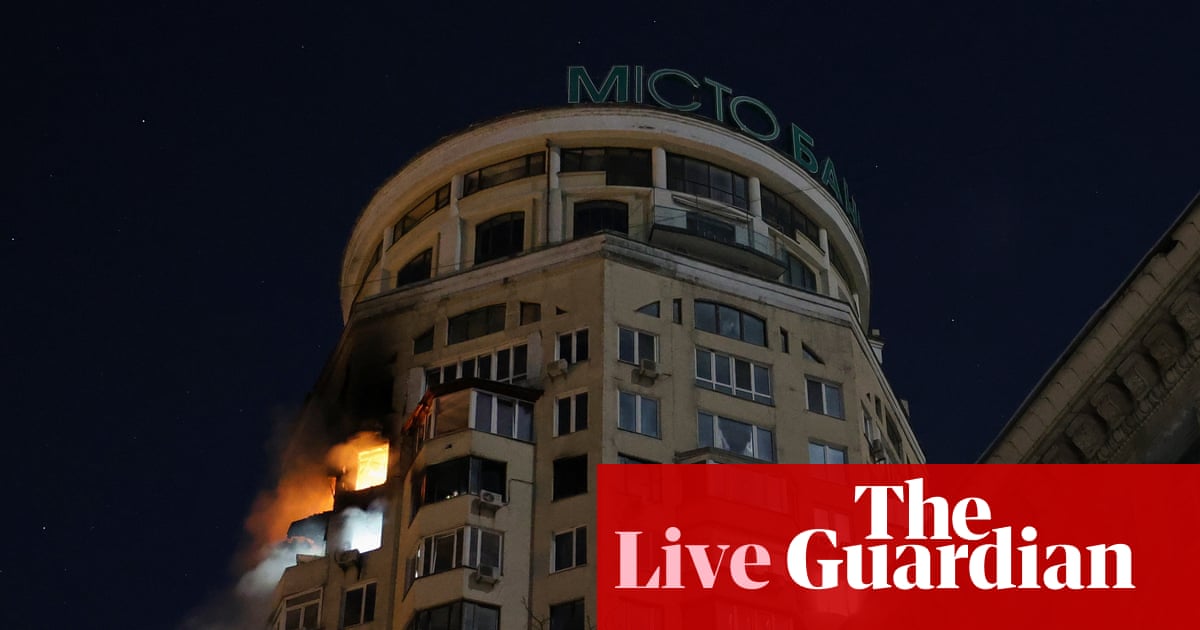
Ukraine ‘ready to play ball’ and come to an acceptable deal but Russia ‘creating chaos’ with its attacks, Nato chief says
Nato secretary general Mark Rutte and Volodymyr Zelenskyy held a joint press conference earlier and both gave statements to the press before taking questions. Here are the highlights:
Volodymyr Zelenskyy
Zelenskyy said there must be “consequences” for Russia’s overnight attack on Ukraine, which he said broke the terms of the temporary energy ceasefire announced by the US last week. He cautioned against “partners” remaining “silent” over the strikes.
Zelenskyy said licenses are needed so Europe can adequately protect itself, including for missiles crucial for air defence systems that the US has.
Zelenskyy said himself and Rutte agreed that a Ukrainian army with 800,000 personnel is an acceptable size. As a reminder, the Kremlin has said it will only feel safe when Ukraine’s army is capped at 600,000.
Zelenskyy said EU membership forms a key part of security guarantees but said the most important thing is what “Europeans would be ready to do if Russia will attack us again and what Americans will do”.
Mark Rutte
Rutte said Ukraine needs binding commitments and security guarantees in the case of future Russian aggression. He said this is what the ‘coalition of the willing’ brings, including the deployment of European forces and a “crucial” US “backstop”.
Rutte said he is confident that allies would allocate $15bn this year under the Prioritized Ukraine Requirements List (PURL) programme, under which Nato countries buy weapons from the US to give to Ukraine. He said two-thirds of Nato allies are participating in the initiative.
Rutte also urged for more equal “burden-sharing” as some allies “are doing a lot” and a few are “doing nothing”. He stressed the positive contributions of countries including Norway, Holland, Germany, Denmark, Canada and Sweden.
Rutte said Russia’s full-scale invasion, launched in February 2022, was “crazy” and said its continuing assault on Ukraine is targeting civilian infrastructure, creating “chaos” for innocent civilians.
Rutte said Ukraine is ready “to play ball” and come to a deal – acceptable to Kyiv – with the Russian side, but added that the massive Russian attack last night was a “really bad signal” ahead of future negotiations.
Updated at 10.11 EST
Key events
Show key events only
Please turn on JavaScript to use this feature
Europe must keep control over key technologies that underpin the region’s economies, the European Union’s Financial Services Commissioner said on Tuesday, adding to growing calls for the bloc to be less reliant on US-based technology giants.
Europe is increasingly focused on “digital sovereignty” – the idea that reliance on companies from an increasingly isolationist United States is a threat to Europe’s economy and security.
“Europe must retain control over the key technologies that underpin and drive our economies,” EU commissioner Maria Luís Albuquerque told a financial technology regulatory conference in Brussels.
A senior official at the Netherlands’ central bank also told the same event that Europe should be less reliant on technology firms based outside the region.
Nato has started the military planning for an Arctic Sentry mission, a spokesperson for the alliance’s military headquarters Shape said on Tuesday.
“Planning is underway for a Nato enhanced vigilance activity, named Arctic Sentry,” Colonel Martin L O’Donnell, spokesperson for the Supreme Headquarters Allied Powers Europe, said, confirming a report by German magazine Spiegel.
He refused to provide additional details as planning had only just begun.
A Russian overnight attack damaged part of the Motherland monument in Kyiv, an iconic Soviet-era World War II memorial, Ukraine’s culture minister said on Tuesday.
The gigantic statue of a woman holding a sword and shield towers over the Ukrainian capital, with a complex at its base housing the National Museum of the History of Ukraine in the Second World War.
The statue is a symbol of Kyiv. After Russia’s invasion, Ukraine replaced the Soviet hammer and sickle emblem on it with a Ukrainian trident.
Birds fly over the city at sunset, with the Motherland Monument in the background, in Kyiv, Ukraine, Wednesday, Jan. 21, 2026. Photograph: Efrem Lukatsky/APShare
Updated at 11.01 EST
Ukraine ‘ready to play ball’ and come to an acceptable deal but Russia ‘creating chaos’ with its attacks, Nato chief says
Nato secretary general Mark Rutte and Volodymyr Zelenskyy held a joint press conference earlier and both gave statements to the press before taking questions. Here are the highlights:
Volodymyr Zelenskyy
Zelenskyy said there must be “consequences” for Russia’s overnight attack on Ukraine, which he said broke the terms of the temporary energy ceasefire announced by the US last week. He cautioned against “partners” remaining “silent” over the strikes.
Zelenskyy said licenses are needed so Europe can adequately protect itself, including for missiles crucial for air defence systems that the US has.
Zelenskyy said himself and Rutte agreed that a Ukrainian army with 800,000 personnel is an acceptable size. As a reminder, the Kremlin has said it will only feel safe when Ukraine’s army is capped at 600,000.
Zelenskyy said EU membership forms a key part of security guarantees but said the most important thing is what “Europeans would be ready to do if Russia will attack us again and what Americans will do”.
Mark Rutte
Rutte said Ukraine needs binding commitments and security guarantees in the case of future Russian aggression. He said this is what the ‘coalition of the willing’ brings, including the deployment of European forces and a “crucial” US “backstop”.
Rutte said he is confident that allies would allocate $15bn this year under the Prioritized Ukraine Requirements List (PURL) programme, under which Nato countries buy weapons from the US to give to Ukraine. He said two-thirds of Nato allies are participating in the initiative.
Rutte also urged for more equal “burden-sharing” as some allies “are doing a lot” and a few are “doing nothing”. He stressed the positive contributions of countries including Norway, Holland, Germany, Denmark, Canada and Sweden.
Rutte said Russia’s full-scale invasion, launched in February 2022, was “crazy” and said its continuing assault on Ukraine is targeting civilian infrastructure, creating “chaos” for innocent civilians.
Rutte said Ukraine is ready “to play ball” and come to a deal – acceptable to Kyiv – with the Russian side, but added that the massive Russian attack last night was a “really bad signal” ahead of future negotiations.
Updated at 10.11 EST
EU has ‘open mind’ on UK customs union talks, says official Jennifer Rankin
The European Commission would be “open-minded” to discussing closer trade ties with the UK, including a customs union, a senior EU official has said.
The EU economy commissioner, Valdis Dombrovskis, told the BBC that the European bloc was “ready to engage with an open mind” when asked about a customs union.
The comments come amid growing pressure within the Labour party to enter a customs union with the EU, as the government seeks to boost economic growth at a time of geopolitical turmoil.
The UK chancellor Rachel Reeves welcomes Valdis Dombrovskis (R) to 11 Downing Street in London, on 2 February. Photograph: Tolga Akmen/EPA
Keir Starmer is looking for deeper economic links with the EU single market, having said the customs union “doesn’t now serve our purpose very well”.
A customs union with the EU would call into question UK trade deals with countries such as India, Australia and Japan, which add little to economic growth but are potent symbols of Brexit. In theory, inside a customs union, the UK would be under the umbrella of the EU’s 40-plus trade agreements with about 70 countries and regions.
You can read more here:
France is lacking in warships and accompanying missiles required to face an era that could lead to war, army chief Fabien Mandon said on Tuesday.
“Today the number of warships is insufficient and the quantities of missiles on board [of ships] are especially insufficient,” Mandon told a naval conference in Paris.
“Those are the areas of effort needed in the future because the battle will be difficult and so we need weapons and we need to have quantities,” he said.
He added that preparations now needed to be made for a possible return to war.
Updated at 09.16 EST
Kyrgyzstan said on Tuesday the European Union’s sanctions envoy would visit on 26 February after a report that the EU was planning to ban some exports to the Central Asian country for allegedly facilitating Russian sanctions evasion.
Bloomberg News reported last week that the EU was considering the first use of its “last resort” anti-sanctions evasion tool by banning exports of certain categories of goods to Kyrgyzstan.
In a statement, Kyrgyzstan’s government said deputy prime minister Daniyar Amangeldiev held a video call with EU envoy David O’Sullivan on Tuesday and they agreed on “constructive and substantive dialogue on sanctions-related issues“.
It said further talks would take place during O’Sullivan’s visit to Bishkek later this month.
ShareAir alert warning of possible Russian missile attack heard in Kyiv during Rutte visit – report
An air alert warning of a possible Russian missile attack blared out across Kyiv on Tuesday during a visit by Nato chief Mark Rutte, AFP reporters heard.
The Ukrainian air force warned there was a “threat of a ballistic” missile.
Russia fired a record number of such missile at Ukraine in a massive overnight attack that knocked out heating and power for hundreds of thousands of people as temperatures dipped below minus 20C.
Ukraine’s President Volodymyr Zelenskiy and NATO Secretary General Mark Rutte walk after a joint press conference, amid Russia’s attack on Ukraine, in Kyiv, Ukraine February 3, 2026. Photograph: Anatolii Stepanov/ReutersShare
Updated at 09.35 EST
Sweden and Denmark will jointly procure and supply Ukraine with air defence systems worth 2.6 billion Swedish crowns ($290 million) to help it ward off Russian attacks, the countries’ defence ministers said on Tuesday.
Sweden will fund 2.1 billion crowns of the purchase of Tridon air defence systems, developed by BAE Systems Bofors, the Swedish arm of the defence material group, while Denmark will contribute about 500 million crowns, Swedish defence minister Pal Jonson said.
“This means that Ukraine can develop an air defence battalion if they so wish,” he told a joint press conference in Gothenburg, Sweden, with his Danish counterpart Troels Lund Poulsen.
“The purchase doesn’t just support Ukraine on the battlefield with more material, but also strengthens our production capacity in Sweden.“
ShareRussia ‘paying heavy price’ for the war, with over ‘one million casualties to date and rising’ – Nato chief
According to a summary of the address, Mark Rutte also said:
President Trump and his team are determined to stop the bloodshed, with the support of America’s allies – and it is clear that Ukraine is committed.
Direct talks are now underway and this is important progress. But Russian attacks like those last night, do not signal seriousness about peace. We know Russia is paying a heavy price for this war with over one million casualties to date and rising.
Yet, despite Putin’s willingness to sacrifice countless of his own people, he’s not winning. Any gains on the battlefield are grindingly slow.
ShareNato chief says securing Russia-Ukraine agreement ‘will require difficult choices’
During Nato chief Mark Rutte’s address to the Ukrainian parliament earlier, he said:
The United States, Europe and Canada have affirmed their readiness to provide the assurance that Ukraine needs to be able to forge a peace with Russia. The members of the coalition of the willing made encouraging progress on these guarantees when they met last month in Paris. I was at that meeting and so was President Zelenskyy.
Some European allies have announced that they will deploy troops to Ukraine after a deal is reached. Troops on the ground, jets in the air, ships on the Black Sea. The United States will be the backstop, others have vowed to support in other ways.
The security guarantees are solid, and this is crucial – because we know that getting to an agreement to end this terrible war will require difficult choices.
ShareZelenskyy says work of his negotiators ‘will be adjusted’ after Russia used ‘record number’ of ballistic missiles in latest attack
Shifting our attention back to Ukraine now, where the country’s president, Volodymyr Zelenskyy, said Russia’s latest attacks involved a “record number” of ballistic missiles and deliberately targeted energy infrastructure.
Zelenskyy said there were 32 ballistic missiles, 28 cruise missiles, 11 missiles of “other types” and 450 attack drones used in the assualt that was launched as temperatures dropped to -20C and left many apartments in Kyiv without heating.
In a post on X, Zelenskyy wrote:
Energy infrastructure facilities in several regions were hit, with the greatest damage in the Kharkiv and Dnipro regions, Kyiv and the region, the Vinnytsia and Odesa regions, as well as in Zaporizhzhia…
The heating situation is particularly difficult in Kyiv, Kharkiv, and Dnipro, as well as Lozova in the Kharkiv region …
Each such Russian strike confirms that attitudes in Moscow have not changed: they continue to bet on war and the destruction of Ukraine, and they do not take diplomacy seriously. The work of our negotiating team will be adjusted accordingly.
The overnight Russian ballistic and drone attack came shortly before Nato chief Mark Rutte was in Kyiv to meet Zelenskyy and to address the national parliament. The latest round of talks between Russia, Ukraine and the US are due to be held on Wednesday and Thursday in Abu Dhabi. You can read more here.
Mark Rutte addresses members of the Ukrainian parliament in Kyiv. Photograph: Andrii Nesterenko/AFP/Getty ImagesShare
Updated at 07.31 EST
Son of Norway’s crown princess denies four counts of rape as trial begins Miranda Bryant
Miranda Bryant is the Guardian’s Nordic correspondent
The son of Norway’s crown princess has pleaded not guilty to four counts of rape on the first day of his trial for multiple offences, a legal saga that has embarrassed the royal family and raised questions over domestic abuse in Norway.
Appearing in front of a packed courtroom at Oslo district court on Tuesday morning, Marius Borg Høiby also denied charges including abuse in close relationships and filming women’s genitals without their knowledge.
Høiby, 29, pleaded guilty to charges including sexually offensive behaviour, a serious drug offence, violation of a restraining order and several driving-related offences. He pleaded partially guilty to serious bodily harm, reckless behaviour and violation of a restraining order.
His pleas for two of the charges, bodily injury and two cases of damage, were inaudible. He faces 38 charges in total.
The lead prosecutor, Sturla Henriksbø, said that despite Høiby’s status there should be “equality before the law”. You can read more here:
The Guardian’s Europe correspondent, Jon Henley, has written a full report on why prosecutors have raided the French headquarters of Elon Musk’s social media platform X, which you can read here:
Updated at 07.04 EST