
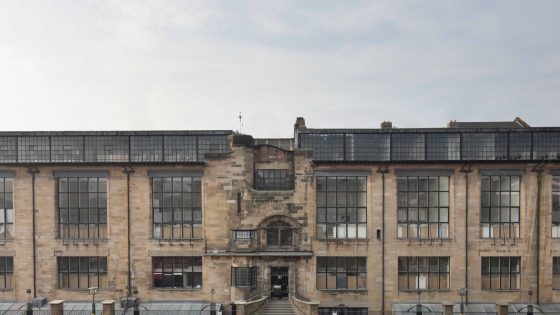
The 1909 landmark, designed by Charles Rennie Mackintosh, has been a burnt-out shell since a major fire in 2018. Following the 2024 appointment of Reiach and Hall with Purcell to oversee the architectural way forward for restoration, the strategic outline business case (SOBC) was due to be published early last year.
However, this has proved more complicated than the school anticipated and is still being drawn up.
According to a GSA spokesperson, the business case depends on the outcome of an arbitration hearing with the A-listed school’s insurers, which will rule over who will fund the multimillion-pound rebuild. The AJ understands the hearing is due next month.
Two years ago the school initiated arbitration proceedings over its claim with the building’s insurer. The outcome of this arbitration will spell out the amount of funding the school is likely to receive and, therefore, the form of the restoration.
The GSA spokesperson commented: ‘As we have previously stated, the arbitration process is confidential and once any hearing is held and a decision issued, it will provide GSA with certainty on the level of the insurance claim and inform decisions on the next stages of the project.
‘The work by Reiach and Hall with Purcell is extensive and comprehensive, identifying a number of potential routes to faithful reinstatement which are being rigorously assessed and costed. These two aspects need to be concluded before the economic impact study can analyse core options and the overall SOBC Addendum concluded.
‘[We] continue to maintain the structure, ensuring continued stabilisation, conservation and advance works as appropriate.’
In 2023, the AJ revealed that the school had been forced to scrap a procurement process for a £62 million restoration of the building after a bungled awarding of the job. Practices in contention for the major design job included Hawkins\Brown and John McAslan + Partners.
Instead of restarting the process, the school brought in Reiach and Hall and Purcell to look again at the strategic business case and to ‘identify the appropriate route to delivery of the faithful reinstatement’ of the much-loved landmark.
The two practices are understood to have gone back to an earlier brief, working to update the 2021 strategic outline business case for restoring the building.
At the time the GSA said the architects, working alongside cost and economic consultants, would be ‘robustly testing the GSA’s previous assumptions, costs and economic impact, timelines and approaches to delivery of this significant project’.
Following the conclusion of the SOBC work – now expected later this year – a new procurement process for detailed design work and delivery is expected to be launched.
However, any future restoration will likely be delivered in phases – and not by the original 2030 deadline for completion. The £62 million price tag is also expected to rise.
At the time of the 2018 fire, the building was nearing the end of a £35 million restoration following a previous fire in 2014.
Last month, the GSA spelt out its opposition to a 365-student bed scheme on its doorstep, designed by HAUS Collective for developer Vita Group, at a hearing last month.
Glasgow City Council approved the scheme, on the site of a former ABC cinema, last June, but it has since been called in by the Scottish government.

The Mackintosh building will remain under wraps for two years before restoration work begins. Photo: Alan McAteer for GSA
Representatives for the GSA told the independently appointed reporter that the student accommodation scheme would adversely impact the Mackintosh Building – a view backed by Historic Environment Scotland (HES).
The GSA’s submission to the hearing revealed that it remained committed to a faithful reinstatement of the Mackintosh Building and ‘making positive steps to bring it back as part of a functioning world-class art school’.
When the scheme was approved by Glasgow City Council, the GSA told the AJ that it would ‘fundamentally compromise the Mackintosh Building’s heritage significance as a purpose-designed art school and with it, the building’s future use’.
A spokesperson for the Scottish government told the AJ: ‘Following careful consideration, ministers called in the planning application for their own determination. An independent reporter has been appointed to examine the proposal and submit a report and recommendation to ministers, who will then make the final decision on this planning application.
‘As this is a live application, it would not be appropriate to comment further.’
In documents submitted to the hearing on behalf of Vita, the developer said ‘the proposal represents a development approach that considers the setting of the GSA within its urban context. Its design addresses planning policy requirements relating to heritage, urban design, and town centre uses, while seeking to mitigate risks associated with alternative approaches’.
Comment: Paul Sweeney, Labour MSP for Glasgow
Everyone in Glasgow and everyone who cares about the Glasgow School of Art’s future is incredibly frustrated at the interminable delays and strategy for restoration since the devastating second fire of 2018.
The lack of obvious leadership at any level really has been dismaying, and devastating to watch play out [though] I recognise the art school has limited resources and is severely constrained by the ongoing arbitration over the insurance for the building.
It comes back to the fact that government – at UK, Scottish, and indeed city level – has utterly failed to adopt a strategic posture in relation to what is arguably Scotland’s finest architectural achievement.
They really should be ashamed of their continued indifference and disdain for the future of this building.
It is time for the government to put its arms around the Glasgow School of Art and make this a national priority. The slumping shoulders routine has been depressing to watch [especially] in contrast to [the restoration of] Notre Dame in Paris, or even if you look at the Sagrada Familia.
The ongoing arbitration case will play out, but ultimately, the national mission is to restore the Glasgow School of Art.
I don’t understand why the government can’t step in, deal with the arbitration in a way which takes it off the critical path and doesn’t make it a blocker to progress.
There are plenty of things that can be done. Meanwhile, you could start outfitting the rooms, starting to commission the interiors, you can do off-site works and stone preparation. A lot of activity can happen while waiting for the building to dry out under the tent structure.
I don’t understand why we can’t finance and progress these activities in advance. It feels like we are in a state of paralysis, which is completely unnecessary and depressing.
Of course, the broader context has been the appalling attitude of the neighbours, the ABC owners, who are happy to just demolish the listed building that sits on that site and flip it for completely inappropriate accommodation. At every level, it’s just been a really depressing episode.
With the ABC case, it’s a symbol of a wider collapse of cultural leadership in Scotland, particularly when we just look at the heritage crisis looming, not just in Glasgow, but across Scotland.
We’ve got a huge amount of public buildings facing serious risk.
The increasing number of heritage buildings at risk is quite concerning. So we need to have a bit of a sanity check about what we’re doing with our heritage plan in Scotland.
Where is leadership coming from? It’s certainly not coming from ministers, which, to me as a parliamentarian, is deeply frustrating.