
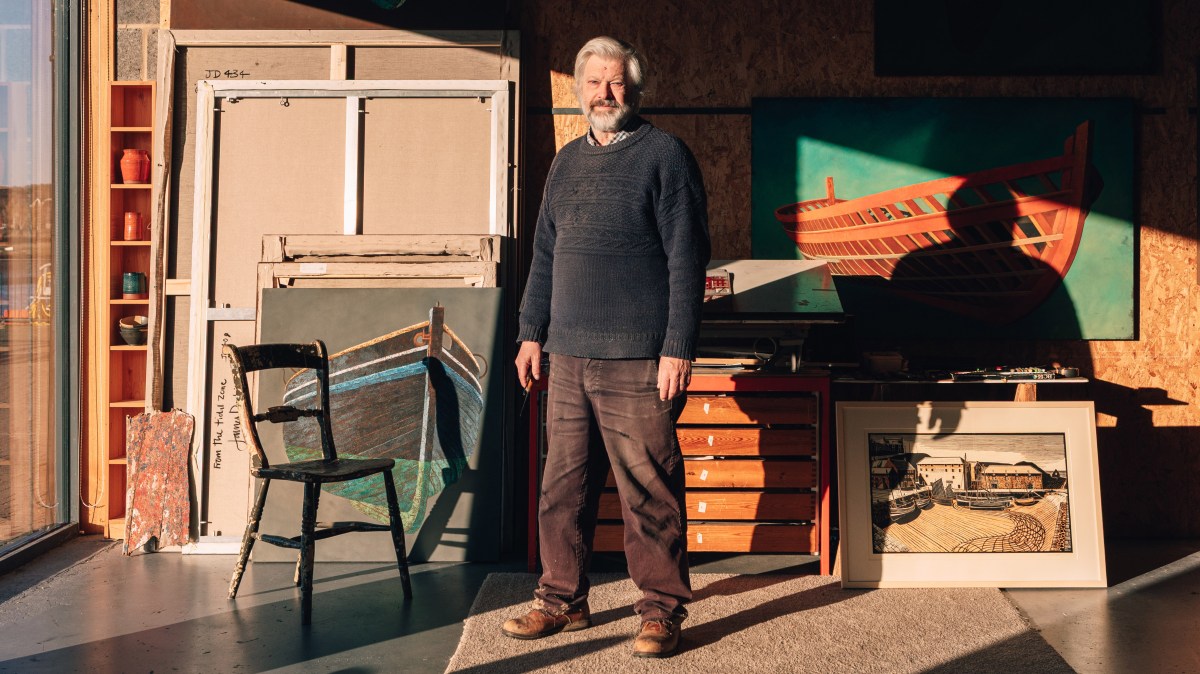
Shipwright-turned-artist James Dodds has dedicated much of his life looking at working boats the way a portraitist studies faces. Dubbed “the boatbuilding’s artist laureate”, his works showcasing clinkers, luggers, winkle brigs, Essex smacks, Viking skiffs and Norfolk crabbers are held in collections at the National Maritime Museum and V&A Museum.
“The shape of traditional boats that have evolved over centuries around our coast have long been the subject of my paintings,” explains Dodds, one of Britain’s foremost maritime artists, whose latest exhibition, Love is a Boat, opened at David Messum Fine Art in London this week and will run until February 27.
Born in 1957, Dodds grew up overlooking the Essex marshes in Brightlingsea, when the port town at the mouth of the River Colne had a railway, two thriving shipyards and a fishing fleet. Its liminal meeting of mud, water and sky has captured his imagination ever since. By 14, Dodds was crewing on a charter boat. At 15, he was apprenticed in a Maldon shipyard, training as a boatbuilder and learning the kind of hand-tool skillset he now describes as “little changed since the building of the Ark”.
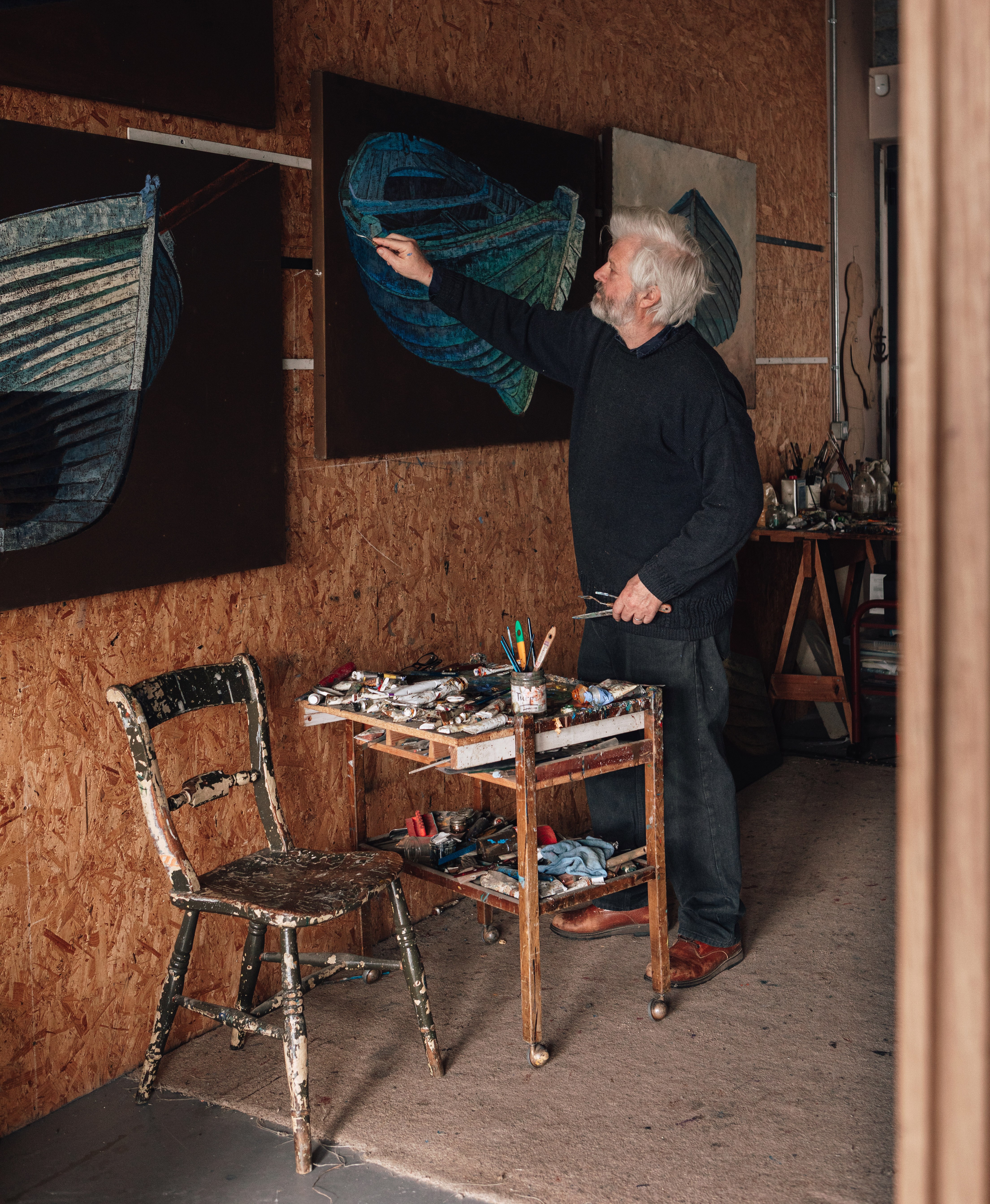
Dodds has artworks in collections at the National Maritime Museum and V&A Museum
MICHAEL BRANTHWAITE
Life at home was also shaped by craft for Dodds, a longtime tinkerer and serial renovator. He lived during the 1970s with his father Andrew Dodds, a prolific Radio Times illustrator, as a National Trust tenant at Bourne Mill, a late 16th-century fishing lodge and mill. Together they painstakingly rebuilt the 18ft-diameter water wheel and coaxed the surviving machinery back to life. “Millwrighting work was not that different from that of a traditional shipwright,” says Dodds modestly.

Bourne Mill near Colchester, Essex
ALAMY
Succumbing to his artistic inclination, at 19 Dodds enrolled at Colchester School of Art, then went on to the Royal College of Art. In 1980 he bought a tumbledown two-up, two-down Suffolk cottage beside a cherry orchard with his ex-wife. It has roof rafters made from old ladders and Suffolk white bricks laid directly on earth; perhaps unsurprisingly, it failed to reach its reserve at auction. Dodds offered just over £17,500 and bought it, relaying the floor, rebuilding much of the structure and putting in a garden studio. Dodds founded Jardine Press there four years later, printing early books with type borrowed from Gainsborough House’s print workshop in Sudbury, initially to support his linocuts, paintings and writings on boats.
After his first marriage ended, Dodds was ready to build again — this time in Wivenhoe, an Essex town whose creative zeitgeist was catalysed by an artist couple, Richard Chopping and Denis Wirth-Miller (known as Dickie and Denis), who drew a lively circle including Francis Bacon and Ian Fleming. Chopping illustrated covers for Fleming’s James Bond series; Wirth-Miller had a landscape in the Royal Collection. “There was a vibrant arts club here in the 1960s,” Dodds says. “Moving from a Suffolk cottage felt like coming home, being near the sea again, surrounded by other artists.”

Dodds bought land in Wivenhoe, which is on the left bank of the River Colne, in 1992
GETTY IMAGES
In 1992 he bought land beside a derelict shipyard in Wivenhoe conservation area for £18,500, where “the tide used to come up and down the drains in the dirt road”. This became Barnacle House Studio, a living-working space housing an art studio and Jardine printing machines. It took three months and £18,000 to build with help of friends (contracting out brickwork, plastering and roofing). The sail loft-inspired design is by Dodds’ stepfather Bryan Thomas, the architect behind Beth Chatto’s house.
He then met his second wife, Catherine, a ceramicist. Two children (Douglas and Mary) later, they extended the studio and converted the ground floor into bedrooms. Still cramped, they sold Catherine’s terrace, remortgaged the studio and bought a Victorian house in Brightlingsea in 1997 for £62,000. Another substantial renovation ensued; a conversion from health authority building to domestic hub. They sold up to buy the house next door to Barnacle House Studio (£410,000) which has been their home since 2005.
James Dodds: from shipbuilder to painter
It’s a lived-in patchwork of salvaged and inherited furniture, art and sculpture, with books by the wallful — maritime history, art, poetry and plays — and paintings by friends, alongside works from his father’s generation (Peter Coker, Henry Collins, Richard Bawden). A cello hangs from the ceiling, made into a light by their son after an ill-fated stint training as a violin maker. Catherine’s fish-shaped cups sit ready for tea; hand-carved birds and fish by their “dear friend” Guy Taplin line the walls.

Dodds with his wife, Catherine, in their Brightlingsea home
MICHAEL BRANTHWAITE
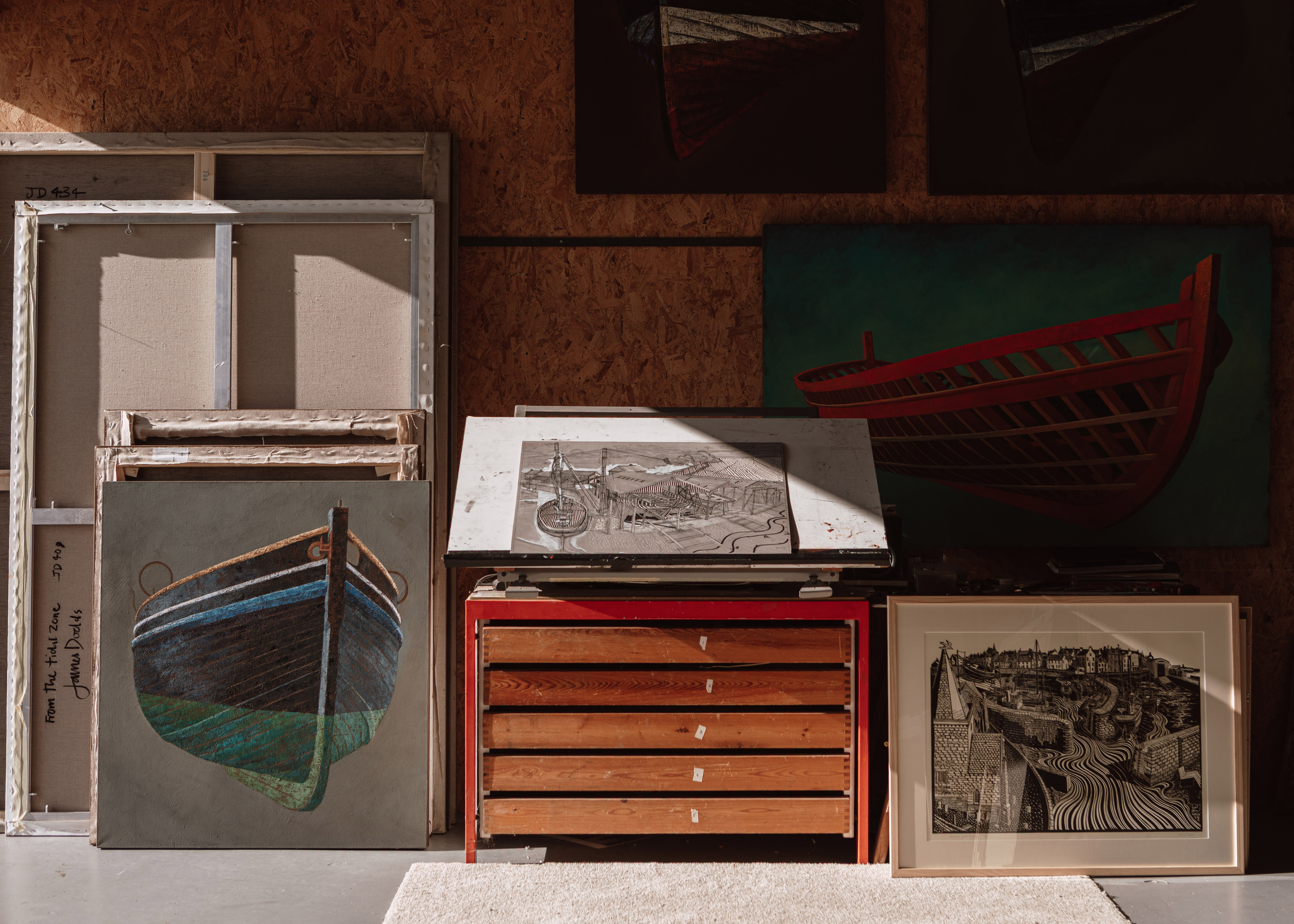
The historian Ken Worpole says that Dodds’ works depict “single boats as quasi-religious icons”
They lost their river views after the old shipyard was redeveloped, but Dodds has found a way back to the water. Part of the development included commercial units alongside the Colne; in 2014 he bought the lease for one (£100,000) to fit out as a new painting studio. On a spring tide, the water comes within 20ft of the door: “Every time you look out the window it’s another view.”

Dodds at Barnacle House, where he makes linocuts and prints
It’s here where Love is a Boat was conceived. Born partly from lockdown necessity — “not being able to get out and see boatyards” — the exhibition draws from Scottish, French, Norse and Mediterranean traditions, including boats Dodds followed through photographs and conversations with boat-builders and museums abroad. The historian Ken Worpole says that these works depict “single boats as quasi-religious icons, detached from their watery context,” while the writer Belinda Bamber likens their ribs to “the rhythm of ceiling vaults in a medieval church nave, another place of sanctuary.”
Dodds’s take is simpler: “Painting boats is my haven. They not only represent community but also a faith to build and paint them, my salvation, a refuge. Literally, my lifeboat. My hope is that these paintings will give the viewer the same sense of calm and peace.”
Love is a Boat runs until February 27 at David Messum Fine Art, London, messums.com