
Sign up for the Slatest to get the most insightful analysis, criticism, and advice out there, delivered to your inbox daily.
In 2023, Allison Hamilton noticed a lump in her breast.
The discovery, combined with her fibrocystic breasts—a common, noncancerous condition that can cause lumps and cysts—meant that she needed a more comprehensive diagnostic exam to investigate the symptoms. But her insurance covered just a basic screening mammogram, so she paid thousands of dollars out of pocket for the in-depth imaging, which includes an ultrasound.
During the exam, the radiologist noted that Hamilton, who is 49, had “dense breast tissue” but did not explain further—only that she should always get extra screening exams. The results came back all clear.
“It’s like, ‘No big deal,’ right?” said Hamilton. “I thought it was OK.”
Then, in early 2025, she noticed another lump. This one felt painful. Still unsuccessful in trying to get her insurance to cover the cost, Hamilton paid more than $1,400 out of pocket for a diagnostic mammogram and ultrasound. That led to a biopsy, which in April revealed that Hamilton had Stage 2 triple-positive invasive lobular carcinoma.
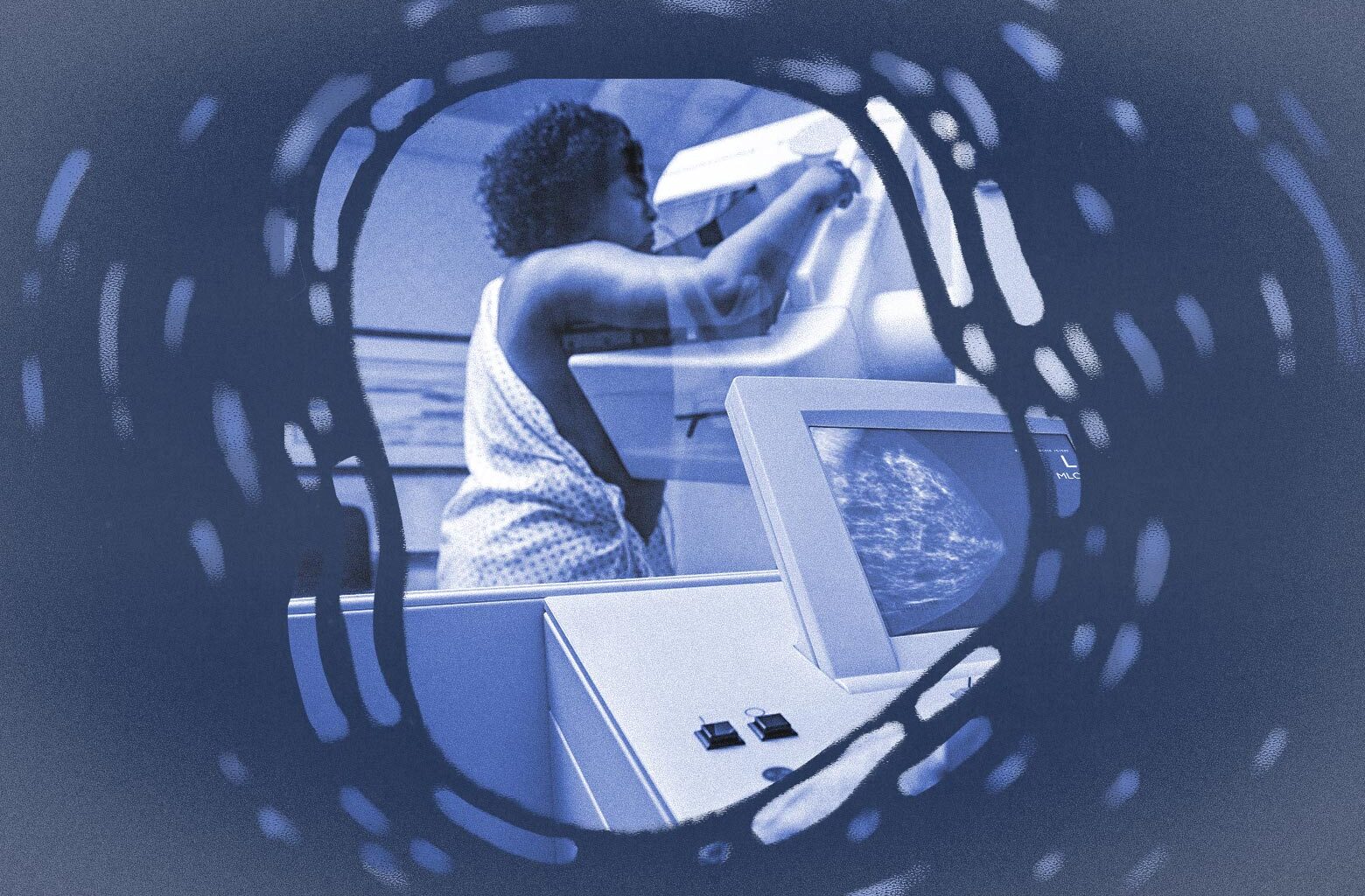
Dense breast tissue like Hamilton’s is a common condition shared by about 40 percent of women who get mammograms, according to the American Cancer Society. The characterization of dense breasts refers to how much fat, glandular tissue, and fibrous tissue are in the mix. (The condition occurs regardless of cup size.) The more glands and fibrous tissue a person has, the denser their breasts. And everyone has their own unique blend.
Women with dense breast tissue have increased risk of developing cancer. The tissue can also hide cancer, which shows up on a mammogram as white; unfortunately, so do cancerous tumors. Experts and activists liken it to searching for a snowball in a blizzard.
“If I had just gone in for the screening mammogram and not been more in touch with my body about, like, Oh, this one feels a little weird, I would have probably had a clean mammogram and come back in one year,” said Hamilton, a Los Angeles–based mother of two. By that point, how much further would the cancer have advanced?
Many patients learn about their dense breast tissue during their annual screening mammogram exam or in the form letter they receive afterward. There is little guidance on what to do next, especially if the results are “normal.” Trying to make sense of what to do if you have dense breast tissue can feel like putting together a puzzle without looking at the picture on the box.
“There’s a lack of guidance to patients about supplemental screenings,” said JoAnn Pushkin, the executive director of DenseBreast-info, Inc., an educational and advocacy organization. “Nobody’s calling to say, ‘Gee, you want to come in for an MRI?’ ”
Many members of the dense-breast club may not know that a mammogram is just the first step in cancer screening. “It should not be the last [step] if the goal is to find cancer early,” added Pushkin. “And that is the goal.”
If caught early, breast cancer is treatable with up to a 99 percent five-year survival rate, according to the American Cancer Society. For those with dense breasts, however, it can take extra exams to see through the snowstorm.
Supplementary screening exams like breast ultrasounds, 3D imaging, biopsies, and MRIs are available, but one of the challenges is knowing whether you meet the criteria, said Wendie Berg, a radiology professor at the University of Pittsburgh School of Medicine and chief scientific adviser to densebreast-info.org.
Currently, the Food and Drug Administration requires only breast centers to inform patients, via a follow-up letter, if they have dense or non-dense breasts—a binary. For those with dense breasts, it’s important to know that there are two levels of density: heterogeneously dense and extremely dense. This is important information because the chance of missing cancer on a mammogram rises with the level of density. (About 40 percent of cancers in extremely dense breasts are missed on mammograms, said Berg.) But typically only the letter sent to the health care provider specifies a patient’s breast-density level.
It used to be that women weren’t even informed about their dense breast tissue and its associated risks of hiding and developing cancer. Per a new FDA guideline that took effect last year, breast centers are now required to notify patients about their breast density—though not what to do about it beyond tepid advice to talk to their health care provider.
“How can so many women have this major risk factor and not even know?” said Lauren Raineau. “That seems criminal.” Forty-year-old Raineau has heterogeneously dense breast tissue, something she learned only after being diagnosed with Stage 2 HER2-positive hormone-negative breast cancer in 2024. The screening mammogram is still the front line in detecting breast cancer. Get one, but follow it up with a real conversation with your provider about whether a mammogram is enough, said Pushkin.
If you have extremely dense breasts, you should consider getting more screening, said Berg. If you have heterogeneously dense breast tissue and other risk factors, such as a mother or sister who had breast cancer, you should seek further screening, she advised. Of course, additional tests could lead to even more tests, which can be stressful and costly.

Jane C. Hu
It Could Be the Next Blockbuster Drug. There’s Just One Part No One Wants to Talk About.
Read More
For women who qualify for supplemental breast screening, MRI has proved to be the better tool in detecting cancer, according to a clinical trial study. “The bottom line is, if you qualify for an MRI, you should get it,” said Berg.
The question then becomes: Can you get one? At the University of Pittsburgh Medical Center, where Berg practices, there is a six-month wait for a screening MRI. And many insurance companies—like Hamilton’s—still refuse to cover supplemental screening, leaving patients to pay for pricey preventive-care tests not once but year after year.
People Are Doing Something Strange and Illegal With the Epstein Files
It’s the Gold Standard of Early Cancer Detection. For 40 Percent of Women, It Doesn’t Work.
Thirty-six states and the District of Columbia require insurers to cover secondary screenings, but federal plans like Medicare and Medicaid don’t have to comply. Neither do large national insurers like UnitedHealthcare or Aetna. Lawmakers have tried and failed to fix the insurance gap, twice. The Find It Early Act would require every insurer, including Medicare and federal plans, to cover supplemental and diagnostic breast imaging with no copays. The Access to Breast Cancer Diagnosis Act has been introduced but omits Medicare and federal plans entirely. Both bills are expected to be reintroduced. How many more women with dense breasts will have their breast cancer diagnosis delayed while politicians deliberate?
After my first mammogram, I received the form letter informing me that I was a member of the dense-breast-tissue club. Because my routine screening hadn’t detected any abnormalities, I didn’t give it a second thought. Then, while hanging out with a roomful of women, the subject of breasts came up. Every single person in that room revealed that they had dense breasts, which we thought could be remedied somehow through self-massage. We all started massaging our own breasts.
In the course of reporting this story, I learned that self-massage doesn’t help. But until the information gap—and the insurance gap—is fixed, this, unfortunately, is where we’re at.

Sign up for Slate’s evening newsletter.