
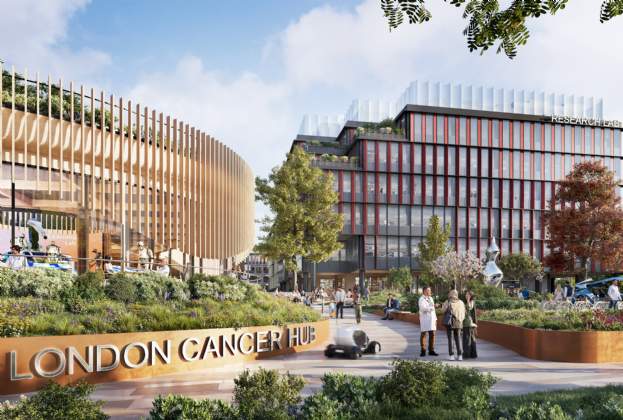
The approved scheme will deliver around 1 million sq ft of state-of-the-art laboratory and research space, unlocking the next phase of growth at the London Cancer Hub and strengthening the UK’s science and innovation infrastructure.
Planning approval was granted on World Cancer Day (4 February), underlining the urgency of advancing cancer research and treatment. The development will play a vital role in helping the UK tackle future health challenges by providing critical science infrastructure that supports innovation, attracts investment, and accelerates life-saving discoveries.
The approved plans will deliver new laboratory and research space across 12 acres, strengthening the London Cancer Hub’s wider innovation facilities and supporting collaboration between researchers, clinicians, start-ups, scale-ups and global life sciences companies to drive scientific breakthroughs and support emerging businesses.
It is expected to create 3,000 new jobs, the majority in high-skilled R&D and life sciences-related manufacturing. The expansion forms part of the wider London Cancer Hub district and, once the full district is realised, is expected to support around 13,000 jobs in total and contribute an estimated £1.2 billion in Gross Value Added (GVA) to the UK economy, according to analysis by the London Borough of Sutton.[1]
The wider London Cancer Hub district is already home to internationally renowned institutions including The Institute of Cancer Research and The Royal Marsden NHS Foundation Trust, alongside the Innovation Gateway, which supports early-stage life sciences companies. Together, these assets form a globally recognised cluster for cancer research, treatment and commercialisation, helping translate scientific discovery into clinical impact.
Designed to the highest environmental standards, the new buildings will target net-zero carbon in operation and deliver the amenities and public realm expected of a world-leading employment district, including affordable homes for key workers, enabling scientists, clinicians, nurses, teachers and academics to live close to where they provide vital services; and new public spaces designed to support wellbeing, collaboration and community.
The London Cancer Hub is recognised as nationally significant science infrastructure, aligned with government ambitions to position the UK as a global leader in life sciences and health innovation. Recognised in the Mayor of London’s Growth Plan as a key engine for frontier innovation, the project will deliver significant economic benefits, creating high-skilled jobs and drawing international investment into the UK’s life sciences sector. The project, designed by Gensler, won the New London Architecture Award 2025 for Healthcare and Life Sciences, recognised for its transformative mixed-use masterplan creating a vibrant, science-led district in Sutton, blending world-class research, labs and community spaces.
Samruti Patel, planning director at Savills, says: “Securing this planning permission marks a major milestone in delivering 1 million sq ft of state of the art laboratories, research facilities, amenities and affordable key worker housing to support the expansion of one of the world’s leading cancer research districts. This achievement follows extensive partnership working with the Institute of Cancer Research, the Royal Marsden Hospital, key stakeholders, the local community, and close collaboration with officers at the London Borough of Sutton and the GLA.
“The London Cancer Hub will generate substantial benefits for the UK life sciences sector – strengthening the nation’s cancer research capability, accelerating commercial innovation, and attracting global talent and investment. It is uniquely positioned to advance the ambitions set out in the government’s National Cancer Plan, published on World Cancer Day, and to support the London Growth Plan by fostering partnerships, driving economic opportunity and enabling high value industries to thrive.
“With exemplary architecture and high quality landscaped public spaces, the scheme will create an environment that nurtures innovation, collaboration and wellbeing – delivering long term benefits for patients, partners and scientific communities across the world.”