
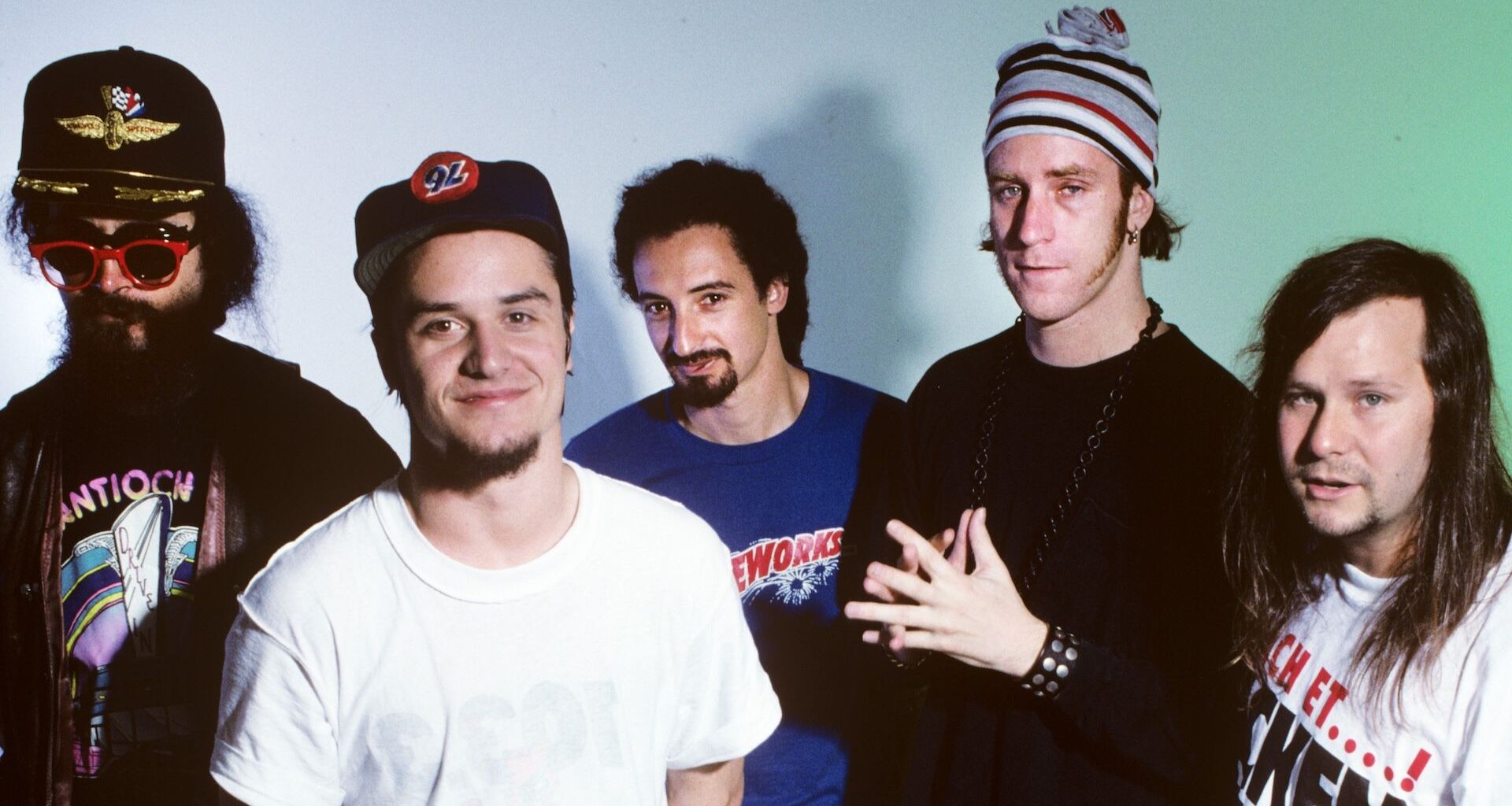
Although it was misunderstood and maligned at the time, the legacy of Faith No More’s legendary fourth album Angel Dust has grown substantially since its release in 1992.
A unique and genre-mashing classic, their fourth studio album is of the all-time great “Fuck you!” responses to mainstream success. And, in true FNM style, their fans’ first taste of Angel Dust was Midlife Crisis: an uncompromising, funk metal single which sampled Beastie Boys and Simon and Garfunkel, its lyrics were inspired by the “desperate” behaviour of a pop megastar and yet still managed to break into the UK Top 10 singles chart.
Faith No More – Midlife Crisis (Official Music Video) [4K] – YouTube
![Faith No More - Midlife Crisis (Official Music Video) [4K] - YouTube](https://www.newsbeep.com/uk/wp-content/uploads/2026/02/1770320290_272_maxresdefault.jpg)
Faith No More were one of the hottest bands on the planet following the release of their third album The Real Thing in 1989. The record had taken on a life of its own after lead single Epic became a huge mainstream breakthrough, and by 1991, the band had been nominated for both Best Hard Rock and Best Metal Performance at the Grammys, Best International Group at the BRITs and multiple MTV Video Music Awards, they’d also been certified Platinum in the US, with sales of the album passing the one million mark.
The smart money would have been on FNM following up The Real Thing with another set of catchy, goofy, funk rock tunes, but instead the band decided to do the opposite.
You may like
“When we did The Real Thing we had a tiny budget, we were broke, and on top of that nobody really gave a shit about us,” bassist Billy Gould told Hot Metal Magazine in 1992. “Nobody knew what kind of music we played and nobody could classify us. We were at a real disadvantage in those days, but now we’re at a real advantage.”
This newfound “advantage” meant that Faith No More were able to really indulge their wildest and most unusual creative urges on the follow-up to The Real Thing. The result of this freedom was Angel Dust.
“It would have been real easy for us on this last album to do something that would have been completely compatible with typical FM standards,” keyboardist Roddy Bottum told Public News in early 1993. “But we’ve always tried to shy away from doing anything like that. It’s not just sticking to one format or jumping from one to another or even trying to please anyone. We try to please ourselves first and foremost.”
“When we did The Real Thing, we had a tiny budget, we were broke, and on top of that nobody really gave a shit about us…”
Billy Gould
One reason for the album’s unique slant was in no small part to the influence of vocalist Mike Patton. He’d replaced former frontman Chuck Mosley late into the creation of The Real Thing, so Angel Dust was the first FNM album where he was able to stamp his identity fully on the band.
“That was strictly Patton,” Bottum continued, describing the more idiosyncratic moments on Angel Dust. “He brings to the band his own influences, the kind of stuff he’s into. He does listen to some strange music, like polka.”
By the time Angel Dust hit the shops, Patton had established himself as something of an HR nightmare. He told British journalist and radio DJ Mary Anne Hobbs that he believed a video of someone eating shit was “much cooler” than watching people kissing, while The Face was treated to an anecdote about the time he “pooped on a bench” outside of The White House. Then there was the infamous hairdryer incident, as recounted to the NME.
“When I was staying in a hotel room once,” Patton began. “I took a shit, rolled it into a ball and put it in the hair dryer so that the next guest to dry their hair would get hot shit in their face. Ain’t that rock n’ roll?”
You may like
So, although there was certainly a desire from Faith No More to mess with their formula on the new album, it’s arguable that Patton was the driving force that made Angel Dust so wantonly unusual.
“I think we’ve stretched what we are to an absurd level this time, which is great,” he told Reflex Magazine in 1992. “I think we would all be really happy if people took this record home and went, ‘What the hell is this?!’ I think that’s gonna happen – and I think that’s a good thing.”
Faith No More – ‘Midlife Crisis’ [HD] | Live at Pinkpop 1995 – YouTube
![Faith No More - 'Midlife Crisis' [HD] | Live at Pinkpop 1995 - YouTube](https://www.newsbeep.com/uk/wp-content/uploads/2026/02/1770320290_482_maxresdefault.jpg)
The band’s record label Slash, a subsidiary of Warner, didn’t quite share Patton’s opinion. They argued with Faith No More about the album’s name, which Bottum came up with. They argued about the artwork depicting a great egret on the front and meat locker on the back. They argued about the sound of the album itself, but the band refused to budge on all three points.
“We got a little flak when our record company first heard it,” Bottum explained to BAM Magazine. “Initially, they were a little shocked.”
Obviously, when it came to picking the first single from Angel Dust, their straight cover of The Commodores’ ballad Easy was sitting right there as an obvious choice… but Faith no More insisted on something else.
Midlife Crisis had been giving the working title Madonna and had been inspired by Patton’s feelings towards the pop superstar at that time.
“The song is based on a lot of observation and a lot of speculation,” he told Faith No More’s website. “But, in sort of a pointed way, it’s kind of about Madonna… I think it was a particular time where I was being bombarded with her image on TV and in magazines and her whole shtick kind of speaks to me in that way… like she’s going through some sort of problem. It seems she’s getting a bit desperate.”
The song itself was one of many from Angel Dust to feature what the band described as a “gratuitous” number of samples. The song’s drum track was looped from Simon and Garfunkel’s 1970 folk rock hit Cecilia and the bridge featured a sample from the song Car Thief by the Beastie Boys. A track, ironically, taken from the hip hop trio’s sample-stuffed 1989 masterpiece Paul’s Boutique.
All of this was mixed up with Gould’s wonderful throbbing, bobbing bass line, Bottum’s icy, creeping synths, a gritty riff from guitarist Jim Martin and, to top it all off, Patton’s twitching, grunting, hollering, spittle-flecked vocals. Midlife Crisis was weird and unlike anything else happening in rock at the time. But somehow, it remained incredibly catchy.
“The song is based on a lot of observation and a lot of speculation. But, in sort of a pointed way, it’s kind of about Madonna…”
Mike Patton
When it was released as a single on May 25 1992, as the first new post-The Real Thing material, it performed well. The song reached number 10 on the UK Top 40 Singles Chart and topped the Billboard Alternative Airplay Chart in the US.
When Angel Dust arrived a fortnight later, again, it initially did well, but was ultimately too odd an album to see the band continue their upward commercial trajectory.
It was only towards the end of the 90’s, with nu metal in its pomp, that Midlife Crisis was reevaluated alongside the rest of Angel Dust as the enduring masterpiece that it is considered today.
Covered by the likes of Disturbed (on two separate occasions) and former Korn drummer David Silveria’s new band Breaking in a Sequence, name-checked as an inspiration by everyone from Corey Tayor to Papa Roach to Deftones to Ghost, its legacy as one of the 90’s most influential songs is set in stone and proof that a staunch refusal to bend your artistic vision to fit the zeitgeist can pay off.