
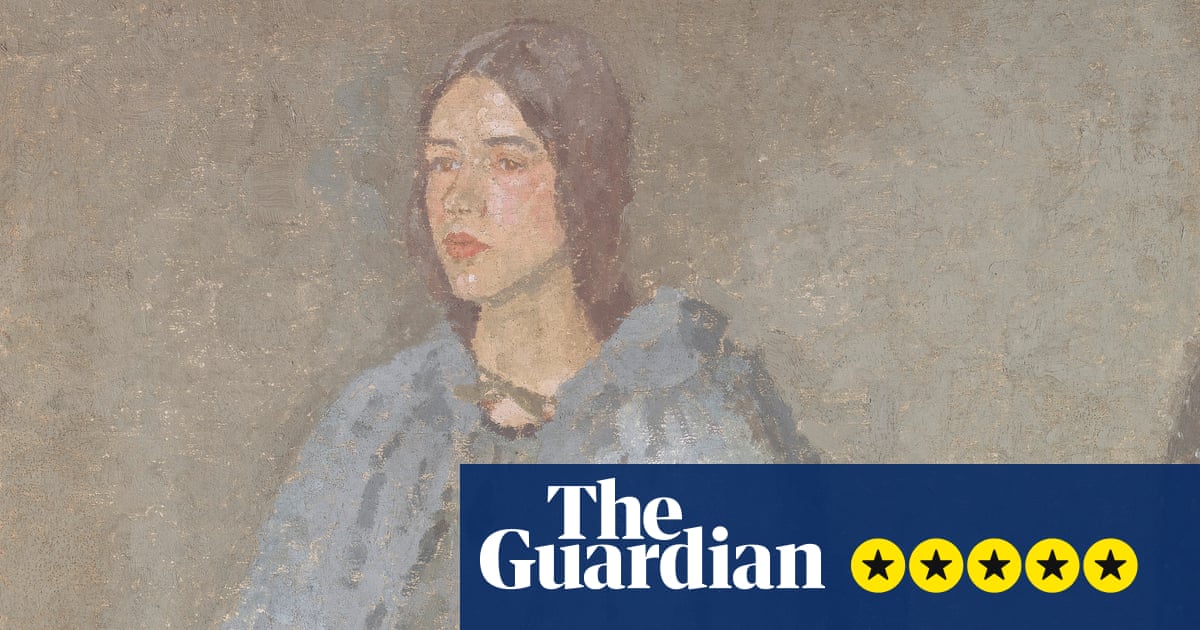
This is Gwen John straight, no chaser. Cardiff’s National Museum has put together a superb, daunting retrospective of the woman who is now, perhaps, the most famous Welsh artist. It is not a blow-by-blow biographical story of how she was born in Haverfordwest in 1876, how she and her brother Augustus both loved art as children, how she insisted on going to the Slade School of Fine Art like him then made her life in bohemian France. Instead, the moment you enter the show, you are plunged into her spiritual, austere existence. We meet her in the glory of her solitude, painting cats and the sparse rooms she rented in Paris and women alone in moments of calm thought.
There is a row of variants of a young woman in a blue dress with long dark hair sitting weakly in an armchair, a table at her elbow, all painted in about 1920. In most there’s a cup and teapot on the table, in one it’s a bowl of soup. She looks down as she reads a letter, occasionally a book. Their titles vary too – The Letter, The Seated Woman, The Convalescent.
Their brilliance lies in what they don’t show. There are no hats covered with fruit, no chatting crowds, no omnibus, none of the anecdotal details other British artists of her generation tended to get distracted by. John cuts out the social flab and paints the essence of inner experience, the woman’s sorrow, illness, despair, recovery as she sips and reads.
Battered by life … Portrait of Mrs Atkinson, 1898. Photograph: Alamy
It took enormous intelligence and decisiveness to paint so purely. Her earliest works are hardly more crowded than her maturest ones. Mrs Atkinson, painted in about 1898, sits in Victorian black, her elderly face battered by life, her eyes unsmiling, the precise details of hearth and wallpaper behind her underlining the bleak truth. Portraits of John’s friend Dorelia on their first trip together to France are already pared down, purified, mystical. John has begun her great renunciation. She will only paint what is essential.
Not that she’s an artist without passion or desire. She was more than a little in love with Dorelia, whom she portrays in a warm golden lamp glow at night in Toulouse. When John stayed on in Paris, getting work as a nude artist’s model including in the studio of Auguste Rodin, she started an affair with the already world-famous pioneer of modern sculpture. Her study of Rodin’s leonine face is here. So is Rodin’s portrait of her, a bronze head craggily textured by inner turmoil. He didn’t just look at her body after all.
The glory of solitude … Seated Tortoiseshell Cat. Photograph: Robin Maggs/By permission of Amgueddfa Cymru – Museum Wales
For an artist interested in stripping reality to basics, it made sense to dispense with clothes. She may have been a child of Victorian Wales but she saw nudity as natural. The two versions of her Self-Portrait, Nude, Sketching, from about 1908-9, use brownish paper and in one case white gouache like Rodin’s drawings, but here the nude is the artist. John is cool and unabashed as she stands naked with sketchbook in hand, studying herself in a mirror.
She has the same drive to escape the repressive, claustrophobic dishonesty of the world she was born into that drove male modernists of her time – Rodin but also Matisse, Klimt, Schiele. Clothes symbolise social trappings, hierarchies, lies that define and oppress. Better to be free and truthful, if a little chilly in an unheated Paris room. Yet in her search for a simplicity beyond social fuss, John was also attracted to the opposite, represented in a stunning row of portraits of nuns, their faces framed by white triangular headdresses.
The only smile in the show … Mère Poussepin Seated at a Table, 1913-1920. Photograph: By permission of Amgueddfa Cymru – Museum Wales
These nuns were members of a Catholic religious community at Meudon, in the Paris suburbs, where John moved in 1911. She converted to Catholicism and was keen to serve the church artistically. Her nuns are paradoxically individualist: each woman comes across as characterful and unique inside her religious uniform. One, based on a print of the community’s 17th-century founder Mother Marie Poussepin, even smiles – the only smile in the show.
John’s mysticism doesn’t stop at nuns. The blue her young women wear so often is, in Christian art, the colour of purity and heaven. In The Pilgrim, a woman sits meditatively in a huge blue cape as if ready to set out on a sacred quest that will be hard, lonely, necessary.
In 1935 she wrote from Meudon to a curator at this museum after it bought its first work by her. “I am very happy and honoured that you have bought one of my little paintings for the museum,” she says in a note that is framed here. And they truly are “little”. This is an exhibition of small pictures in pale colours, so subtle they are almost spectral, a misty gathering of silent women in small rooms and long-dead cats. But in its emotional power, the art of Gwen John is enormous, heavy, even crushing. Wales does full justice to its great modern artist.
Gwen John: Strange Beauties is at National Museum, Cardiff, from 7 February to 28 June