
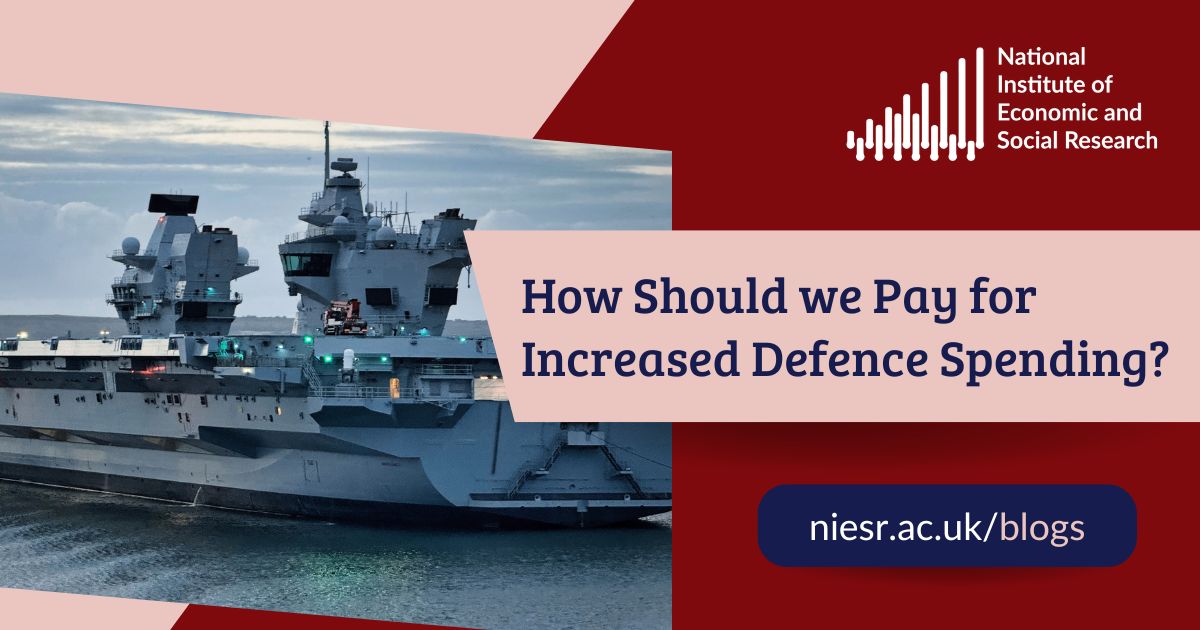
The UK needs a sustained increase in defence spending. Geopolitical tensions have intensified, and the demand for military capability and readiness has risen accordingly. These pressures are unlikely to prove temporary.
Last year, the UK spent around 2.3 per cent of its GDP on defence, around £66 billion. The government has committed to raising defence spending to 2.5 per cent of GDP by 2027, with an ambition to reach 3.5 per cent by 2035. That implies an increase of around £6–7 billion per year in the near term, rising to more than £30 billion per year by the mid-2030s in today’s money.
The OBR’s latest forecasts incorporate a path to roughly 2.6 per cent of GDP, consistent with the government’s near-term commitment. But meeting the 3.5 per cent ambition is not currently accounted for in the OBR’s fiscal rules assessment. Meanwhile, the FT reported this week a funding gap of £28 billion over the coming years to implement the recommendations of the Strategic Defence Review – a bottom-up review of capability needs commissioned by the incoming Labour government.
This creates an obvious macro-fiscal challenge. The UK has high public debt, limited fiscal headroom under its own rules, and a gilt market that remains highly sensitive to fiscal sustainability news.
In this blog, we examine what economics and public finance theory suggests about financing a defence build-up of this type, what there is to learn from historical experience, and what this implies for UK policy over the coming decade.
Efficiency and Equity Considerations
The basic public-finance question underlying this issue is: how should the state fund an increase in the provision of a public good? We can approach this from both efficiency (i.e., how do we maximise the size of the pie) and equity (i.e., who should bear the burden) angles.
Efficiency
The classic framework for analysing debt versus tax finance is Robert Barro’s “tax smoothing” argument (Barro, 1979). Because taxes are distortionary – they induce behavioural responses such as substitution away from taxed activities – it is inefficient to vary tax rates from year to year. Instead, the government should set fiscal policy such that expected tax rates tomorrow equal those today, moving tax rates only when the economy is hit by an unexpected shock.
So, when the government faces a temporary spike in spending needs, it’s optimal to fund the spike through debt rather than immediate tax rises, then repay gradually later. Debt acts as a buffer, spreading the tax burden over time and smoothing the distortions associated with taxation. Wars are the canonical case: unexpected, temporary surges where debt finance avoids sudden, distortionary tax spikes.
However, if the government faces a permanent increase in spending needs, this logic no longer applies. A permanent rise in spending as a share of GDP should be met with a corresponding increase in current and expected future tax rates. Debt-financing a permanent shift would imply a persistently higher deficit and an ever-rising debt path.
A defence-specific variant of this logic treats higher security spending as an insurance premium. If geopolitical threats have risen temporarily, borrowing to fund the insurance premium during the high-risk period makes sense – you smooth the cost over time and repay when the threat recedes. But if the threat is permanent, so is the insurance premium. Debt finance then means funding a structurally higher baseline of spending indefinitely.
The UK’s situation looks more like the latter. The shift in defence needs is likely to persist for the foreseeable future, reflecting a fundamental change in the security environment rather than a temporary spike. The planned spending profile is not a rapid ramp-up followed by a drawdown, but a sustained increase building from 2.3% of GDP at present toward 3.5% of GDP by 2035. Viewed through an efficiency lens, the challenge then is to find a permanent funding source.
Equity and intergenerational burden-sharing
If higher defence spending generates durable benefits for future generations – through long-lived assets, deterrence effects, or alliance-building – then spreading some costs forward in time is justified: future cohorts benefit from the service flow and can reasonably bear part of the bill.
However, two considerations complicate this argument.
First, defence is primarily insurance, not growth-enhancing investment. The main return is a reduction in the probability or severity of catastrophic outcomes. Some evidence suggests defence R&D can generate large spillovers for the rest of the economy (Antolin-Diaz and Surico (2025)). But these effects are based on US data and are less certain than those from infrastructure or human capital investment.
This matters for intergenerational burden-sharing. If defence does not materially raise future output, then future cohorts inherit a smaller fiscal space while potentially facing their own elevated security costs if threats persist. The “pay later because you’ll be richer later” logic that applies to productivity-enhancing investment does not so clearly apply here – or there is at least a question mark about the magnitude of the effect.
Moreover, defence assets depreciate rapidly through technological obsolescence. Some modern military platforms have short effective lifespans, and the returns come from maintaining a continuous pipeline of upgrades and readiness rather than from discrete long-lived assets. This makes the service flow look less like a traditional capital investment and more like funding for a permanently higher baseline of public-good provision.
Second, there is an intra-generational equity dimension. Defence protects all citizens, but burdens fall unevenly. Military service is borne disproportionately by younger cohorts. If older current generations vote for defence expansion but finance it through long-term debt, they capture security benefits immediately while deferring fiscal costs to cohorts that also bear military risk.
This asymmetry is not unique to defence, but it is starker than in many other areas of public spending. It matters in political-economy terms: democracies with ageing populations face a structural bias toward debt finance for spending that benefits current generations, as the median voter may not internalise future tax burdens. The result is a systematic shift of fiscal costs onto younger and future cohorts who lack representation in today’s policy choices.
Macro conditions also matter
Two further considerations shape financing options. First, debt-financed increases are more defensible when there is spare capacity in the economy and higher demand is less likely to be inflationary. Where the economy is operating near capacity, a borrowing-funded expansion risks being offset by tighter monetary policy, crowding out private activity – and dampening multipliers. Second, with high public debt and modest headroom against the fiscal rules, a permanent step-up in defence spending would erode fiscal buffers and increase exposure to adverse market sentiment.
How Have Defence Build-ups Been Financed in the Past?
A useful historical benchmark is UK rearmament in the years leading up to the Second World War. After years of underinvestment during the 1920s, UK defence spending had fallen to just 1.4 per cent of GDP by 1932. This occurred against a backdrop of extremely high public debt – around 190 per cent of GDP in that same year – reflecting the legacy of the First World War and the Great Depression. In this environment, the Treasury imposed tight limits on the pace of rearmament, concerned that a rapid expansion could undermine fiscal and financial stability.
That stance began to shift in the mid-1930s as geopolitical risks intensified. The 1935 Defence White Paper marked the first formal recognition that the international environment had deteriorated sufficiently to justify a substantial increase in military spending. But the real acceleration came in 1938, when rearmament moved from a precautionary programme to an urgent preparation for war. Defence spending rose to around 4 per cent of GDP by 1938, and to 7–8 per cent of GDP by 1938–39, on the eve of the conflict.
This was financed largely through National Defence Loans – long-dated bonds earmarked for rearmament. Debt finance was viewed as appropriate because the threat was perceived as imminent, the spending need was highly front-loaded, and the economy was still operating with considerable slack after the Depression. Even so, financing constraints were real. The initial defence loan issues were not fully subscribed, and the Bank of England ultimately had to support the market, underscoring the limits of bond finance even in the face of an existential threat.
The 1930s context differs sharply: the threat was existential, the build-up far larger, and capital controls, spare capacity, and the structure of the UK’s financial system and its role in the global economy made financing easier.
Looking more broadly, historical evidence suggests that borrowing has been the dominant financing mechanism during major military build-ups, particularly when spending rises sharply and unexpectedly. In a study of roughly 100 military buildups from 1800 to today, Marzian and Trebesch (2025) find that governments have financed wars mostly through borrowing and to a lesser extent tax increases – often involving substantial tax reforms that expanded the tax base rather than marginal rate changes (Ilzetzki (2025)). The Korean War stands out as an exception. As documented by Ohanian (1997), the United States financed the surge in military spending largely through higher taxation rather than deficits, with little increase in public debt.
What Does This Mean for the UK?
What do these frameworks and experiences suggest for the UK? The efficiency case points toward permanent sources of revenue when public spending is permanently higher. The equity case suggests current generations should bear much of the cost, particularly given the intragenerational asymmetries involved. History shows that initial debt financing for rapid buildups is common. Many other European countries face similar pressures, but with very different starting fiscal positions.
For the UK, there are three broad options for financing a sustained increase in defence spending:
Increasing borrowing, potentially involving some relaxation of the fiscal rules. (It is worth noting that capital spending is already excluded from the government’s binding stability rule, so the investment component of higher defence spending would sit outside that constraint.)Increase taxes, whether through explicit rate rises or base broadening.Lower spending elsewhere, via reprioritisation within existing budgets.
Some borrowing may be appropriate to smooth the transition. But three factors limit the scope for sustained debt finance. First, the spending increase is gradual rather than sharply front-loaded, which weakens the efficiency case for smoothing. Second, UK fiscal space is constrained: public debt is high, fiscal rules are met with modest headroom, and gilt markets remain sensitive to perceptions of fiscal loosening. A back-of-the-envelope calculation using estimates from a previous blog suggests that a 1 per cent of GDP increase in the deficit could raise 10-year gilt yields by 15-35 bps – a material increase in debt-interest costs on a debt stock approaching £3 trillion. Third, the equity considerations discussed above point against deferring the bulk of the cost to future cohorts who may face their own elevated security challenges.
Some European governments have opted to lean more heavily on borrowing. Germany has relaxed its constitutional debt brake, but its stronger fiscal position makes this more feasible than for the UK. Moreover, even where defence investment sits outside the binding fiscal rule, it still adds to public debt and raises future debt-interest costs.
Taken together, this suggests that while some borrowing may be appropriate as part of a transition to ensure defence spending can come on stream at the required pace, the bulk of the long-run adjustment will need to be financed through either higher taxes or lower spending elsewhere. This is an uncomfortable position, but it is the consequence of entering this period with a high debt-to-GDP ratio and limited fiscal buffers. Taxes are already high by historical standards, and further increases risk weighing on economic activity. That places the spotlight squarely on the spending side of the public finances, where the UK has made substantial long-term commitments – notably in pensions, welfare and healthcare – that will be increasingly difficult to reconcile with higher defence spending without hard choices.
The intragenerational equity dimension sharpens these trade-offs further. Defence spending delivers collective security, but its risks and burdens are not evenly shared. Military service and exposure to conflict fall disproportionately on younger cohorts. Financing higher defence spending entirely through debt – or through higher taxes on labour – would shift much of the burden onto those same groups. Seen through that lens, it is reasonable to ask whether age-related spending commitments, such as the state pension triple lock, should form part of the wider fiscal conversation. The triple lock has generated cumulative spending increases well beyond what was originally anticipated. Ensuring that the costs of national defence are shared more evenly across generations may therefore require revisiting how such commitments evolve over time.
For much of the post-Cold War era, the UK benefited from a peace dividend that made it possible to expand pensions, welfare and healthcare while allowing defence spending to shrink. The return of sustained geopolitical risk implies that this dividend has been exhausted and that the trade-offs we have postponed can no longer be avoided.
Some pieces I found very helpful reading while preparing this post:
Marzian and Trebesch (2025), “How to finance Europe’s military buildup? Lessons from history”, Kiel Policy Brief, No 184, Kiel Institute for the World Economy.Ilsetski (2025), “Guns and growth: The economic consequences of defense buildups”, Kiel Report, No. 2, Kiel Institute for the World Economy.Boileau and Warner (2025),“UK defence spending: composition, commitments and challenges”, IFS Green Budget Chapter.Barro (1979), “Federal deficit policy and the effects of public debt shocks”, NBER Working Paper No 443.Ohanian (1997), “The macroeconomic effects of war finance in the United States: World War II and the Korean War”, American Economic Review.Mason (2024), “Lessons from the 1930s: Rearm according to the threat, not the fiscal rules”, Council on Geostrategy.