
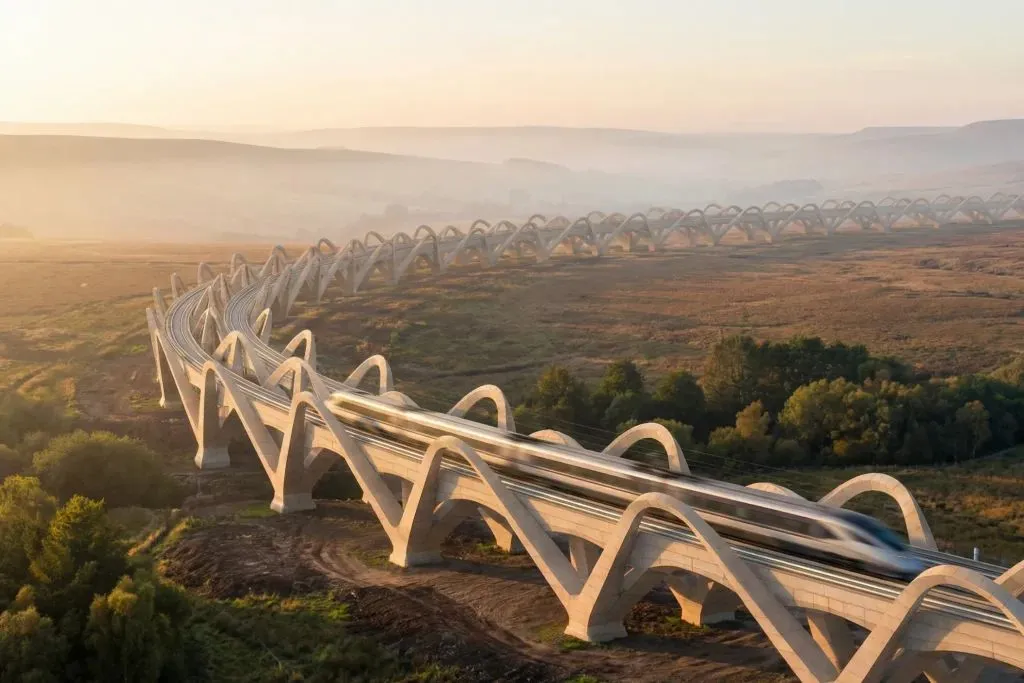
The proposal, which the Derbyshire-born former architect plans to submit to this year’s Royal Academy summer exhibition, combines nine cities in the north of England, Scotland, Wales and Ireland through a high-speed rail system.
Inspired by the mammoth ambitions of Saudi Arabia’s 170km-long Line mega-project, Williamson says his Northern Powerhouse proposal would establish a ‘new global city, [which is] dispersed but connected’. The Loop would link Dublin, Belfast, Glasgow, Edinburgh, Newcastle, Leeds, Manchester, Liverpool and the Welsh city of Bangor.
As part of the Northern Powerhouse Loop vision, 50m-long trains ‘would run every five minutes at speeds of up to 300 miles per hour on an elevated viaduct, minimising disruption at ground level’.
The new city would be supported by a ‘continuous infrastructure’ running alongside the rail route, which Williamson imagines would be ‘capable of gathering and redistributing power from onshore and offshore wind, alongside small modular reactors located at key nodes’.
He said in a statement shared with the AJ: ‘Maybe I have been too influenced by the scale, the vision and the ambition of NEOM the Line in Saudi Arabia, having worked on the high-speed stations running alongside the 170km city for the last few years.
‘Maybe I have been too influenced by the Line’
‘But we in the British Isles should be equally ambitious about our future. At present, the government seems to expect each city to compete for the same investment funding, when we need to encourage connectivity and collaboration.’
Williamson’s concept follows on the heels of the government’s recent commitment to push forward the £45bn long‑promised Northern Powerhouse Rail (NPR) project at the centre of a programme of investment in transport, skills and housing.
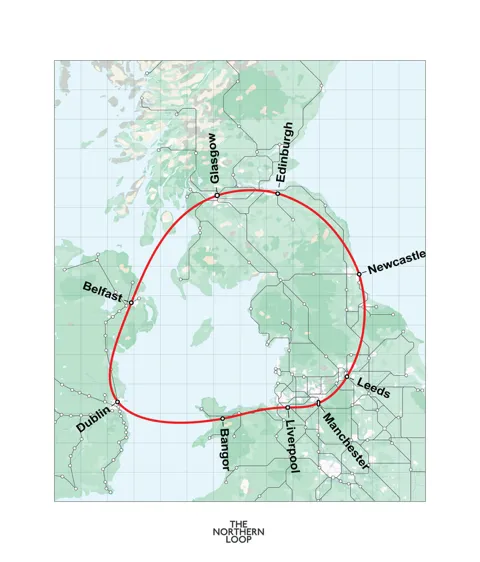
Chris Williamson’s Northern loop city vision (credit: Ope Adeyileka)
A new Birmingham-Manchester rail line has also been signalled as a long‑term ambition that could support northern rail links, though the government says this would not amount to a reinstatement of the cancelled HS2 link, and would not be built until after the completion of NPR.
The government has said the NPR will be delivered in phases, starting with improved links between Sheffield and Leeds; Leeds and York; and Leeds and Bradford; and taking forward development of the Leamside Line in the North East. Later phases would include a new Liverpool-to-Manchester route via Manchester Airport and Warrington, and upgraded routes across the Pennines.
Separately, Greater Manchester mayor Andy Burnham has continued to call for a new underground station in Manchester city centre. WW+P, which Williamson co-founded, previously worked on underground Manchester Piccadilly proposals for HS2, which rail chiefs ruled as too costly.
Speaking to the AJ almost two years ago, and before becoming RIBA president, Williamson defended his and WW+P’s work on high-speed rail for NEOM’s The Line – which recent reports suggest has been drastically scaled back. He said at the time that his involvement on the major Saudi project ‘is not a decision I take lightly’.
In an interview with the Discovery Channel for the documentary The Line in 2023, Saudi crown prince Mohammed bin Salman revealed that a circular shaped city had initially been explored for Neom before The Line was created.
Williamson is not the first to propose a circular, connected city in the North. The late Will Alsop unveiled similar plans for a giant but more linear city in the North 21 years ago, under the last Labour government, which received the backing of then deputy prime minister John Prescott.
Discussing the economic cost and political ambition required for his proposal, Williamson said: ‘The level of economic investment is significant, as are the potential benefits. Construction costs are estimated at £130 billion, with projected economic benefits of around £12 billion per year. From the stations, automated vehicles would serve the final leg of journeys, extending the reach of the system beyond the core network.’
He added: ‘The inclusion of Dublin and Belfast would require progress on border arrangements and political cooperation. The project would also release capacity on existing surface transport networks, supporting reductions in road freight and contributing to wider carbon reduction objectives.’
The theme of this year’s Royal Academy summer show is ‘interconnectedness’. Ryan Gander and Stuart Piercy are its curators.