
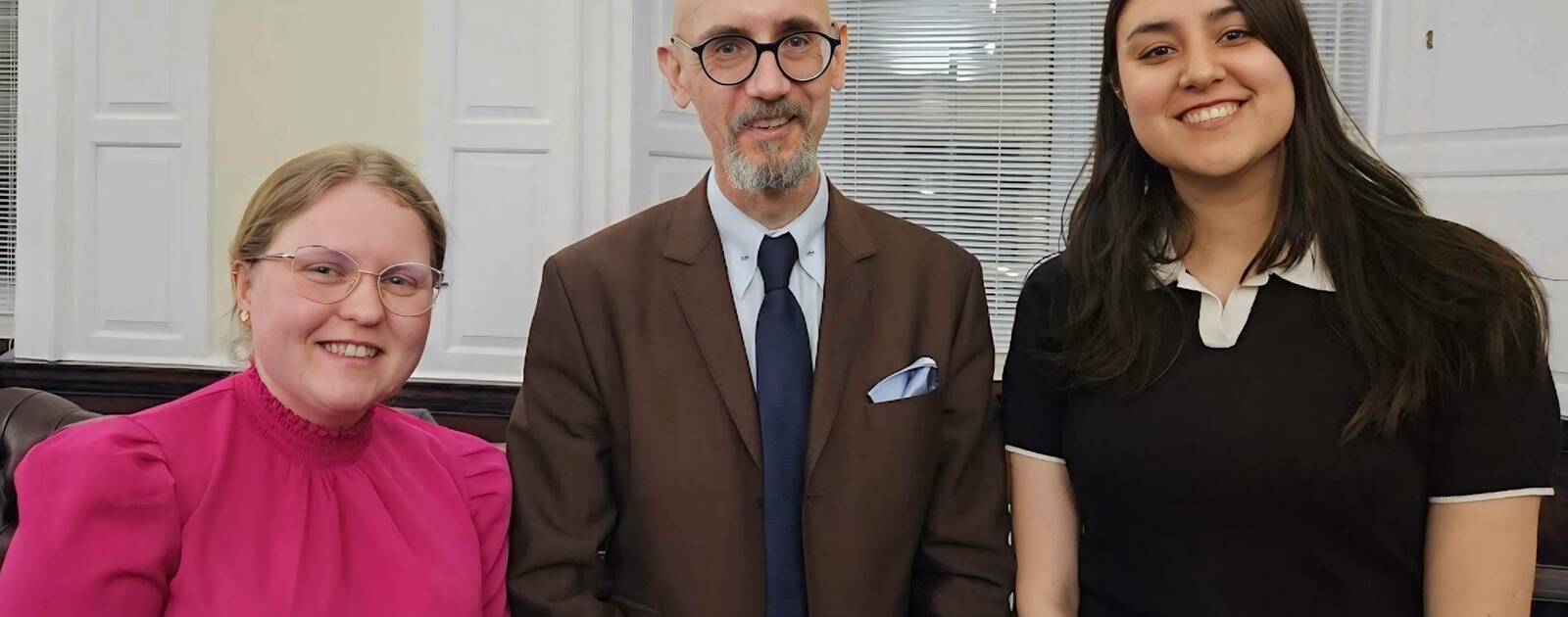
3L Analli Torres (right) is pictured with her supervisor, Dr. Adrian Bradley (center), and fellow extern, 3L Krystal Szerzen (left).
Analli Torres, a third-year law student at Notre Dame Law School, contributed significantly to a successful validity challenge to a UK patent covering an important pharmaceutical product. This success grew out of her externship with Cleveland Scott York—one of Europe’s leading intellectual property firms—which she pursued as a student in the Notre Dame London Law Programme.
Vortioxetine is an antidepressant sold under the brand names Trintellix (in the United States) and Brintellix (in Europe). Sales were in excess of $1B in 2025. The main patent protecting the product will expire in 2027. Several further patents were filed by the applicant (Lundbeck), relating to the use of vortioxetine in various specific clinical situations. If unchallenged, these further patents would effectively extend Lundbeck’s monopoly by several years. This would delay the market entry of generic products, causing additional costs for healthcare systems.
Cleveland Scott York challenged one of the further patents at the United Kingdom Intellectual Property Office (UK IPO). The key legal ground was sufficiency—the requirement that a patent must include enough detail for someone in the same field to actually work or use the invention. Torres carefully reviewed the data in the specification and helped develop arrangements as to why these did not meet the legal standard of sufficiency. These arguments proved decisive. The UK IPO agreed with the reasoning and found the patent insufficient.
Although the patent remains in force, the finding was extremely important and surprising—the same patent having been unsuccessfully challenged elsewhere.
Torres stated, “My externship at Cleveland Scott York was an incredibly rewarding and educational experience. My supervisor, Dr. Adrian Bradley, placed real trust in my abilities and always encouraged me to take my analysis further. I am so glad that the UK IPO ultimately agreed with our reasoning and found the claims of the patent to be insufficient.”