
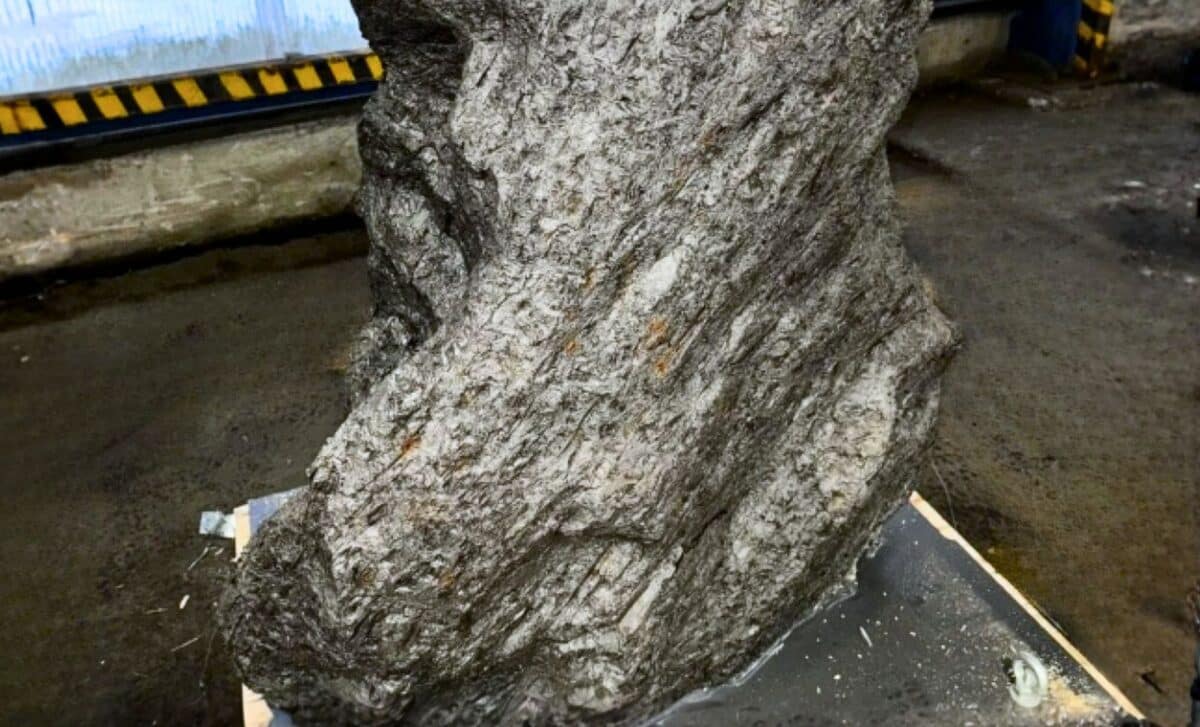
A shipping container bound for the United Kingdom was stopped at the Port of Saint Petersburg in early February 2026. Inside, Russian customs officers found a large, unidentified metallic object. The cargo had been labeled as a decorative item for landscaping.
Investigators determined that the shipment required further inspection. The container’s manifest showed inconsistencies, and the object’s dense structure, revealed during a routine cargo scan, raised concerns. A video later released by the authorities showed officials opening the crate to reveal an oblong, dark mass unlike anything typically moved through commercial export channels.
Details released in the days following the seizure confirm the object is not only rare but of potential national and scientific significance.
A 2.8-Ton Meteorite Misdeclared as Garden Art
The Federal Customs Service of Russia announced that the intercepted object is a 2.8-ton fragment of the Aletai meteorite, one of the largest known iron meteorites. The item had been declared as a garden sculpture, with no indication of its extraterrestrial origin.
Customs officers seized the shipment under laws governing the export of strategically significant natural resources. Officials estimate its market value at more than 323 million rubles, or approximately $4.2 million USD, based on a statement released on 5 February 2026.
 An official inspecting what the customs agency said was a 2.8-ton chunk of the Aletai meteorite intercepted at the port in Saint Petersburg, on Feb. 5, 2026, as it was set to be smuggled out of the country to the U.K. Credit: Russian Federal Customs Service/TASS
Footage released by the Russian authorities shows customs personnel opening the crate and revealing a large, dense metallic body. Its rough surface and grey appearance were inconsistent with the description provided in the shipping documents. As reported by The Moscow Times, the discovery was made during a standard cargo check at the port.
No individual or organization linked to the shipment has been identified. Investigators have not confirmed how the specimen entered Russian territory or whether it had previously been part of any known scientific or private collection.
Iron From Space: Scientific Value of the Aletai Meteorite
The Aletai meteorite was first recorded in 1898 in western China’s Xinjiang region and is classified as a Group IAB iron meteorite. It is composed mainly of iron and nickel alloys, believed to originate from the core of an early planetary body that underwent differentiation over 4.5 billion years ago. These materials offer critical insight into the thermal and structural evolution of the early solar system.
Iron meteorites are notably resilient to atmospheric entry, making large intact fragments rare but not unprecedented. Their size, metallic composition, and visual appearance have made them desirable not only for scientific analysis but also as private collector items. Research institutions frequently cite concerns over the scientific loss caused by undocumented specimens entering private hands.
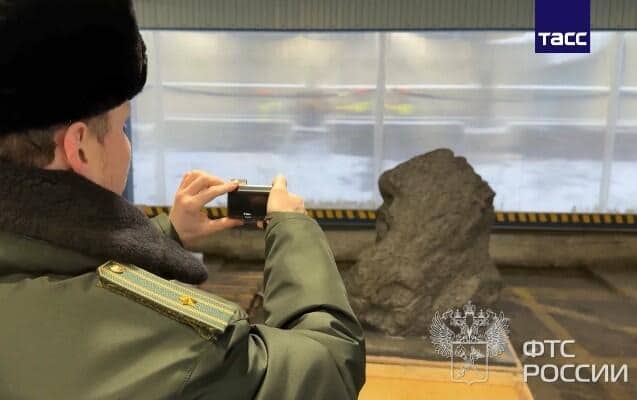 Another image of the 2.8-ton chunk of the Aletai meteorite intercepted at the port in Saint Petersburg. Credit: Russian Federal Customs Service/TASS
Under Russian law, certain meteorites are classified as state-protected natural objects, and their export is prohibited without government authorization. The legal framework treats such specimens similarly to cultural or geological heritage assets. Violations can result in criminal prosecution and permanent seizure of the material.
The 2.8-ton fragment seized in Saint Petersburg is now undergoing forensic examination. Its classification and connection to previously catalogued fragments of the Aletai meteorite are yet to be confirmed by laboratory testing.
Smugglers Target Space Rocks as Demand Surges in Private Market
The case highlights continuing vulnerabilities in cross-border controls over geological and scientific materials. Misdeclaration of high-value artifacts remains a recurring tactic used to evade detection. Items such as fossils, cultural relics, and rare minerals have previously been exported under misleading descriptions such as “sculpture” or “decorative stone.”
The international trade in meteorites occupies a regulatory gray zone. While private ownership is permitted in countries like the United Kingdom and the United States, others, including Russia and Argentina, treat meteorites as non-transferable national property. Without a global agreement governing extraterrestrial material, enforcement depends on local law and customs procedures.
In its coverage, CBS News noted growing ethical concerns among scientists regarding the private sale of meteorites. When specimens are separated from their geological context and sold without proper documentation, their scientific value often diminishes significantly. Institutions may refuse to study or accept such specimens if provenance cannot be verified.
Market demand for meteorites has increased steadily over the past five years. Iron meteorites, particularly those with unique features or confirmed origins, have been known to fetch thousands of dollars per kilogram in private sales and auctions.
Forensic Analysis Underway as Authorities Investigate Export Violation
As of 6 February 2026, the seized meteorite fragment remains in the custody of the Russian authorities. Forensic analysis is being conducted to confirm its origin, classification, and whether it corresponds to any previously registered Aletai mass. Testing is expected to involve isotopic, mineralogical, and magnetic property analysis.
The criminal investigation initiated by the Federal Customs Service is ongoing. No arrests or charges have been announced. The intended recipient in the United Kingdom has not been publicly identified, and there has been no statement regarding coordination with British law enforcement.
The meteorite is currently being held under national protective measures in accordance with Russian export control laws on strategic materials.