
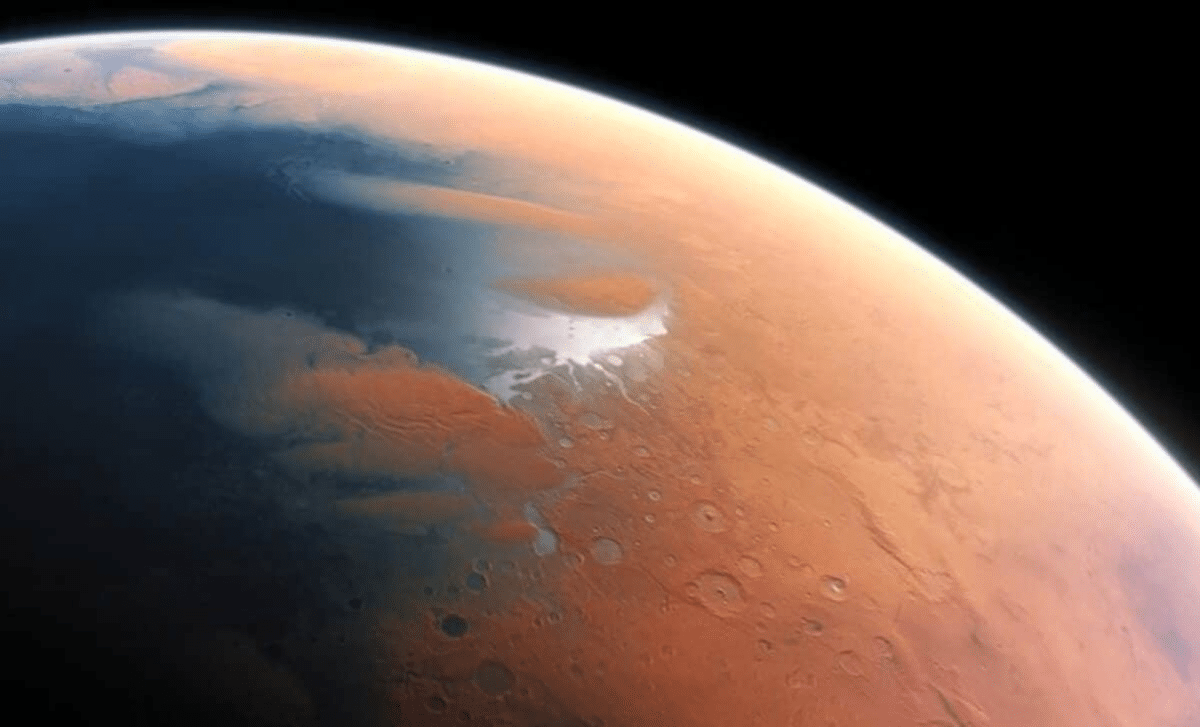
Mars, once a much wetter and more dynamic planet, is now a dry and inhospitable desert. The mystery of how the red planet lost its water has fascinated scientists for decades. A groundbreaking study published in Communications Earth & Environment on February 2, 2026, has brought us a significant step closer to understanding this enigma. The research reveals that localized dust storms, previously considered insignificant, can have a major impact on Mars’s atmosphere and contribute to the loss of water. By investigating these dust storms, the study provides a new perspective on the planet’s climate evolution and opens new pathways to unraveling the history of Martian water loss.
The Role of Dust Storms in Mars’s Water Loss
Dust storms are a well-known feature of Mars’s atmosphere, but their influence on the planet’s water dynamics has often been underestimated. The new study, led by researchers from the Instituto de Astrofísica de Andalucía and the University of Tokyo, and published in Communications Earth & Environment, challenges previous assumptions about these storms. While large, planet-wide dust storms have been known to affect the Martian climate, this study focuses on the role of smaller, regional storms. These localized events can also lead to significant water transport to higher altitudes, where it is more likely to escape into space.
“The findings reveal the impact of this type of storm on the planet’s climate evolution and opens a new path for understanding how Mars lost much of its water over time,” says Adrián Brines, co-lead author of the study.
This discovery underscores the importance of reconsidering the impact of these smaller storms, which were previously thought to have little effect on water loss compared to the planet-wide dust storms that occur primarily during the Martian southern hemisphere summer. The study’s findings suggest that even short and localized dust storms can contribute to the long-term evaporation of Martian water.
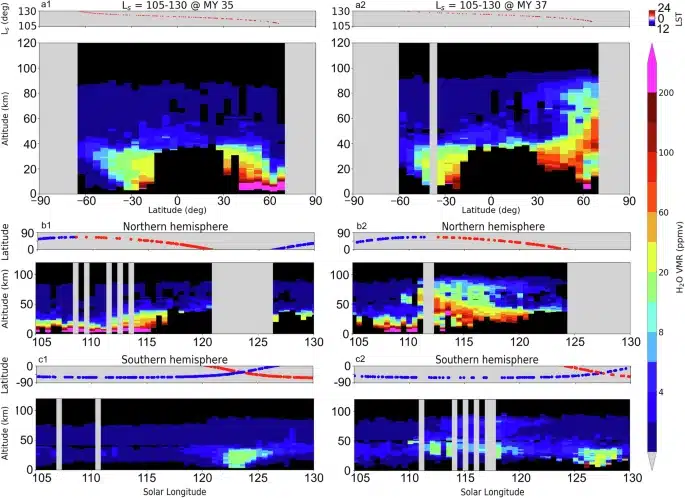 Vertical distribution of water vapor volume mixing ratio (VMR) as a function of latitude (a1, a2) and solar longitude for the northern (b1,b2) and southern (c1,c2) hemispheres during MYs 35 (left) and MY 37 (right). Dots over each panel indicate the solar longitude, latitude and local time of the NOMAD observations. Blue and red dots indicate morning and evening observations, respectively. Credit: Communications Earth & Environment
New Insights into Mars’s Water Transport Mechanisms
The study’s key discovery involves the detection of an anomalous increase in water vapor during the Martian northern hemisphere summer. Researchers observed that an intense, localized dust storm in Martian year 37 (2022–2023 on Earth) caused the amount of water vapor in the middle atmosphere to spike dramatically, reaching levels up to ten times higher than usual. This phenomenon had never been observed in previous Martian years, challenging existing models of Martian climate and water loss.
“This discovery adds a vital new piece to the incomplete puzzle of how Mars has been losing its water over billions of years,” says Shohei Aoki, co-lead author of the study.
The increase in water vapor is especially significant because it suggests that seasonal variations on Mars, previously thought to be of little consequence, may in fact play a much larger role in water transport. The study also highlights how dust storms can act as an important mechanism for driving water vapor to higher altitudes, where it can be easily lost to space due to the thin Martian atmosphere.
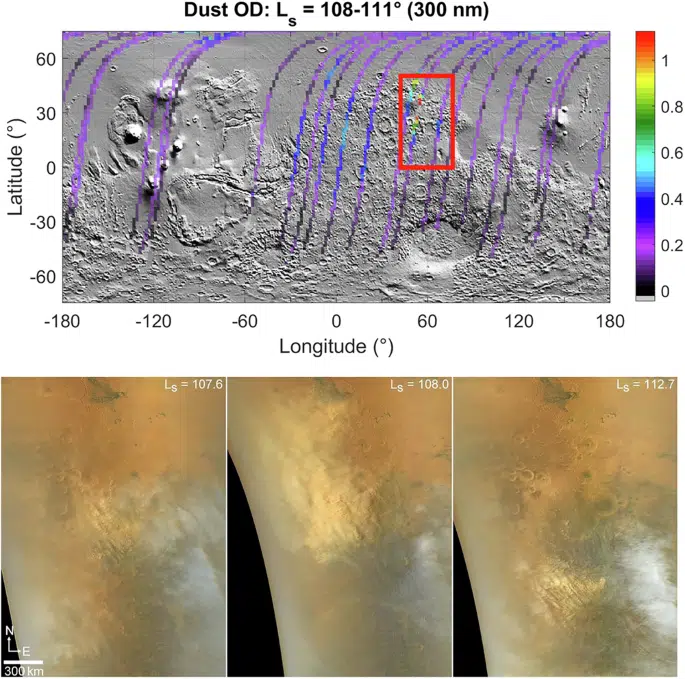 Geographical distribution of the dust optical depth (300 nm) retrieved from NOMAD/UVIS nadir measurements between LS=108∘-111∘ of MY37 (using a 2∘ × 2∘ averaging grid). (Bottom) MRO-MARCI daily global map images of the early growth of a once in a Martian decade regional dust storm in northwest Syrtis Major (red box in top panel) observed on (left) 21 August 2023 at LS = 107.6∘, (center) August 2023 at LS = 108.0∘, reaching an areal extent of 1.2 × 10⁶ km2. The regional storm persisted for 5-sols. A more common local storm followed, (right) originating in western Syrtis Major on 1 September 2023 at LS = 112.7∘. White features are water ice clouds, dust storms appear as yellowish-orange clouds. Note the water ice clouds above the eastern side of the two storms on the first sol of each event. Color composite created from (437, 546, and 604 nm) filter images and have been cylindrically projected from 0∘-40∘N, 45∘-75∘E, at 1 km pixel−1.
Credit: Communications Earth & Environment
The Impact of Hydrogen Escape on Mars’s Water Loss
A crucial factor in understanding the loss of water on Mars is the escape of hydrogen from the atmosphere. As water molecules break down in the atmosphere, hydrogen is released and can escape into space. The study observed a significant increase in hydrogen at the exobase, the region where the Martian atmosphere transitions into space, following the localized dust storm. The amount of hydrogen detected in this region was 2.5 times greater than in previous years during the same season, indicating that a substantial amount of water had been lost.
The escape of hydrogen is a direct indicator of how much water Mars has lost over time.
“These results show that short but intense episodes can play a relevant role in the climate evolution of the red planet,” Aoki concludes.
This new understanding adds an important layer to our knowledge of Mars’s atmospheric processes and water loss. It suggests that while large dust storms might dominate the narrative of Martian water escape, smaller, more localized events could have a comparable impact.
Implications for Mars’s Climate Evolution
This research not only sheds light on the mechanisms of water loss but also provides valuable insight into the evolution of Mars’s climate. Mars’s transition from a water-rich environment to its current arid state is a process that has occurred over billions of years. By identifying the role of localized dust storms, scientists can now refine their models of Mars’s climate history. The findings imply that Mars may have experienced more frequent and intense weather events in its past than previously understood, potentially accelerating the loss of water and contributing to the planet’s current dry state.
By revising our understanding of Martian climate dynamics, this study opens new avenues for exploring the history of water on the red planet. It also encourages further investigation into how short-lived atmospheric events could have contributed to long-term climate shifts. As researchers continue to study Mars’s atmosphere, these new insights will help build a more complete picture of the planet’s evolution and its capacity to support life in the distant past.
The Role of Regional Dust Storms in Future Research
The discovery that regional dust storms could play a crucial role in Mars’s water loss invites a closer examination of other localized weather events on the planet. Scientists have long focused on large dust storms that cover vast areas of the planet, but this new research suggests that smaller-scale events may be equally important. These storms could be more frequent and widespread than previously thought, making them an important factor in future climate models.
Understanding the full range of dust storm events on Mars is critical for future missions to the planet, including efforts to understand its habitability and search for signs of past life. As space agencies plan future Mars missions, it will be essential to monitor dust storm activity closely to better predict the planet’s weather patterns and their impact on water loss.