
(Credits: Far Out / Tidal)
Fri 6 February 2026 21:30, UK
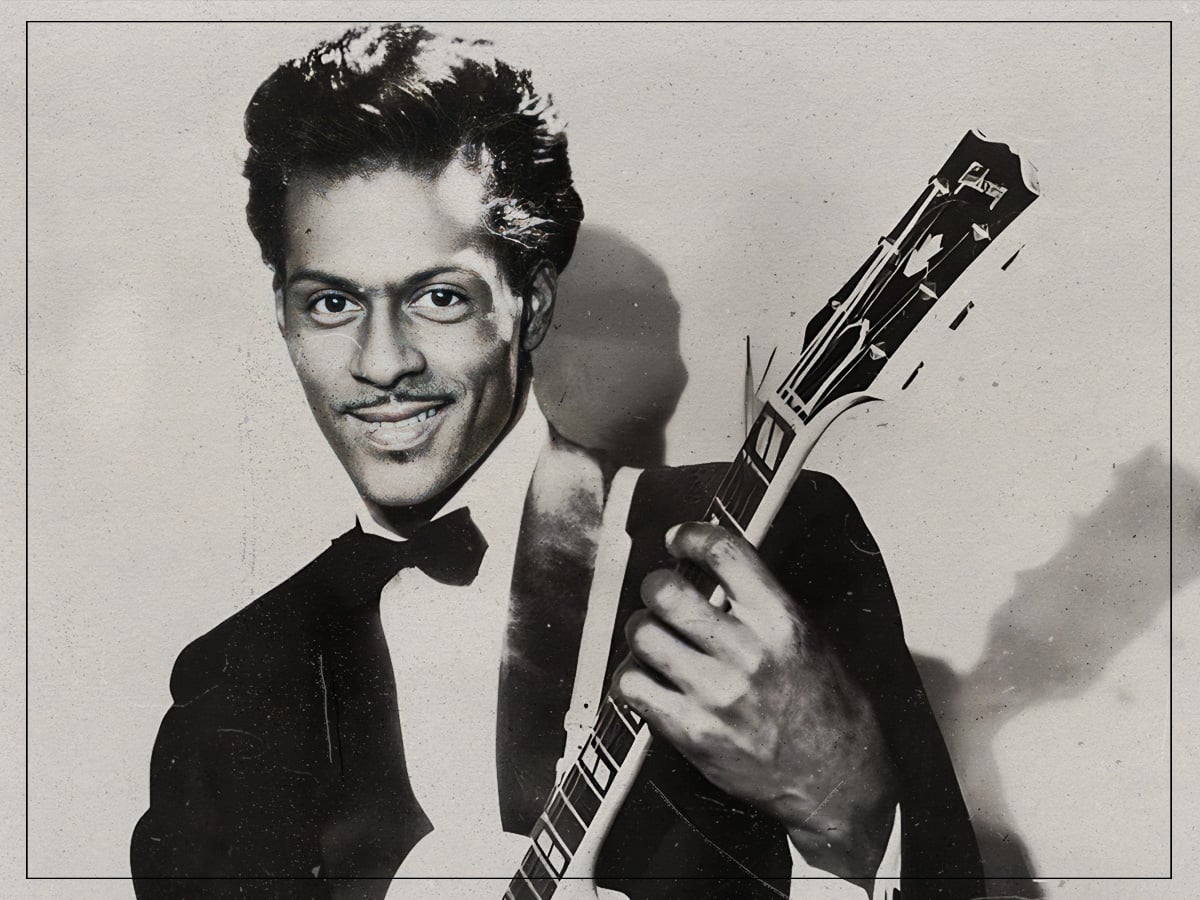
Keith Richards once declared Chuck Berry “the granddaddy of us all”, and even if the drug-fried mind of the Rolling Stones’ guitarist isn’t always the most reliable, it is difficult to argue with the fact that Berry is the root of virtually every rock and roll guitarist under the sun.
Berry was, after all, among the first to morph the sounds of rhythm and blues into the wild, anarchic rock and roll that typified the sounds of the 1950s and has yet to go out of fashion well over half a century later. Armed with his signature red Gibson, the St Louis-born guitarist completely revolutionised the musical landscape, and everybody from John Lennon to Bruce Springsteen is endlessly indebted to the pioneering sounds of records like ‘Johnny B Goode’, which well and truly broke the mould.
Ultimately, though, Chuck Berry wasn’t the only blossoming rock star of the 1950s, redefining the world of R&B. His rise to the forefront was flanked by the likes of Fats Domino, Little Richard, and – quite some years before – Sister Rosetta Tharpe and Big Mama Thornton.
To his credit, the guitarist always seemed to be well aware of that fact, sustaining a sense of modesty which was certainly not in keeping with the kinds of rock guitarists he went on to inspire.
So, although the music press has been falling over itself to cite Berry as the father of all rock and roll since as far back as his 1950s heyday, the guitarist himself has always been one to correct that claim. After all, no cultural revolution as enduring or all-encompassing as rock and roll could be undertaken by one sole performer.
Even back in 2010, by which time Berry certainly looked the part of rock and roll godfather, he was quick to correct any claim that he was the sole source of rock rebellion. During an interview with Rolling Stone, he set the record straight. “
No. There’s Louis Jordan. There’s Count Basie. Nat Cole for sure,” he shared. Adding, “This guy Joe Turner. There’s Muddy Waters, Blue Eyes [Frank Sinatra], Tommy Dorsey.”
While Berry’s insistence that he was never the originator of rock and roll, his selection of alternatives is rather unexpected. Sure, the likes of Muddy Waters and Joe Turner were essential in establishing the blues sound that acted as a precursor to rock, and the likes of Count Basie and Jordan typified the jazz sounds of the 1930s, but there are surely better choices for rock and roll progenitors than somebody like Frank Sinatra.
Sinatra, after all, was famously dismissive of rock upon its first emergence, and his suited crooning style was hardly in line with the wild output of the rock and roll generation. Berry didn’t see fit to expand upon why exactly he plucked those names out, rather than the aforementioned figures that he came up alongside.
Seemingly, though, it was that disparate selection of artists who played an essential role in inspiring Chuck Berry during his early years, and without them the guitarist might never have landed upon his progenitive role at the heart of rock and roll’s first emergence – even if somebody like Sinatra might have shuddered at the thought.
Related Topics