
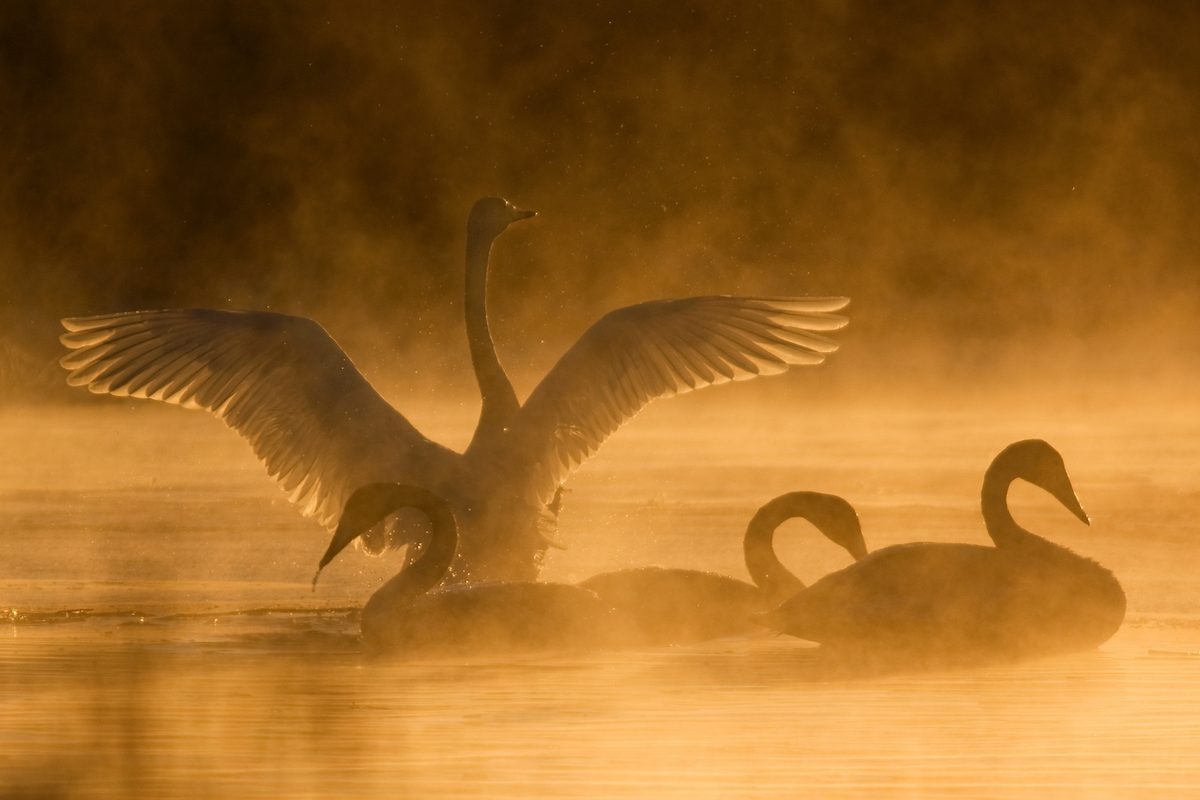
If you hear whooper swans calling to each other on a lake, they might well remind you of a brass band tuning up.
Their performance is not exactly musical! But it’s a deeply resonant sound all the same, which can make the hairs on the back of your neck stand up.
The atmospheric bugling of whooper swans is very much a winter sound in a lot of Europe, where the species only occurs between October and April.
Many of these wintering swans head to wetland nature reserves, such as those of the Wildfowl & Wetlands Trust in Britain, where their numbers are now booming.
Whooper swans at Martin Mere in Lancashire, England. Credit: Getty
When spring comes, the swans migrate north again to breed on boggy lakes, mainly in Iceland and the taiga zone of Scandinavia and Russia.
Whooper swans have an eye-catching patch of sunflower yellow on their beaks. They can easily be confused with tundra, or Bewick’s, swans, which likewise have bright yellow beaks and migrate to Europe in winter. However, that Arctic-breeding species has become much less common in Britain in recent years.
A small flock of whooper swans in Lónsfjörður, East Iceland. Credit: Getty
Top image: Whooper swans. Credit: Getty
More amazing bird stories from around the world