
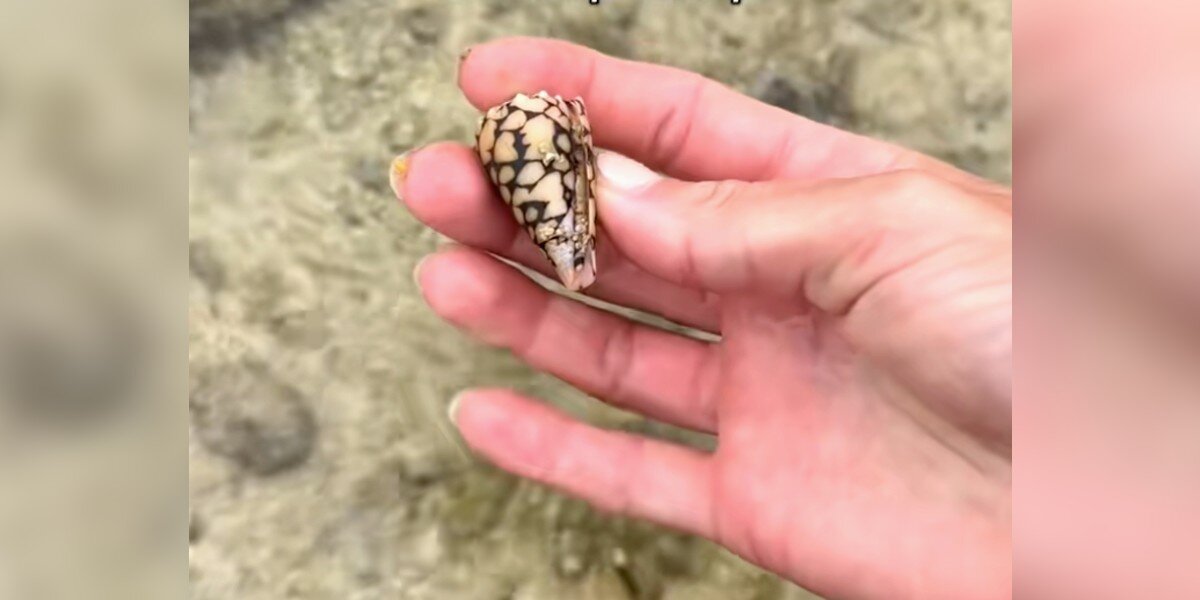
Last year, a resident of Okinawa, Japan, named Beckylee Rawls went tidepooling and spotted a beautiful snail in the water. Taken by the shell’s unique shape and coloring, she picked the animal up and recorded a short video.
After putting the snail down, Rawls did a reverse image search to identify the species — and was utterly horrified. Without even realizing it, by touching the shelled animal, she’d put her life in danger.
“I unknowingly picked up the most venomous creature in the ocean,” Rawls said on TikTok.
It turns out that the animal Rawls had encountered was a marbled cone snail. While cone snails look harmless, they’re actually highly effective predators, who use venom to catch fish, worms and mollusks.
“Cone snails are stealthy when hunting prey and have a harpoon-like tooth called a radula that extends like a long, flexible tube and rapidly injects toxic venom,” Ocean Conservancy wrote on their website.

There are hundreds of cone snail species, all with different levels of venom intensity. The one Rawls picked up just so happens to be one of the most deadly — and there’s no antivenom that could’ve helped her if she’d gotten stung.
“The complexity of the toxins in the venom, and the fact that the venom composition varies widely from species to species, makes the creation of antidotes difficult,” Ocean Conservancy wrote.
Rawls is lucky that she didn’t end up getting hurt while she had the snail in her hand. A marbled cone snail sting can cause severe pain, muscle paralysis, blurry vision and even death.
“I had no idea this was even a thing,” Rawls said. “My story picking up a marbled cone snail could’ve ended a lot differently.”
Cone snails can be found in oceans all over the world, particularly in warm places like Florida, Hawaii and Australia. Rawls hopes her story will encourage people to be extra careful when they’re in these areas to not touch or disturb any cone snails. In general, it’s always a good idea to be as cautious as possible when encountering unfamiliar species.
“If you are exploring warm water beaches or tide pools, know what to look out for,” Rawls said.
