
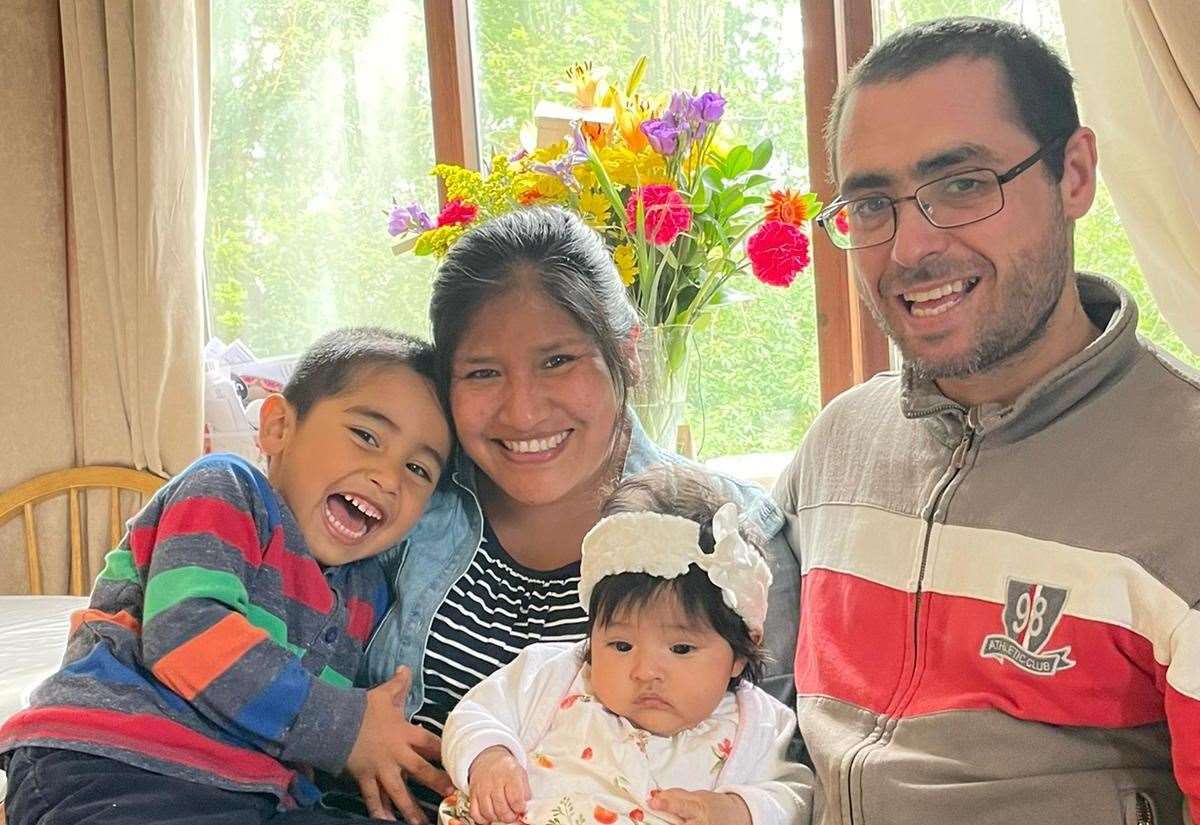
The father of an eight-year-old boy who died on Sunday has spoken about the family’s loss and the rare and severe epilepsy condition that claimed his son’s life.
When Carlos Rodriguez took the eldest of his three children, Adrian, to see a GP in November, he never would have imagined that just a few days later his beloved son would be in the Paediatric Intensive Care Unit (PICU) at Addenbrooke’s, fighting for his life.
 Adrian, left, with his parents and one of his siblings
After what began as a fever, Adrian was diagnosed with Febrile Infection-Related Epilepsy Syndrome (FIRES), an epilepsy condition that causes intense, treatment-resistant seizures in previously healthy individuals – usually children.
According to a German study, FIRES has an estimated prevalence of one in 100,000 children and adolescents, though the annual incidence is estimated to be lower, around one in 1,000,000 children. At present, there is no known cure.
After being admitted on 22 November, Adrian, a Year 3 pupil at Waterbeach Community Primary School, turned eight while still unconscious in the PICU in December.
He remained there until last week, when Carlos and his partner Yannet were given the devastating news that none of the treatments – which included surgery – had worked and that Adrian would need palliative care. He passed away last Sunday (1 February).
“Adrian had a fever and a headache on the Sunday and Monday. On the Wednesday, I went with him to the GP because he was not OK,” said Carlos.
“The GP didn’t know what was wrong and, just in case, he prescribed antibiotics. After one day, it seemed to us that he was making progress and getting better, but on Saturday morning Adrian was not able to wake up.
“He wasn’t able to talk, to walk, or to drink. He was in a kind of comatose state, so I took my car and went with him to the hospital. Then the same day, he was transferred to the Intensive Care Unit.”
Adrian was not immediately diagnosed with FIRES.
“You can only diagnose FIRES when you rule out a lot of other things,” explained Carlos. “There is no test that can tell you that a child has FIRES – because the cause is unknown.
“With Adrian they did a lot of tests and all the tests were saying that there was no virus, no bacteria. They knew that Adrian had brain inflammation and [was having] epileptic seizures.
“He hadn’t had any epileptic problems his whole life – he was a healthy boy.”
Carlos says when the doctors informed him and Yannet that it was FIRES, about 10 days after Adrian was first admitted to hospital, it came as a shock “because I didn’t understand what they were saying”.
“It took me some days to understand what they were saying,” said Carlos.
Two days before Christmas, Adrian opened his eyes, but he wasn’t able to see or to focus.
Dr Marios Kaliakatsos, a consultant paediatric neurologist at Great Ormond Street Hospital and a leading expert on FIRES, travelled to Addenbrooke’s on 22 January to see Adrian.
Carlos and Yannet also met other parents whose children have been diagnosed with FIRES, in person and online. Carlos is a member of a FIRES support group on Facebook.
“A woman called Rachel came from Derby,” said Carlos. “The same happened to her child five years ago.
“He was in hospital in Nottingham, but her boy passed away after seven weeks in the intensive care unit.
“Rachel founded a charity called Sam’s Superheroes Foundation, and she’s trying to help other families affected by this syndrome.
“Then via Facebook, I contacted two other families – one in Nottingham, another one in Essex. Both of them have kids that were in the intensive care unit with FIRES, but both of them came out – but with disabilities.”
Carlos, an engineer from Getafe, just south of Madrid, said that the local community in Waterbeach has rallied round himself and Yannet and their two other children, Victoria, 5, and Daniel, 2.
The couple moved to the Cambridge area from Carlos’ native Spain nine years ago, living first in Milton and then relocating to Waterbeach. Yannet is originally from Huancayo, a city in the central highlands of Peru.
“A lot of people in Waterbeach are helping,” said Carlos, “with meals, or looking after the kids sometimes.”
Various family members came over from Spain to see Adrian in hospital, along with people from Waterbeach, including the local vicar.
“Adrian was a very good student,” said Carlos. “In fact, one day they phoned me from the school saying, ‘Congratulations; because Adrian is behaving so well, we are going to give him a certificate for good behaviour’.
“A lot of days we cry – they told us that it’s good to cry.”
Following Adrian’s passing on Sunday, Carlos said: “He fought hard and lots of people tried to help him, but none of the treatments worked. He had a happy life and he’s left us far too soon.
“We loved him so much and now he is by my side telling me to move forward because we have two other little ones to raise.”
Sam’s Superheroes Foundation is online at samssuperheroes.co.uk.