
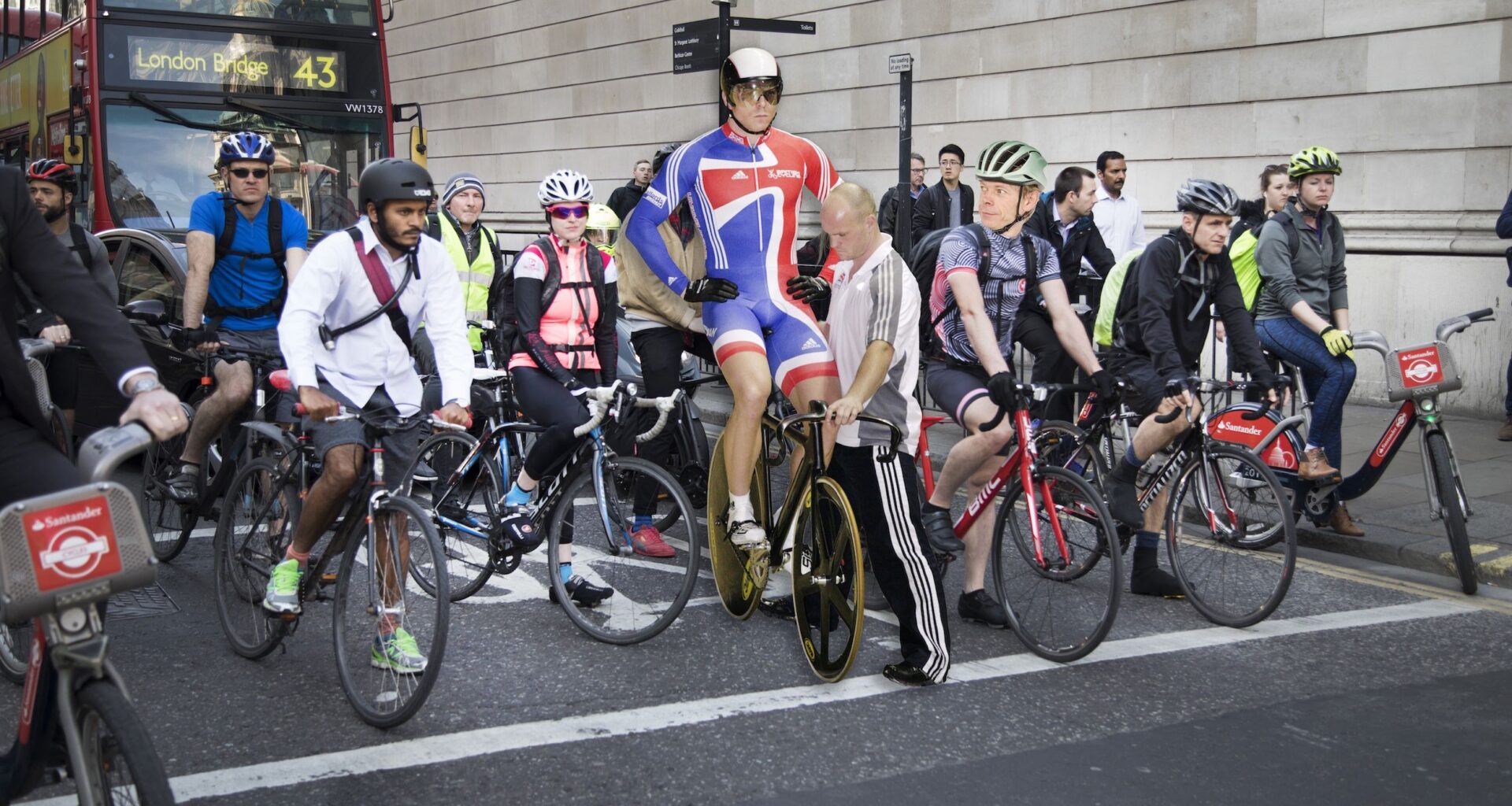
I rode across Central London last week in the middle of a Tube strike. I’ve experienced this before, and it’s always the same. On the one hand, there are cycling groups saying it’s an opportunity to promote cycling. And on the other hand there is reality.
Cycle commuting in London is often weirdly competitive. For Tube strike days, it’s worse. On the Embankment I saw a group of six riders on road bikes jostling for prime spot on the wheel of a Deliveroo rider on an illegal e-bike, and honestly the only thing that was missing was Sirs Jason Kenny and Chris Hoy. And let me tell you, if they had been there, they’d have been swamped. Inexperience joins forces with rage and produces a level of sporting aggression that would make Marianne Vos politely ask if she could be excused.
I enjoy trying to look at it through the filter of real race formats. I think it can help explain what’s going on. It’s clear, for instance, that there’s a points race in progress. There are 5, 3, 2 and 1 points available to the first four riders across the line at any set of traffic lights.
You may like
There’s an extra tactical element that in some respects makes it even better than on the track, because as a rider you have the choice between sprinting for the line from 150 metres back, or letting the lights go red and just barging your way through the riders waiting so that you’re at the very front when they change again.
There are other race formats available, including for track sprinters. If you’re a regular rider in Central London you’ll more than likely know the southbound stretch from Charing Cross Road, across Trafalgar Square, through Admiralty Arch and onto the Mall. If you’re not familiar with it, let me describe it thus: it’s a flying 200 meters.
There is the downhill drop off the track banking (a.k.a. Charing Cross Road), the concentration to keep the fast line round the curve (Trafalgar Square) and the thrill of being catapulted out onto the straight (The Mall) at terminal velocity. Assuming you hit all the lights, of course, and don’t get attacked by a taxi driver who, in his turn, thinks he’s driving the Monaco Grand Prix. Last week as just one of 500 riders trying to lead through the arch at 60 kph, I had as exciting a 15 seconds as I’ve enjoyed in a long time.
Meanwhile, for classics riders, the London local authorities have laid on a handful of segregated bike paths and paths. These are notable for both the appalling nature of the surface, their extreme narrowness and for their abrupt changes of direction. Just like the Tour of Flanders, knowing the parcours is critical, because if you don’t get your positioning right for the key moments, you’ll never see the front of the race again. I’d have said I needed a Tim Declercq to lead me out for the critical section near the British Museum, but I’m not sure the big Belgian would be any match for 40 teenagers on stolen Lime bikes.
I’m exaggerating. Of course I am. But when the roads are crowded, the sheer aggression is really something, from everyone in whatever means of transport. I like to think of myself as a competitive person with some ability to ride a bike, but half the time I was the one just letting anyone get in front of me that wanted to because it didn’t seem worth the argument. When I mentioned it to Mrs. Doc, she said, “Yes, and that’s why you never won the Tour of Flanders.”
I told her she was wrong. It’s not THE reason. It’s just one of many, many, many reasons.
Great Inventions of Cycling: Categories
In the beginning, bicycles were raced by whoever showed up and fancied it. There were no categories to separate different groups of competitors from each other. This was because the first bike races happened in France, which in that era was a nation of madness generally.
You may like
When bike racing arrived in Britain, on the other hand, order was established. There were amateurs, professionals and ladies. That was one category more than the officials cared for, so they put a line through “ladies” and that was the end of that for several decades.
The idea of categorising riders has continued to the present. The main idea these days is to ensure everyone gets fair competition by allowing riders of similar ability to compete with each other. This is done by assessing previous performances, either by a points system or, in e-racing, by tracking power data.
One of the pleasures of progressing through a sport is moving up a category. This is immediately followed by months of being thrashed by all the old inmates who’ve been in that category for ages, just waiting for a wide-eyed innocent to be upgraded into their midst. The old inmates like this because it means they get upgraded to the category above so that the same thing can happen to them there.
This system ensures that everyone settles permanently at the level at which they can no long win anything, so can no longer make any progress. Racing loses all meaning or purpose, other than to simply stay in the category. The only release from this situation is death.
Acts of Cycling Stupidity
An old bike-shop owning friend told me about a recent customer. He’d come in to have his tyre set-up changed to tubeless. “So this is puncture proof?” he asked when he picked the bike up.
“No. You get far fewer punctures because of the sealant. But once in a while you’ll get a big one.”“So then what?”
“Either take the tyre off, pour the sealant out and put in an inner tube, or get someone to come and pick you up.”
Three weeks later the shop phone rang. “Can you come and pick me up?” asked the customer.
My friend says he sighed deeply, and went to pick him up. He tells me that his charge for repairing punctures on tubeless set ups has become inexplicably much, much more expensive.