
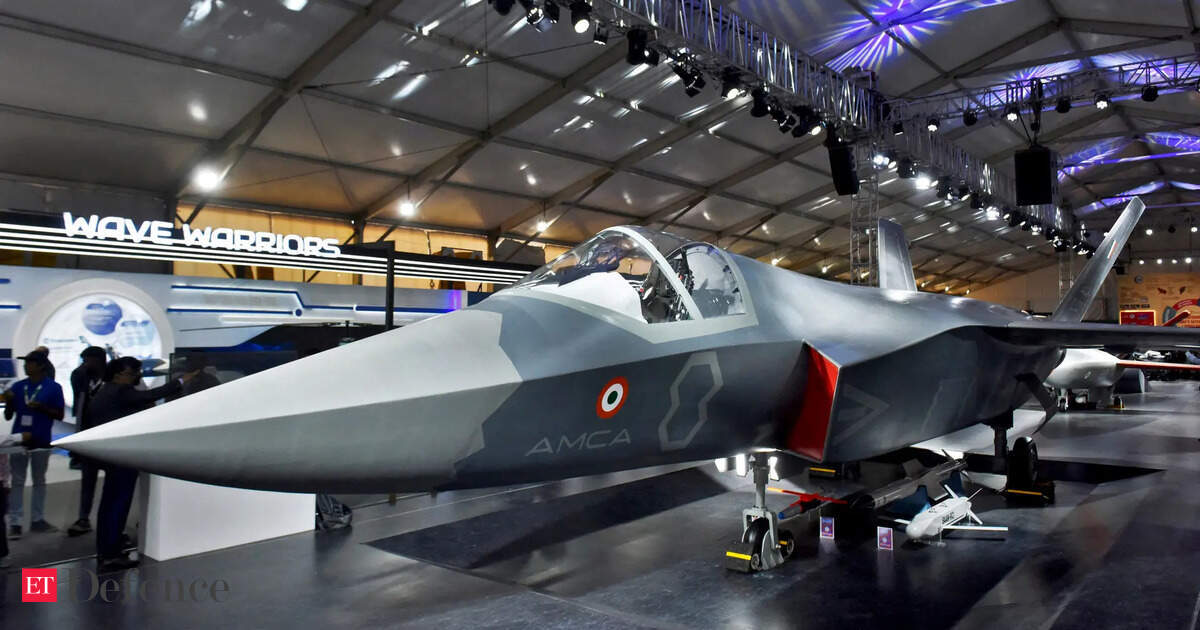
Last week, reports suggested that India’s private sector is likely to be the preferred option to manufacture the Advanced Medium Combat Aircraft (AMCA), the fifth-generation multirole stealth airplane, which is being developed for the country’s air force and navy.
If it turns out that way, it will be a departure from the government’s usual defence procurement strategy of using Hindustan Aeronautics Limited (HAL) for the manufacture of such aircraft, including the light combat aircraft, Tejas.
While HAL’s shareholders have made their feelings clear over the last few days —the stock lost around 14% of its value since the turn of the month—involving the private sector in this complicated, costly endeavour is a step in the right direction. With caveats, of course.
CHALLENGING CURVE
The Aeronautical Development Agency (ADA), under the Department of Defence Research and Development, is spearheading the development of the AMCA. In instances like the Tejas, HAL, being a PSU, was a natural choice as the main player to integrate and manufacture. That is likely changing now. Live EventsAir Vice Marshal (retd) Manmohan Bahadur reckons it will be good to get private players involved and to have another line going since HAL’s order books are full with a large number of orders for the Tejas aircraft.
It will, however, be a demanding transition for India’s private players. While the likes of Tata Advanced Systems, L&T and Bharat Forge are all being talked about as part of the shortlist to integrate and manufacture the fifthgeneration aircraft, they have differing levels of expertise when it comes to projects of this nature.
Some are part of the global supply chain for the likes of Airbus and Boeing, others use their high-precision manufacturing capabilities for artillery, while a few have been working with ISRO, India’s space agency, to build rockets. Being a lead integrator and manufacturer of a fifth-generation fighter, with its complexities and need for redundancies, is fundamentally a different order of challenge.
But it isn’t as if the private sector is starting on a blank page. As defence analyst Angad Singh points out, these companies have been building components and even entire sections of aircraft as a supplier for the global market.
The key challenge is in expanding their field of vision. It is a hard, highstakes role that involves more than high-precision manufacturing. It is one where the company that wins the AMCA deal will be responsible for overall architecture, system integration, software’s interplay with sensors and the lifecycle of the aircraft.
It is clear that private players will need some handholding.
HIRING ON ALL CYLINDERS
While some of that will come from ADA and the defence ministry itself, much will depend on the people who are hired.
G Mohan Kumar, former defence secretary, says the key challenge for any private player who gets the contract is to mobilise resources and manpower: “It is a question of putting together an entire ecosystem of people who can build the parts for it. We have some ecosystem already there for the Tejas.”
That means, if all goes to plan, the AMCA contract will end up signalling a hiring spree from the manufacturer who wins it. Singh says, “Whoever wins will poach liberally from the existing ecosystem. Why would they not? The reality is that institutional memory can be bought.”
It isn’t really an option. Kumar says, “The private sector can bring in innovations because they can bring in the best people.”
Expect a major spike in demand for both retired HAL and ADA hands as well as those who work up and down the aerospace ecosystem, even globally. As Singh points out, “They are not bound by government pay scales and recruiting rules. If you can write a cheque large enough, you can get anyone to stroll over.”
Singh also warns the private sector against unrealistically low bidding. “You often see overambitious bidding. There is nothing that can prevent a super low bid. But when that happens, the programme has every chance of going off the rails. We have seen it in other sectors. Putting in a realistic bid is critical.”
WHAT NEXT FOR HAL?
The hope across the ecosystem is that the private sector will show its efficiency through this contract.
Some of that hope is stemming from the need to show returns. Singh says, “No matter how the contract is administered, the private sector will have finance costs that HAL does not.
HAL has massive cash reserves and no opportunity costs because it isn’t an innovation-heavy creative company. Tata, for example, can’t deploy ₹5,000 crore and not expect a handsome return from it because they could have deployed it elsewhere.”
As Singh underlines, the private sector, by nature, is about working fast, because it is about efficiency of capital, which the public sector doesn’t have to contend with.
So where does that leave HAL? With the speculation on its exclusion from the AMCA deal affecting its stock, it had to come out with a statement that the company “has not received any official communication in this regard”.
While the Bengaluru-based company has, over the years, incurred the wrath of India’s armed forces for delayed deliveries of aircraft, it nonetheless remains a key player in the ecosystem, with hundreds of aircraft on order, not to mention maintenance contracts from across the armed forces. That pipeline should take care of its balance sheet for well over a decade.
But there are lessons it must take away, a key one being the need to hasten its approach. Kumar believes one reason why HAL is not being automatically awarded such contracts is because, “HAL makes decisions very slowly. Nor do they take the kind of risks that the private sector will be able to.”
In the long term, HAL should be spending its energy in solving that problem.