
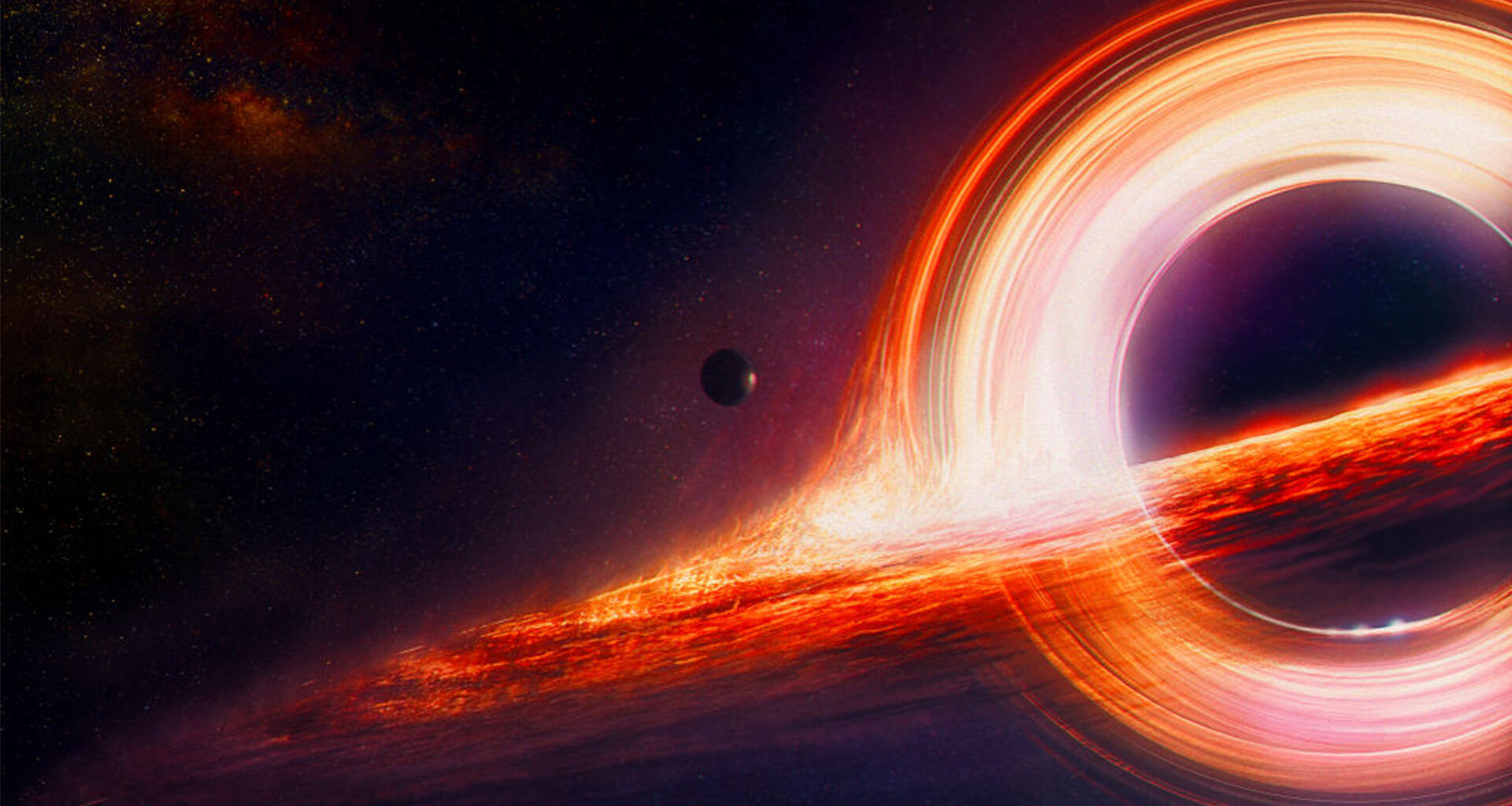
Somewhere in the universe, enormous black holes are circling each other so slowly that their motion can’t be seen, photographed, or even sensed directly. Each of these objects outweighs our Sun by millions or billions of times, yet their final approach toward collision unfolds over centuries or longer.
Scientists have long believed that such pairs should gently disturb space itself as they move — but until recently, there was no reliable way to point to where these systems are.
Now, a new study by researchers working with the North American Nanohertz Observatory for Gravitational Waves (NANOGrav), including physicists from Yale University, shows how this problem might finally be solved.
By combining subtle distortions in spacetime with observations of unusually bright galactic centers, the study authors have demonstrated a practical method for identifying likely locations of merging supermassive black holes.
This work lays the foundation for something astronomy has never had before—a way to chart gravitational waves across the sky and connect them to real cosmic structures.
“Our finding provides the scientific community with the first concrete benchmarks for developing and testing detection protocols for individual, continuous gravitational wave sources,” Chiara Mingarelli, one of the study authors and an assistant professor of physics at Yale University, said.
Individual black hole mergers stay hidden, but why?
Gravitational waves are not all alike. The waves detected by ground-based observatories come from violent, short-lived events. Supermassive black hole pairs behave very differently. They emit waves that rise and fall over years, not seconds, making them extremely difficult to isolate.
Instead of building a traditional detector, NANOGrav relies on natural timekeepers scattered through the galaxy: pulsars. These are compact stellar remnants that spin rapidly and send radio signals toward Earth at remarkably stable intervals.
If the spacetime between Earth and a pulsar is slowly distorted, those signals arrive slightly earlier or later than expected.
In 2023, scientists using this approach announced evidence that many distant black hole pairs were collectively affecting pulsar signals, producing a faint, all-sky gravitational wave background. However, the results came with a major limitation. The signal was blended — it showed that waves existed, not which objects were responsible.
Searching for steady gravitational waves
The new study focused on turning that diffuse signal into something more precise. The key idea was to stop searching everywhere at once and instead concentrate on places where supermassive black hole pairs are most likely to exist.
Previous research had shown that galaxies hosting quasars, extremely luminous regions powered by matter falling into black holes, are statistically far more likely to contain two massive black holes in orbit. Using this insight, the team designed a targeted search strategy.
They examined 114 active galactic nuclei, combining pulsar timing data with measurements of how quasar brightness changes over time. This allowed them to test whether any of these galaxies could plausibly be producing a steady, continuous gravitational wave signal strong enough to influence pulsars observed from Earth.
Rather than claiming a definitive detection, the researchers ranked candidates based on how well they matched expectations. Two galaxies stood out: SDSS J1536+0411 and SDSS J0729+4008. The team gave them informal names, ‘Rohan’ and ’Gondor (from The Lord of the Rings).’
“The names come from both people and pop culture. Rohan was first, for Rohan Shivakumar, the Yale student who first analyzed it, and Gondor was next, because, well—the beacons were lit!” Mingarelli said.
One framework to solve many mysteries
For the first time, researchers have shown that the search for individual supermassive black hole binaries is no longer guesswork. However, the immediate importance of this work is not the discovery of a specific black hole merger, but the creation of a working detection framework.
“Our work has laid out a roadmap for a systemic supermassive black hole binary detection framework,” Mingarelli added.
Even a few confirmed sources would provide fixed reference points, allowing scientists to better interpret the gravitational wave background and link it to galaxy evolution.
In the longer term, this approach could help answer deeper questions: how often galaxies merge, how supermassive black holes grow, and whether gravity behaves exactly as current theories predict on the largest scales.
Plus, it could also bring gravitational wave astronomy closer to traditional observations, tying invisible spacetime signals to visible cosmic structures.
The study is published in The Astrophysical Journal Letters.