
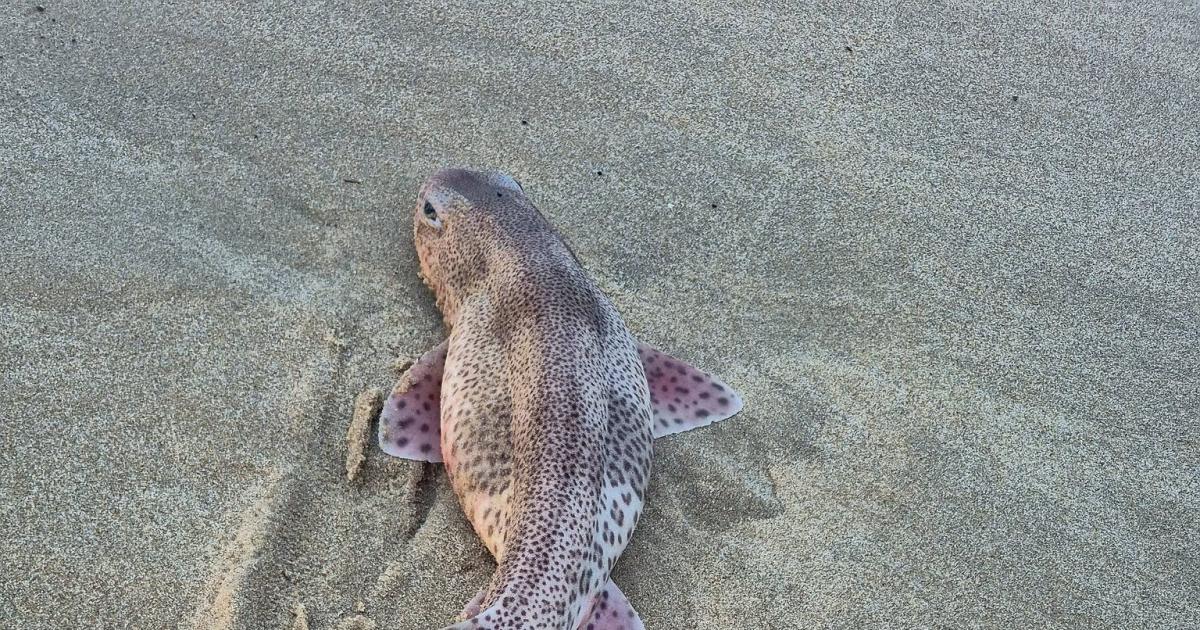
Shee-Shee Elaine found the small-spotted catshark at around 7.40am on Sunday morning near Boscombe Pier.
She said “I was quite alarmed because I’ve never seen anything like that before.
“I’ve never seen that sort of fish. It was quite big.”
A small-spotted catshark (Scyliorhinus canicula), also known as the sandy dogfish, lesser-spotted dogfish, rough-hound or morgay, are the most common shark in UK waters, growing to around 1 metre in length, and named due to the dark spots and blotches covering its skin.
A small-spotted catshark found in Boscombe Beach (Image: Shee-Shee Elaine)
Shee-Shee said she did not know what kind of fish it was when she first came across and had to put the photos into Google Lens to identify it.
The shark was dead when Shee-Shee found it and she said she would have “made an effort to put it back in the water” if it was still alive.
“I’m amazed it was lying there on the beach and the birds hadn’t got to it,” she added.
The sharks live close to the seabed in shallow waters down to 100m deep, feeding on crabs, molluscs and other small fish. When threatened, catshark curl up into a donut shape.
They are known to wash up dead on beaches in the UK after storms.
Small-spotted catshark are smaller and more spotty than the scarcer nursehound (also known as large spotted dogfish or bull huss), and have very rough, pale cream skin, large dark cat-like eyes and a small mouth. Its eggs cases or ‘mermaid’s purses’ are often found washed up onshore.
“Sometimes when I go down there (to Boscombe Beach) I see all sorts,” she said.
“But, I’ve never come across a shark.”