
A look inside the tech, tools, and the team that make the Super Bowl into true eye candy
There are many reasons why NBC’s NFL coverage carries such a big-game, eventized feel — but few are as immediately visible as the network’s commitment tohigh-end, real-time graphics and visual storytelling.
When Super Bowl LX kicks off on Sunday, SMT will once again sit directly inside NBC’s game-production workflow, delivering the real-time data, virtual graphics, and visualization tools that have become foundational to how football is explained on television.
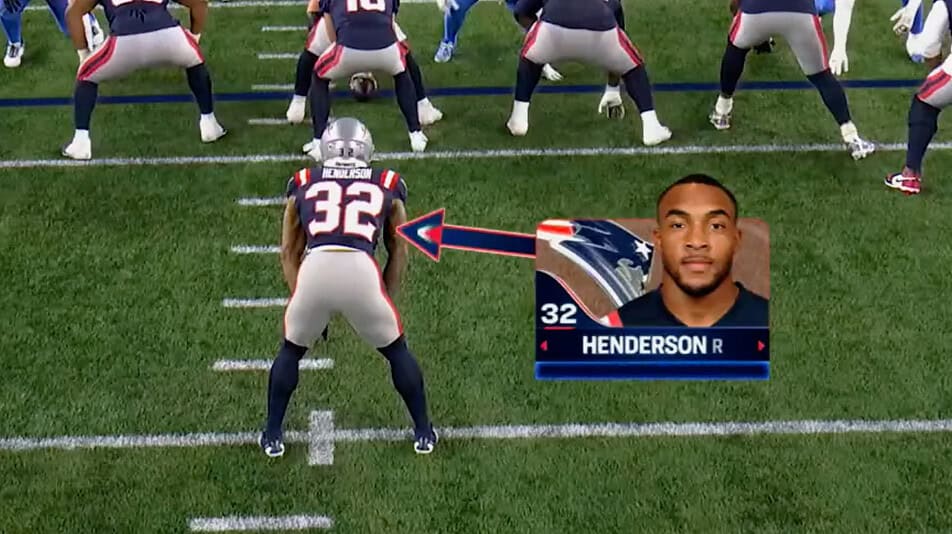 Among the many SMT graphic insertions that NBC Sports’ front bench likes to use on replays are player pointers.
Best known as the company behind the virtual first-down line, SMT is deploying a full suite of virtual graphics, telestration, tracking, statistics, and environmental data systems for the broadcast — spanning live gameplay, replay analysis, studio shows, and international feeds.
This year’s deployment is highlighted by two major presentation updates: a refreshed visual design for SMT’s DRAGON telestration system that aligns with NBC’s new on-air graphics package, and the broadcast debut of a new augmented-reality wind visualization powered by Unreal Engine and Weather Applied Metrics (WAM).
Together, the systems are designed to deepen storytelling around strategy, player movement, and game conditions while fitting seamlessly into NBC’s updated broadcast look.
New Telestration Look Built Into NBC’s Refreshed Graphics Package
For Super Bowl LX, SMT’s DRAGON production telestrators are rolling out a new visual treatment that matches NBC’s redesigned score bug and insert package.
Rather than debuting the look for the first time on Super Bowl Sunday, SMT and NBC introduced it during the Wild Card round to give the production and graphics teams real operational runway.
According to Danny Baker, Coordinating Producer and Super Bowl Team Lead for SMT, that decision significantly reduced risk heading into television’s biggest broadcast.
“We weren’t going into a Wild Card weekend saying, ‘let’s see what we’ve got,’” Baker says. “We had already been testing it, getting feedback, and making changes. Everybody was a lot more comfortable with what we were seeing functionality-wise.”
The advance rollout allowed both sides to refine animation behavior, transitions, and layout details before arriving at the Super Bowl environment.
AR Wind Visualization Makes Its Super Bowl Debut
The most visible innovation in SMT’s Super Bowl toolbox this year is a new AR wind visualization built on Unreal Engine and driven by live stadium-wide wind data from Weather Applied Metrics.
Wind sensors positioned around the stadium generate real-time wind speed and direction data, which SMT converts into on-air AR graphics displayed over optically tracked SkyCam and high-end end-zone cameras. The visualization is designed to illustrate how wind behavior across different areas of the field can influence kicking strategy and outcomes.
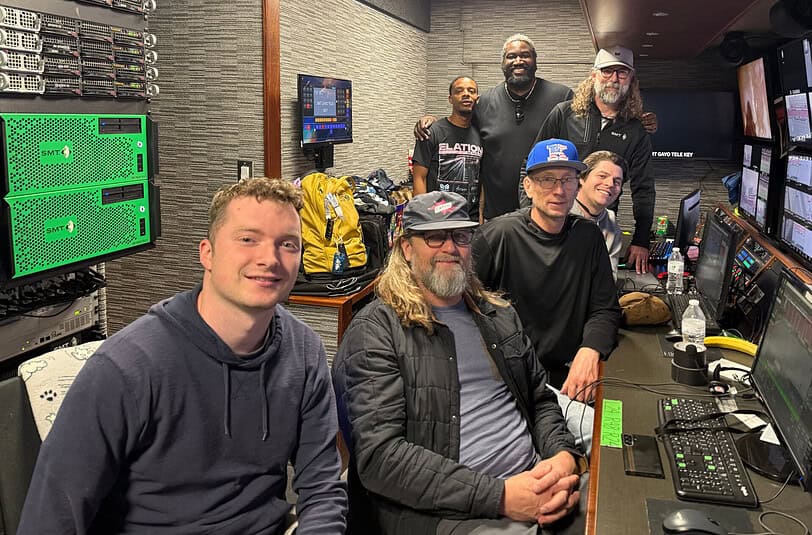 SMT’s primary support team for NBC Sports’ NFL coverage: (from left counterclockwise) Kyle Henn, Jason Aldred, Lance Griffith, Josh Berntsen, Lee Brinson, Danny Baker, and Brandon Warren.
Although the system has been monitored and tested during previous games, Super Bowl LX marks its first full broadcast deployment.
“When it makes air on Sunday, that will be the first time the world has seen it,” Baker says. “The technology has been ready. We’ve been monitoring it and testing it, but this is the first time it will actually be shown.”
For Lee Brinson, VP of Client Services for SMT, the new visualization opens the door to a different kind of environmental storytelling.
“I really hope it makes air, because it tells a fun story,” Brinson says. “You can see the field and you can see the direction of the wind and how it’s moving.”
The system is especially relevant at this stadium, where recent structural changes have altered airflow patterns inside the bowl — one of the reasons the WAM project was originally explored at this venue.
Multi-layer Wind Data Designed For Broadcast Clarity
Behind the scenes, the AR wind system supports multiple height layers across the field, allowing production teams to analyze how wind behaves at different elevations.
For on-air use, however, the design emphasis has been on simplicity and readability. Rather than using complex color schemes or multiple simultaneous layers, the on-air presentation focuses on clear arrows and speed readouts that can be quickly interpreted by viewers.
“We went back and forth on how much to show,” Baker says. “We decided to keep everything very simple for the audience to read.”
The visualization can be deployed over multiple camera angles, including SkyCam and the primary field-goal cameras, with different layer selections used depending on the shot and the storytelling moment.
Player Tracking, Telestration, and Replay as a Single Workflow
Beyond the new AR layer, SMT’s Super Bowl deployment continues to revolve around tightly integrated telestration and player-tracking workflows.
SMT supports multiple telestrators in both the booth and the production truck, allowing analysts and replay operators to move fluidly between first-look replays and illustrated breakdowns. The telestration layer is deeply embedded in NBC’s replay sequencing.
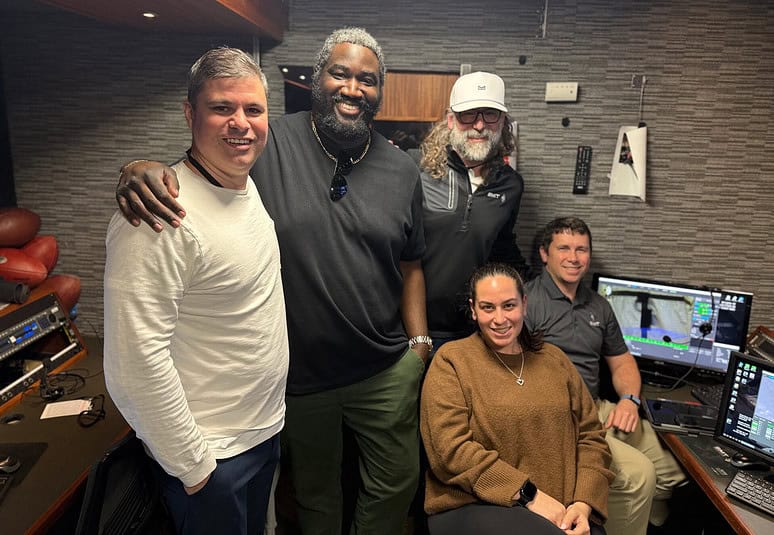 SMT’s overflow support team includes (from left) Craig Choka, Stephanie Ruscio, and John McDonald. Alsopictured are Danny Baker and Lee Brinson.
According to Baker, telestration is no longer reserved for occasional analysis moments.
“It’s almost crucial to the game,” he says. “With NBC, almost every replay sequence involves an illustrated loop.”
That includes officiating explanations, eligibility rulings, route identification, and player isolation, along with headshots and player-ID elements used to accelerate viewer recognition.
The emphasis, Baker says, is on being prepared before the request ever comes from the director.
“I love when [NBC Sports’ lead NFL game producer] Rob [Hyland] looks at our screen and says, ‘oh, SMT’s already there — take that,’” Baker says. “He doesn’t have to ask for it. It’s already built.”
That workflow is executed inside NEP’s ND2-D production unit, where SMT’s primary game-coverage positions are staffed by SMART Tele Operator Kyle Henn; Primary Camera First-and-Ten Operator Jason Aldred; First-and-Ten Color Filter and Camera Lead Utility Lance Griffith; High Sky Camera Tracker Operator Josh Berntsen; and Low Sky Camera Tracker Operator Brandon Warren.
On-site SMT leadership for the game is led by NBC Sunday Night Football Operations Lead Danny Baker and VP, Client Services Lee Brinson, who oversee SMT’s integration with NBC’s production team and the broader virtual-graphics and data workflows throughout game week.
SMT is also again integrating kick-tracking data into its visualization workflow through collaboration with TrackMan.
TrackMan’s tracking data is used to model kick trajectories, which SMT converts into on-air visualizations and virtual trails to help explain ball flight during field-goal attempts and kickoffs. The kick-tracking layer becomes especially powerful when paired with the new AR wind system, providing both environmental context and ball-flight behavior in the same analysis sequence.
Designing For a Daytime Super Bowl
Super Bowl LX’s daytime kickoff introduces additional challenges for virtual graphics and insertions.
Long shadows and constantly changing light levels increase the complexity of keying and color matching compared with a typical night game. Brinson says the team has been preparing specifically for how lighting conditions affect the consistency and visibility of virtual lines and insertions.
“It adds a new degree of difficulty,” he says. “They’re used to doing night games. A day game changes the conditions.”
To accommodate that variability, SMT has added additional keying resources for the Super Bowl broadcast.
Supporting Studio Shows, International Feeds, and Overflow Operations
In addition to the main game production, SMT is supporting NBC’s studio shows and pregame coverage with telestration tools, stats monitors, ticker systems, and data interfaces.
The operation also extends to international and secondary production environments, including Spanish-language broadcasts and overflow production spaces that rely on SMT’s data feeds even when SMT’s full graphics systems are not deployed directly in the truck.
SMT is also operating from NEP’s ST5 overflow unit, which supports supplemental workflows and backup operations throughout the broadcast. That unit is staffed by SMT NBC Client Services Manager Craig Choka; Overflow EIC Stephanie Ruscio; and Overflow Camera First-and-Ten Operator John McDonald.
Staffing and Redundancy Built for a Zero-Tolerance Day
For Baker, one of the defining characteristics of SMT’s Super Bowl deployment is not any single technology, but the level of redundancy built into the operation.
“This is the most televised sporting event in America,” he says. “So we have to treat it as such.”
That approach drives decisions to expand staffing across keying, tracking, and telestration positions and to increase monitoring coverage throughout the workflow.
“You see all these people and you think, why do you need all these people?” Baker says. “There’s nothing left to chance.”
Supporting both the main and overflow environments are additional SMT specialists embedded across the broader Super Bowl production footprint, including Game Utility Brandon Curtis; WAM (Weather Applied Metrics) Implementation Lead Jesse Richardson; Game Utility Chris Hale; Pre-game, Halftime and Post-game Studio Support Will Moran; and Telemundo Support Carter Allison.
Production Toolkit That Scales With The Show
While many of SMT’s core technologies — including player tracking, telestration, and virtual insertion — are not new, Super Bowl LX illustrates how those tools continue to evolve through new presentation styles, new data sources, and tighter integration with replay and storytelling workflows.
Baker credits much of that evolution to how NBC continues to re-imagine the use of long-standing tools.
“It’s really good technology — and it’s super fast,” he says. “But finding new ways to use things we’ve had for years is what makes the difference.”
At Super Bowl LX, SMT’s role is once again less about introducing isolated features and more about enabling a unified, data-driven storytelling environment — one in which telestration, tracking, virtual graphics, and environmental data operate as a single production system designed to help viewers better understand what is happening on the field and why.