
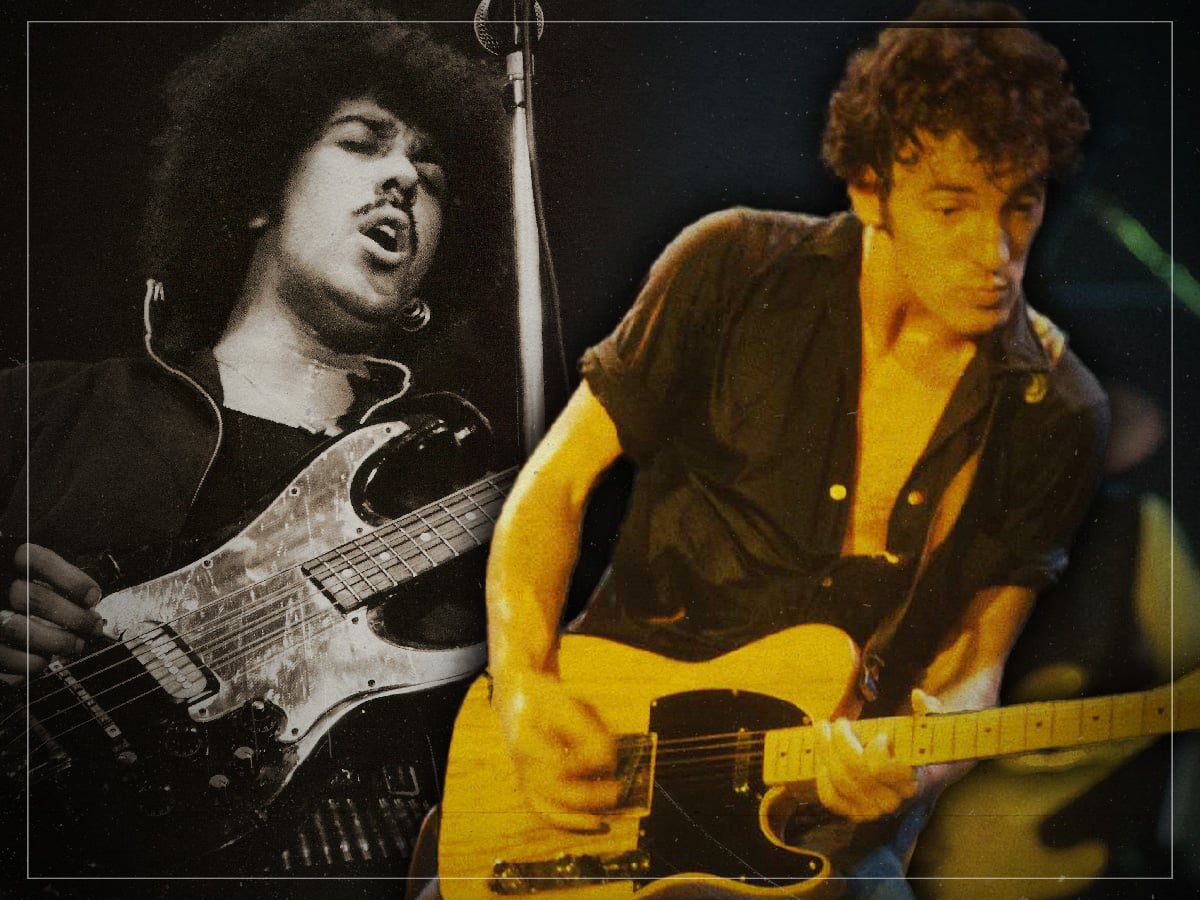
(Credits: Far Out / Harry Potts / Carl Lender)
Sun 8 February 2026 21:30, UK
Every rock star craves being seen as a true original. Phil Lynott took that one step further and actually made it happen.
Hailing from the mean streets of Dublin, he always knew from the earliest age that he was different in some way and destined for greater things. While he may not have anticipated in childhood that this imagining would transform into being the frontman of one of the most feverish rock bands of the late 1970s, creativity always ebbed through his bones.
But although music was obviously front and centre, Lynott viewed himself with a more broad-ranging artistic air than most. He was a master poet, and not just in the singular sense of lyrics. His poetry collections flew off the shelves, which he always claimed he was more proud of than any arbitrary chart achievement.
Yet despite this unique position, as the fame of Thin Lizzy increased and started to create more than a few electric currents, so too did the comparisons between Lynott and another rock icon of a similar creative disposition, but an entirely different outcome. The frontman wasn’t happy. After all, to any other artist, being chalked up to Bruce Springsteen would be like being touched by god.
To Lynott, it was a scathing insult. “There’s a guy here in LA who’s written how I’m Bruce Springsteen,” he said in a 1976 interview. “Now I have to spend half me interviews saying ‘I’m not fooking Bruce Springsteen’.”
To be clear, it wasn’t that Lynott disliked the man – “I appreciate him, but I don’t try to imitate him” – but he simply knew they were cut from different cloths.
“I take it as a compliment when we’re compared, but I take it as an insult when it’s said I imitate him,” Lynott said of The Boss, before adding, “This guy ’ere in LA worded it in such a way that all of a sudden I’m on the defensive. It’s a freaky one, the power of the pen.” It proves that, as much as we think music is universal, New Jersey and Dublin are ultimately worlds apart.
In fairness, it also seems like a sentiment that Springsteen himself would echo, as all he has ever existed to do is be a mouthpiece for the everyday people and not risk falling into the trap of being too similar to anyone else. There is, of course, room for more than one poet to sit at the table, but it took people a long time to truly realise that.
So Lynott continued on his slightly disgruntled way, batting off the shouts of Springsteen imitations and attempting to prove once and for all what he really had to offer while standing on his own two feet. You can say that, in time, he eventually did achieve that, becoming the effervescent, enigmatic frontman that many could only dream of.
Once he was gone, it was only then that it dawned on the masses just how incredible the presence was that they had lost. Lynott was no Springsteen; in fact, he was not anyone else at all. He was always just himself, and as history proved, that was all he ever needed to be.
Related Topics