
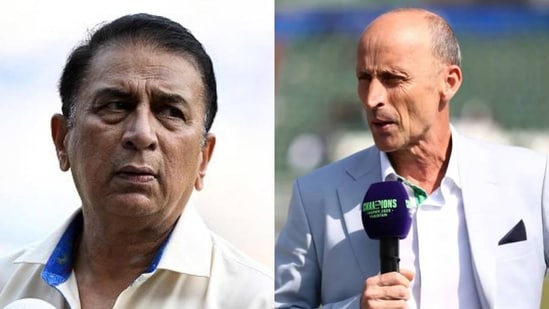
Sunil Gavaskar has drawn a sharp line between dominance and manufactured outrage. Reflecting on Vaibhav Sooryavanshi’s magnificent century in the Under-19 World Cup final against England last week, the former India captain said it was the “real bullying”, and not the kind that “jaundiced people” imagine. Gavaskar’s remark was a pointed response to former England captain Nasser Hussain, who recently questioned the ICC and India amid the ongoing chaos over Pakistan’s threat to boycott the marquee T20 World Cup clash.
 Sunil Gavaskar took a dig at Nasser Hussain for his recent comments on the ICC-PCB row
Sooryavanshi, just 14, smashed a blistering 175 off 80 balls, the highest individual score in a U19 World Cup final, as India piled up 411 and went on to reclaim the title with a commanding 100-run win. England responded with 311 in reply, but the contest had effectively been decided by the young Indian’s breathtaking assault.
Writing in his column for Sportstar, Gavaskar lavished praise on Sooryavanshi’s knock, calling it a performance that single-handedly took the game away from England. “In the just-concluded final of the ICC Under-19 World Cup, Vaibhav Sooryavanshi smashed 175 off only 80 balls against England and single-handedly took the game away from his opponents. To England’s credit, they responded well and also got to 311 in reply to the Indian colts’ 411,” Gavaskar wrote.
But in a column that largely addressed the growing criticism of the ICC amid the ICC–PCB impasse, where former Pakistan cricketers, ex-board officials and overseas voices have questioned the governing body’s decisions, Gavaskar could not resist taking a subtle dig at the critics while referencing Sooryavanshi’s innings.
“Now, what young Sooryavanshi did is bullying, and not the imaginary kind that some jaundiced people see,” he added.
Earlier last week, a clip of Nasser Hussain went viral in which he questioned the ICC’s decision to remove Bangladesh from the T20 World Cup after the Bangladesh Cricket Board refused to send its team to India for the tournament, citing security concerns. The ICC declined to accommodate the request and replaced Bangladesh with Scotland just over a fortnight before the event began.
“If India, a month before a tournament, said, ‘Our government does not want us to play in a country for a World Cup,’ would the ICC have been so firm and said, ‘You know the rules, bad luck, we’re knocking you out?’” Hussain asked on the Sky Sports Cricket Podcast.
“The only thing all sides ask for is consistency. Bangladesh, Pakistan and India must be treated the same. Yes, India fans may say, ‘Cry more, we have the money!’ But with power comes responsibility,” he added.
The comments did not sit well with Gavaskar, who referenced Hussain without naming him directly in his column.
“There are some others, especially from the old powers, for whom India replacing them as the power centre of world cricket has never gone down well. They were quick to join the noise and ask whether, if India had decided not to play in a country, the ICC would have accepted their position or thrown them out of the tournament,” Gavaskar wrote.
The batting great went a step further by invoking the 2003 World Cup, when England refused to play Zimbabwe, not because of security concerns but because of political differences. Calling it a “silly excuse,” Gavaskar noted that the ICC accepted England’s stance at the time.
“In the 2003 World Cup, England refused to play in Zimbabwe, perhaps because they did not like the face of the then-President Robert Mugabe announcing his policies. There was no security threat, yet they forfeited their points. Did the ICC do anything? No, because at that stage, the English and Australian boards ruled the roost, and the others did not want to upset them.”