

AI is a tool for deep contemplation rather than quick gratification in Cognitive Bloom, a device concept created by industrial design studio Map Project Office and recent Royal College of Art graduate Chanwoo Lee.
Map and Lee imagine Cognitive Bloom as a personal device that sits in the user’s home, inviting daily rituals of reflection and, if they keep up the habit, growing a virtual garden in response.
The device consists of two elements, the Pond and the Garden, which sit nested together. Users pick up the Pond when they want to take a quiet moment for self-reflection, and the device aids them by showing prompts in the form of a “wordstream”.
 Cognitive Bloom grows a virtual garden in response to consistent self-reflection
Map conceived the wordstream to encourage interaction without pressure and, unlike some other AI platforms, avoid flattering the user or becoming an echo chamber.
“Rather than simply reinforcing the user’s existing thoughts or patterns, the Pond would aim to gently broaden perspective, supporting independent thinking and personal growth,” Map creative director Angus Dick told Dezeen.
“Ultimately, the goal is to create a reflective companion that supports the individual’s process, without overpowering it or steering it too narrowly.”
 The Pond element presents a “wordstream”
The user’s wordstream will be personalised by anything they say to Pond, and a microphone is activated when the device is picked up.
Interaction begins when the user presses and holds the bezel and then tilts the device toward a quadrant on-screen to choose a type of reflection – either critical thinking, emotional support, self-understanding or decision-making.
Pond then begins communication, using full sentences but showing them broken down into single words, displayed one at a time at a speed that can be adjusted via the bezel. Content is written in the first person, such as “How did I feel about…?”
 Single-word communication encourages focus
Map senior designer Ashley Willard explained that the decision to scroll through words individually came while they were exploring methods of improving cognitive function and efficiency.
“The idea is actually borrowed from speed-reading plug-in software, which is designed to drastically increase the rate someone can read inputted text by creating a stream of individual words, as they require maximum focus to keep up,” said Willard.
“Even when slowing the speed down in our software to a more comfortable pace, the benefits of focus still remained, so it became the perfect way to output dialogue, as well as creating a lovely analogy between your stream of consciousness and the Pond itself.”

Eight actually interesting uses of AI from 2025
As well as speaking their responses back to Pond, Map imagines that users might like to journal or reflect in other ways.
Speaking has the advantage of shaping Pond’s wordstream, which is informed by the current conversation, past conversations – stored locally on the device and not in the cloud – and potentially external sources such as the news.
For the hardware design of Cognitive Bloom, Map drew inspiration from optical lenses and watches – objects with “great tactility and precision”. But perhaps most visible is the influence of Magic 8 Ball toys.
“The simplicity and anticipation of the answer slowly revealing itself from within was a key reference,” said Willard.
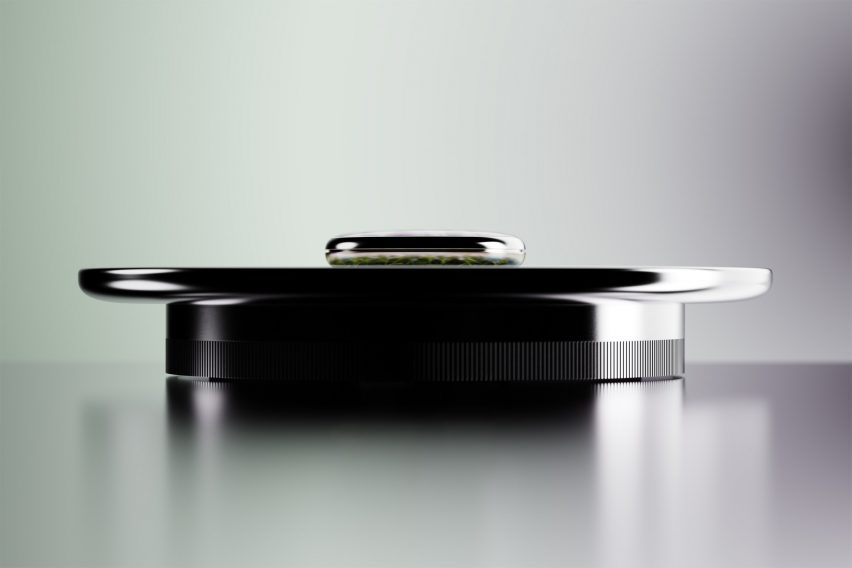 The speculative project allowed the designers to think critically about AI
Depending on how often the Pond device is used, virtual plants will grow on the corresponding Garden module to encourage regular interaction.
Lee is an interface architect who graduated from the Imperial College London and Royal College of Art’s Innovation Design Engineering masters course in 2025.
While there, he built Synapse, a reflection journal using “Socratic AI”, but he said the work made him realise that software alone cannot shape human behaviour as powerfully as hardware.
Map said that their work together on the speculative concept had allowed them to engage critically with AI at a time when clients were increasingly requesting its integration into products.
 The growing of the garden is meant to encourage regular use
“It gives us a safe, non-commercial space to explore the technology thoughtfully — away from the usual time pressures and constraints of client briefs,” said Dick.
“That distance allows us to ask more fundamental questions about what the right things to do with AI actually are.”
More than one in three adults already use AI chatbots like ChatGPT for mental health support although these models weren’t designed for the task, raising concerns about the safety and accuracy of the information they receive.
Map is a London-based industrial design studio founded by designers Edward Barber and Jay Osgerby and now owned by AKQA.
Technology design is a key focus for the studio, with past projects including IBM’s supercomputer, the Beeline bicycle compass and an AI diagnosis concept developed with Modem.