
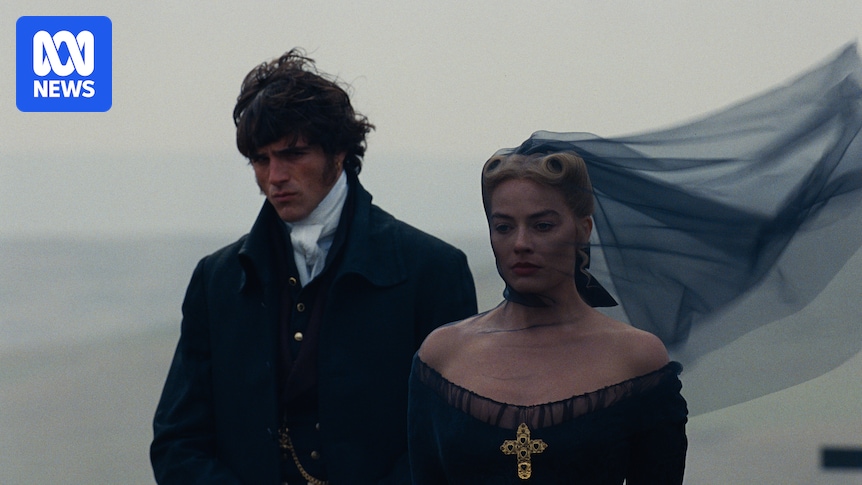
Is 19th-century Gothic romance back? Is Emily Brontë brat? What would Wuthering Heights look like if the spooky, intergenerational melodrama — all those howling winds and pleading ghosts — were replaced with heaving bosoms and sub/Dom bondage?
Fast facts about Wuthering Heights
What: Oscar-winning filmmaker Emerald Fennell’s loose adaptation of Emily Brontë’s classic, a tale of secret passion between a mysterious outsider and a girl who marries into a wealthy family
Starring: Margot Robbie, Jacob Elordi, Hong Chau, Shazad Latif, Alison Oliver, Martin Clunes, Charlotte Mellington, Owen Cooper
Director: Emerald Fennell
Where: In cinemas February 12
Likely to make you feel: Hot and bothered, but not quite satisfied
Oscar-winning British filmmaker Emerald Fennell (Promising Young Woman; Saltburn) is no stranger to provocation, and her new Charli xcx-scored adaptation of Brontë’s 1847 classic already has everyone losing their minds over the liberties being taken with the beloved source material.
From Jacob Elordi’s casting as the novel’s racially ambiguous Heathcliff to executive producer Margot Robbie taking on tempestuous teenager Catherine Earnshaw, the film’s scare quotes — this is “Wuthering Heights”, the film’s marketing insists — have been working overtime to remind the audience that this is but one woman’s riff on the story.
“I wanted to make something that made me feel like I felt when I first read it, which means that it’s an emotional response to something. It’s, like, primal, sexual,” Fennell, who first read the book at 14, told the BBC.
True to her word, the writer-director’s Wuthering Heights — sorry, “Wuthering Heights” — is the kind of fanfic fever dream that feels ripped from the cover of some lurid pulp imprint, full of Gothic spires, crashing thunder, strained bodices and torrid coupling.
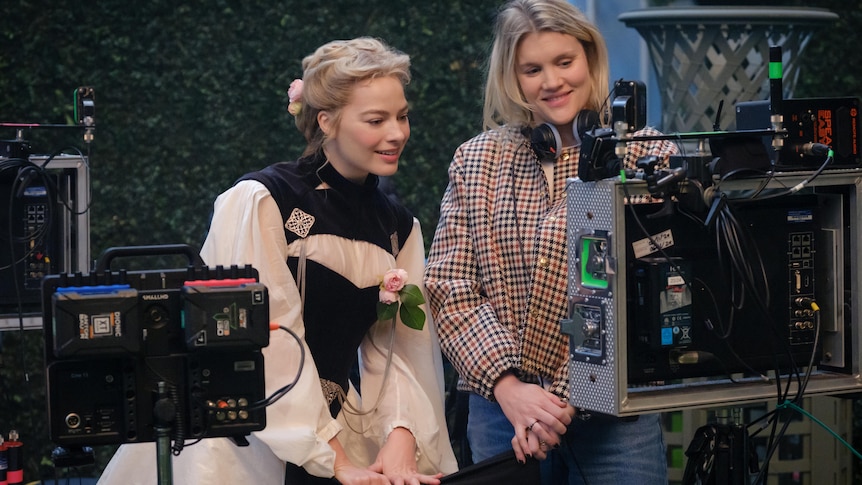
Margot Robbie’s (left) LuckyChap production company has had a hand in all of Emerald Fennell’s feature films. (Supplied: Universal/Warner Bros)
Sex and death
Right from the movie’s opening seconds, with what sounds like a mounting orgasm slowly revealed to be the dying gasp of a man on the gallows, Fennell has sex and death on the brain.
Watching on is young Catherine Earnshaw (a spirited Charlotte Mellington), the mischievous moppet of Wuthering Heights, a gloomy homestead on the Yorkshire moors that has seen better days.
When Cathy’s father (Martin Clunes), busy frittering away what’s left of the family wealth (and his teeth) on booze and gambling, brings home a mysterious young urchin (Adolescence’s Owen Cooper) from one of his ill-fated trips, Cathy names the orphan Heathcliff.
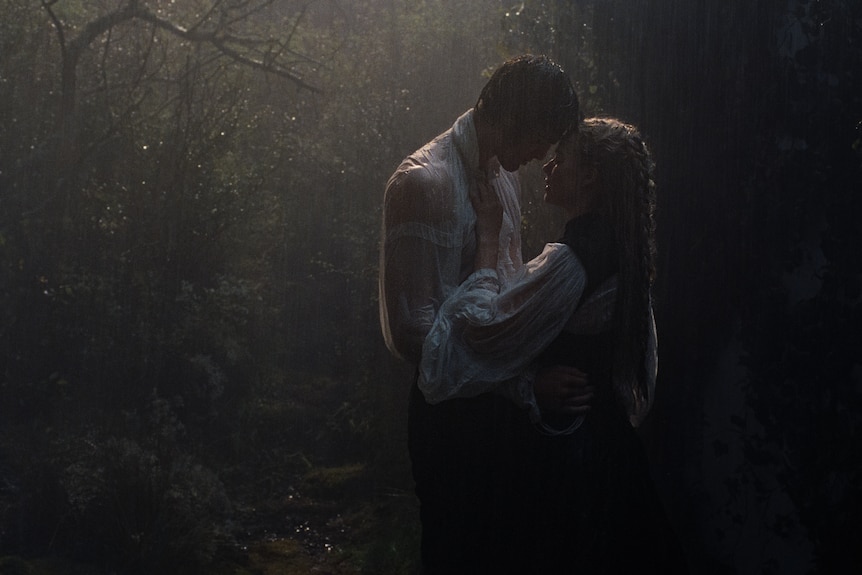
Fennell has said the inverted commas around her film’s title represent that it’s her teenage interpretation of Wuthering Heights. (Supplied: Universal/Warner Bros)
Roaming and rambling across the moors, the wild-eyed Cathy and Heathcliff quickly become inseparable, and quickly grow up — with a glow-up — into Queensland’s finest, Margot Robbie and Jacob Elordi.
Elordi has always had a cruel, brooding quality barely disguised by his matinee idol looks, and his physicality makes for a suitably dark and stormy Heathcliff — even if he appears to have taken some accent lessons from the Gallagher brothers.
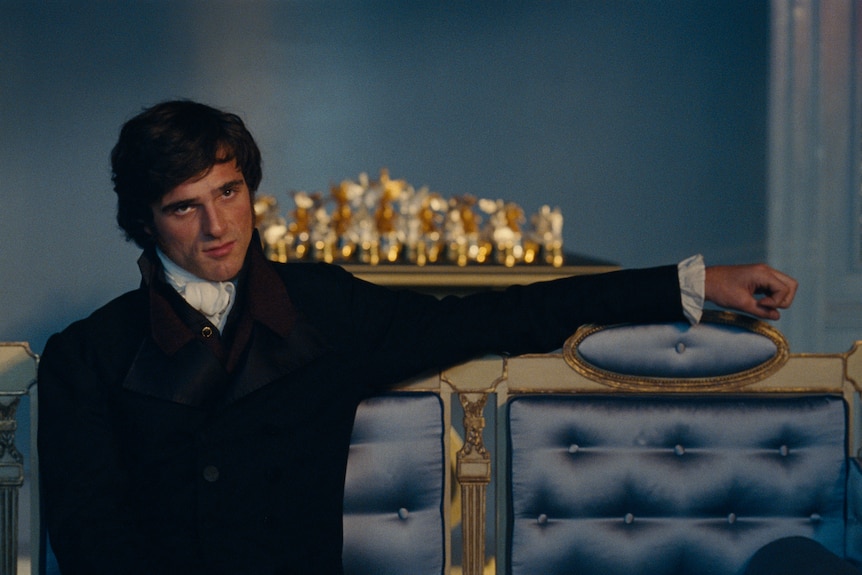
Fennell said seeing Elordi with sideburns while filming Saltburn inspired her choice for the actor as Heathcliff. (Supplied: Universal/Warner Bros)
Robbie, meanwhile, plays the unhinged Cathy closer to upwardly mobile rom-com heroine or naughty Disney princess — the kind who spends her days masturbating on the moors or peeping on stable-hands engaged in sweaty bondage sessions in the farmhouse.
Why Wuthering Heights is one of the year’s most controversial adaptations
Heathcliff and Cathy’s burgeoning, windswept romance is cut short by the arrival of new neighbours at nearby Thrushcross Grange, an opulent mansion with ruby-red halls and Beauty and the Beast-style candelabra holders that Barbie would deem too garish.
And its barmy new residents — the swarthy textile merchant Edgar Linton (Shazad Latif) and his borderline-idiot ward Isabella (poor Alison Oliver, giving it her all) — wouldn’t be out of place at Fennell’s Saltburn.
With a scorned Heathcliff banishing himself abroad, Edgar has soon married Cathy and installed her at his palace with her longtime confidante and housekeeper, Nelly (Hong Chau). (Having the two main actors of colour portray the romantic villain and the meddling help, respectively, is certainly a curious choice on Fennell’s part.)
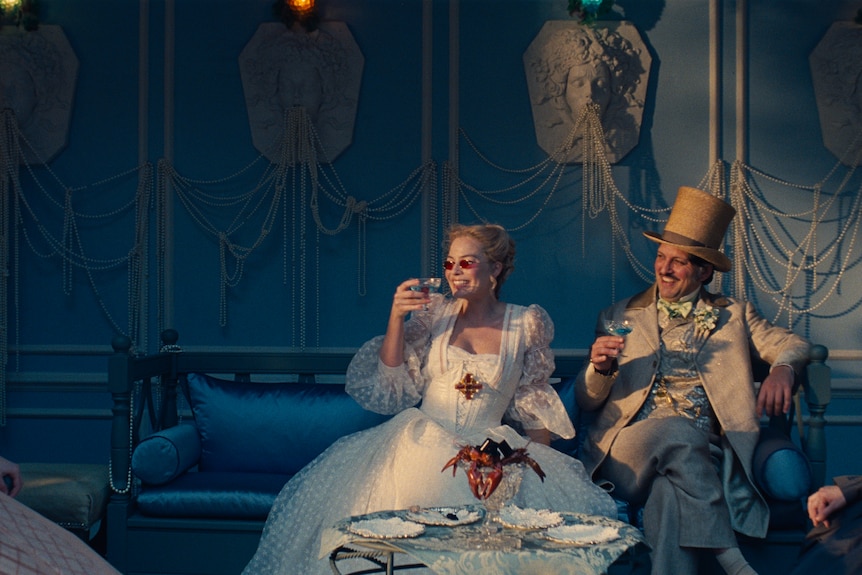
Cathy shacks up with Edgar Linton (Shazad Latif) after fumbling the bag with Heathcliff. (Supplied: Universal/Warner Bros)
It’s a marriage of social convenience rather than true love, at least from Cathy’s perspective. Fennell takes her cues less from Brontë than her own Saltburn in these early passages, playing the author’s class anxieties and patriarchal entanglements closer to farce — almost as though playing anything without a layer of irony might confuse a modern audience.
By contrast, Heathcliff’s swooning return and his secret affair with the married Cathy, is the movie’s sweet spot. It’s the best representation of Fennell’s idea of Brontë as slumber-party ur-text, a sexual awakening unraveled by torchlight under the covers.
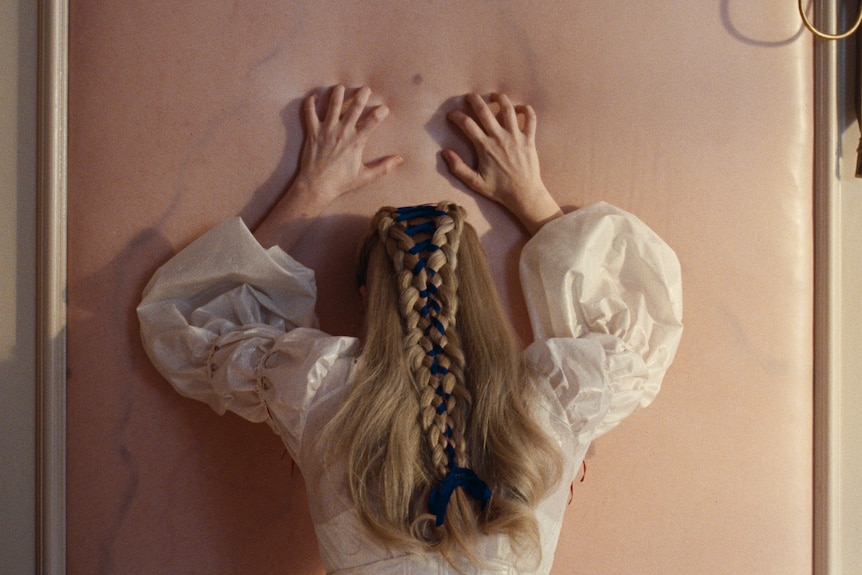
Cathy’s bedroom walls were designed to look like Margot Robbie’s skin, using photograph’s of Robbie’s arm and skin-toned latex. (Supplied: Universal/Warner Bros)
Pinterest-perfect
Robbie and Elordi summon their movie-star charisma, Fennell shows off her talent for hot and heavy close-ups, and Charli’s songs trill eerily from some auto-tuned teen bedroom of the future.
Even the director’s goofier choices — like revealing Heathcliff’s silver tooth in a moment of supposed intensity — feel like loving doodles from a schoolgirl’s fantasy of the novel.
Sure, every frame looks more or less designed for a mood board, but the film’s old-school movie look — shot in 35mm VistaVision by Saltburn cinematographer Linus Sandgren — is undeniably ravishing, particularly coupled with production design that’s equal parts Black Narcissus, Bram Stoker’s Dracula and Stevie Nicks music videos. It’s tactile and sensuous.
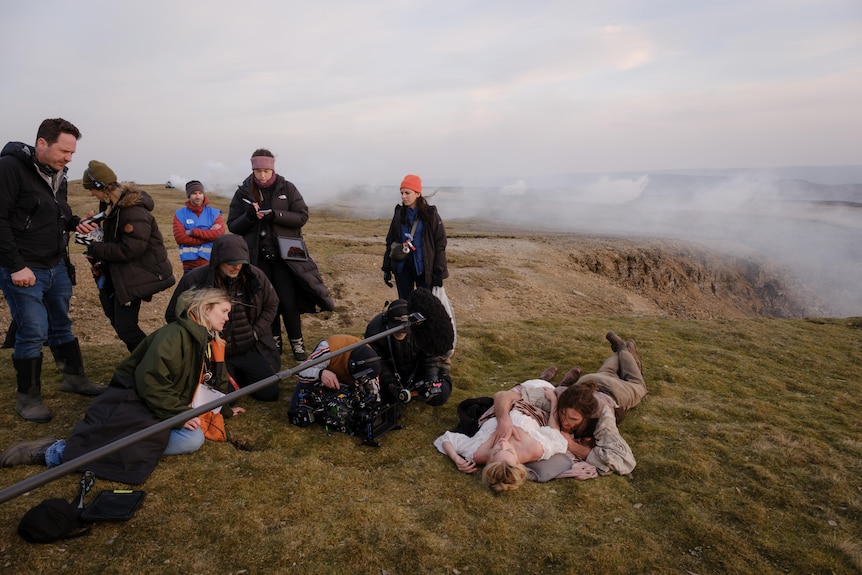
Parts of Wuthering Heights were shot on location in the English Yorkshire Dales region. (Supplied: Universal/Warner Bros)
For all her stylistic exertion, though — all those squelching slugs and runny eggs and sweat glistening on skin — Fennell can’t get to the essence of a story that’s always been more of a haunting than a romance, nor conjure up something sufficiently radical to make it her own.
As magnetic as Elordi and Robbie are as performers, no amount of steamy montages can quite convince us that they’re souls entwined in the cosmos, the kind of supernatural pairing whose whims seemed to command the elements — one of the reasons Kate Bush’s Wuthering Heights remains undefeated as the greatest adaptation of the novel; a feat it achieves in all of four minutes and 29 seconds.
Still, Fennell’s Wuthering Heights is most definitely her own, and if you want to see Jacob Elordi hoisting up Margot Robbie by the bodice with one hand — and let’s face it, who doesn’t — her lurid, lusty adaptation may well satisfy your Valentine’s Day craving. Hooting and hollering at this hot mess is all part of the fun.
Wuthering Heights is in Australian cinemas from February 12.