
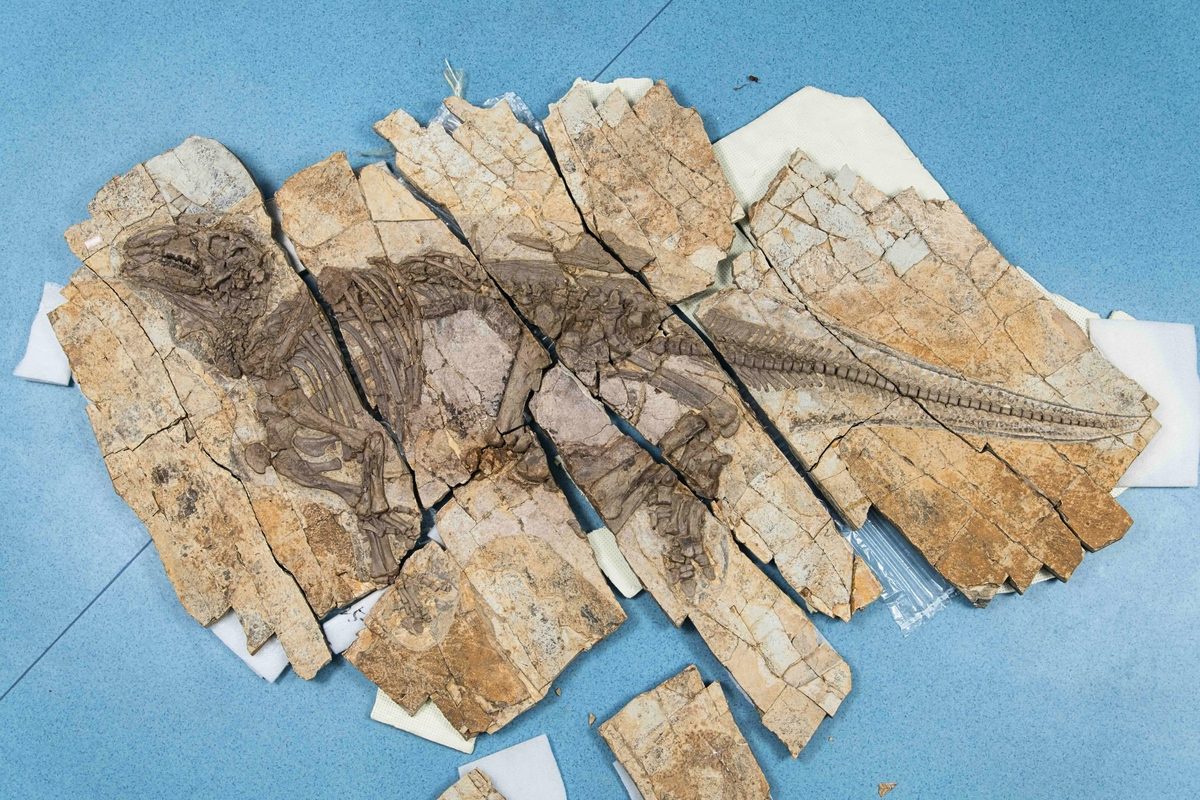
A new Chinese dinosaur shows that at least some members of the Iguanodon group – long assumed to be entirely scaly-skinned – had short spikes across part of the body.
Dubbed Haolong dongi by a joint team from China, Belgium, France and Italy and led by Jiandong Huang of China’s Anhui Geological Museum and Pascal Godefroit of the Institute of Natural Sciences in Brussels, the new dinosaur has been published in Nature Ecology & Evolution.
Its name means ‘spiny dragon’ in Chinese, the species name honouring influential Chinese dinosaur expert Dong Zhiming, who died in 2024.
The single known Haolong specimen is 2.4 m and fully complete. Unfused bones show that it was a juvenile at death, and it is assumed from related species that adults were somewhere around 5 m long.
Haolong is an iguanodontian, part of the group that includes the famous thumb-spiked Iguanodon from western Europe as well as the hadrosaurs or duckbills of global distribution. Iguanodontians are themselves part of the much more inclusive group called ornithischians. Stegosaurs, the armoured ankylosaurs and the horned Triceratops and its kin are also part of the ornithischian group.
What makes the fossil remarkable is its quality of preservation, since the bones are surrounded by a substantial quantity of preserved soft tissue. Much of this pertains to the skin and its external structures. By using both laser-stimulated fluorescence and conventional microscopy, Huang and colleagues were able to document incredible complexity in Haolong’s skin, preserved right down to the cellular level.
Remarkably, this was a bristly dinosaur, possessing cylindrical spikes that projected backwards from the animal’s neck and body. Some are tiny at just 2-3 mm long while the longest are around 4 cm long. By taking cross-sections and examining them microscopically, the team found that the spikes are hollow and with an outer structure formed of multi-layered, stiffened skin. They most likely looked like short porcupine quills.
Remarkably, this was a bristly dinosaur, possessing cylindrical spikes that projected backwards from the animal’s neck and body.
Tiny, rounded, oval and polygonal scales of a sort typical for dinosaurs are also present across the body, and the spikes project from in between them. In addition, large, overlapping scales are present along the upper surface of the tail and arranged in nine rows extending along the tail’s length. This is also unique for an iguanodontian, since the other species in which skin is preserved either have tiny, non-overlapping scales in this region, or large, tall scales that form a frill along the midline.
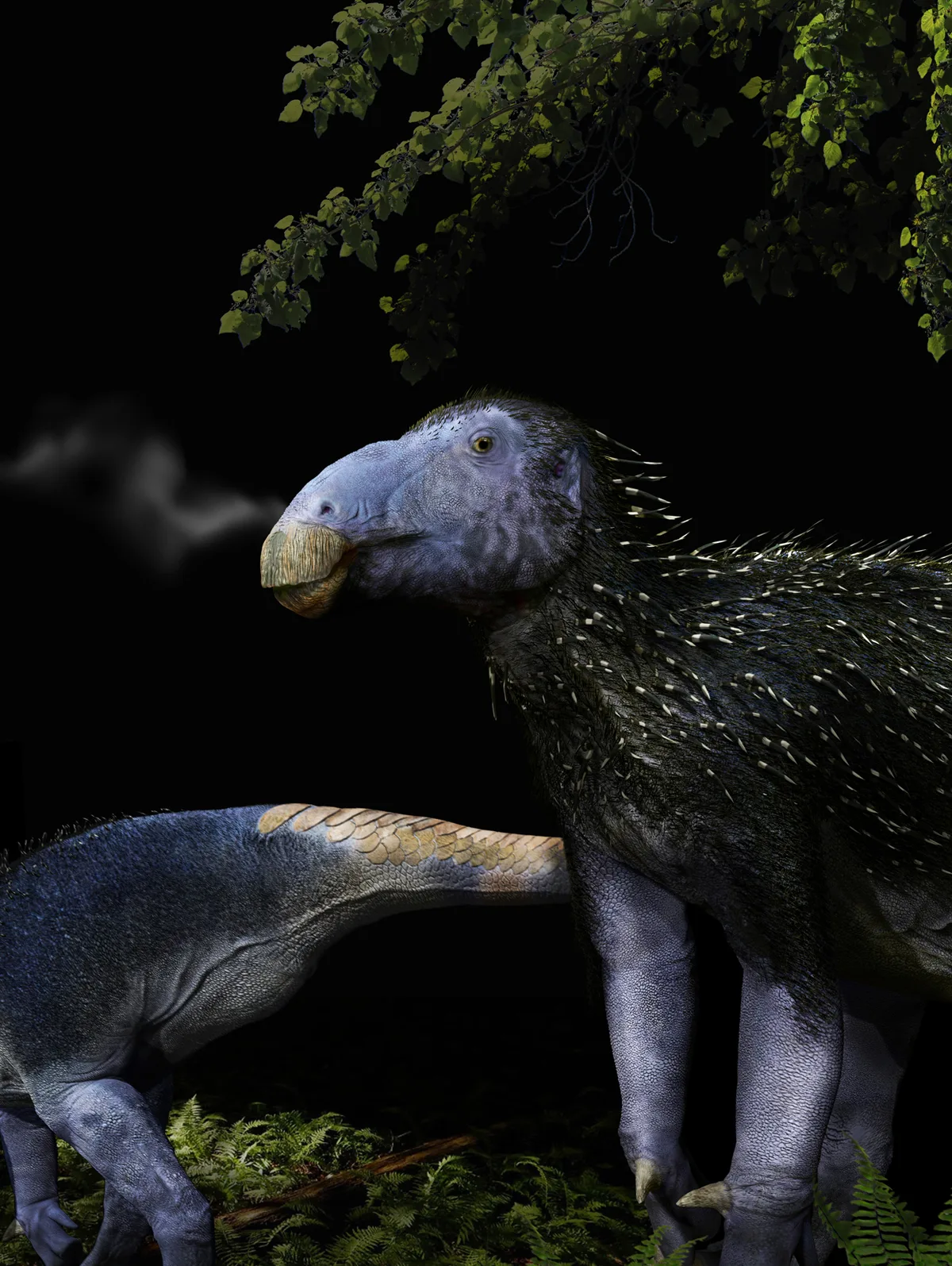 An artist’s impression of what Haolong dongi may have looked like. Credit: Fabio Manucci
Tail scales vaguely like those of Haolong were described for a very different ornithischian – the small, bipedal Kulindadromeus from the Jurassic of Siberia – in 2014 so it would seem that plate-like tail scales evolved more than once among these dinosaurs.
Recent years have seen the discovery of ornithischians with long filaments on the tail and even, in some small species, an extensive covering over most of the body. These filaments look similar to those of theropods, the dinosaur group that includes birds. This could mean that ornithischian filaments should be identified as feathers. But the Haolong spikes appear to be something else again. “Maybe this shows that the diversity of skin coverage in dinosaurs was amazing, beyond a simple dichotomy involving just scales and feathers”, suggests Godefroit.
What roles these spikes might have had remains an interesting question. The possibility that they had a sensory function was considered by the team but regarded as unlikely. Their large size and separation from other structures on the outside of the skin makes them very different from the microscopic, bristle-like organs that have a sensitive role in modern reptiles.
Haolong lived in a cool environment where the annual average temperature was around 10° C. Other dinosaurs here might have used bristles and feathers as insulation. The possibility that Haolong’s spikes had some role in insulation does exist, but they don’t appear to have formed an insulative coat. What seems most likely is that the spikes had a role in deterring predators.
Our improved understanding of ornithischian skin has, increasingly, led artists to depict these animals with spiny coverings, fuzzy coats and elaborate filaments and spikes. Haolong provides some justification for such ideas. Perhaps spikes of this sort were present in other iguanodontians but have simply not been preserved. “Importantly, we still need to understand the specific processes behind such remarkably odd preservation”, adds Godefroit.
Top image: Haolong dongi. Credit: Thierry Hubin, Institute of Natural Sciences
More amazing stories about dinosaurs