
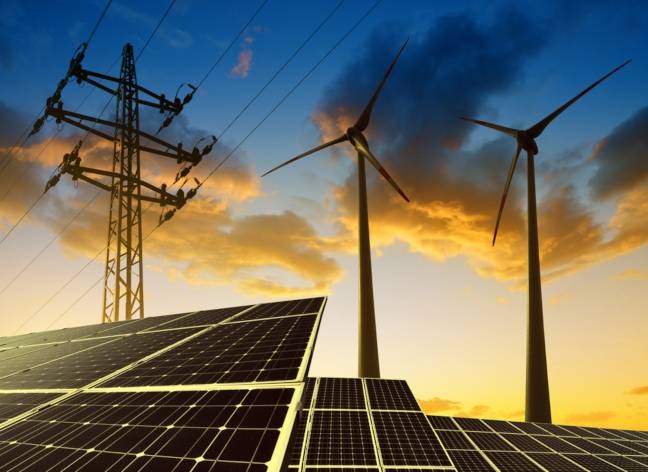
Let’s hope it’s always sunny … in Texas, at least for Google’s sake. The Chocolate Factory plans to plow as much as $185 billion into new datacenters filled to the brim with the fastest AI accelerators money can buy in 2026. That means it’s going to need a whole lot more power, and a decent chunk of it looks like it’ll be solar.
On Monday, the search and advertising titan entered a power purchase agreement (PPA) with French energy infrastructure provider TotalEnergies to pave Texas with a gigawatt of solar panels to fuel Google’s AI ambitions.
The PPA includes the construction of two solar farms in central and north-central Texas. According to TotalEnergies, its Wichita and Mustang Creek sites will produce 805 MWp and 195 MWp of solar capacity, respectively. More importantly, they won’t require launching datacenters into orbit to do it, something Google and others also happen to be looking into.
Hyperscalers often use PPAs to get new sources of power online fast. Under a PPA, a customer agrees up front to purchase the energy generated at an often favorable rate over a period of several years. This capacity is usually added to existing grid infrastructure, rather than being connected directly to the load, though behind-the-meter agreements have become more common in recent years.
We’ve reached out to Google for comment on how exactly it plans to consume the power generated by TotalEnergies’ solar farms, but, in either case, it stands to benefit from additional capacity and a greener, often cheaper, mix of power.
The deal represents a major expansion of TotalEnergies’ renewable footprint. The company currently operates approximately 10 gigawatts of solar, wind, and battery storage capacity across the US.
Both plants are slated to break ground in the second quarter of 2026 and will eventually provide Google’s datacenters with an estimated 28 terawatt hours of renewable electricity over the 15-year contract, the companies said in a joint statement. That’s weather-dependent, of course. Having said that, there are worse places to build a solar farm than Texas.
According to the National Laboratory of the Rockies, on average two solar farms should receive between 4.75 and 5.25 kilowatt-hours per square meter per day of radiation from our sun, which is better than most states in the US can hope for.
One longstanding drawback of solar power is the sun has to be shining to produce energy, and daylight only lasts for a few hours each day depending on the season. To overcome this, Google will either need to schedule its most power-hungry jobs during daylight hours when the mix of solar energy across the grid is at its highest – for training workloads, this is entirely possible – or deploy some sort of energy storage for evening and overnight hours.
While Google has discussed its work on CO₂ battery storage in the past, it hasn’t said whether it plans to use the technology in conjunction with the TotalEnergies agreement.
Energy isn’t the only thing Google needs to support its datacenter spending spree. AI datacenters are expensive, and packed with fast-depreciating assets, meaning they have only a short window to turn a profit.
To help finance this expansion, its parent company Alphabet is tapping the bond market. As per Bloomberg, it was set to raise $20 billion from a US dollar bond sale on Monday, while separately pitching rare 100-year bonds in overseas markets – almost four times longer than Google has been a company. ®