
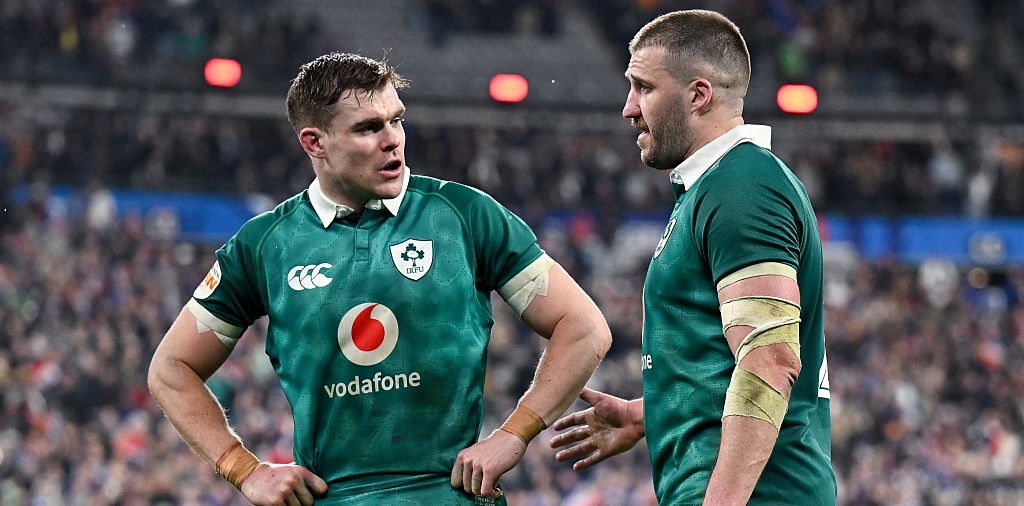
Children around the world are told not to point fingers at others as three more point back in their own direction. It seems the lads at Virgin Media Sport never received this message.
Speaking in the aftermath of Ireland’s sorry 36-14 loss to France in the Six Nations opener in Paris, Joe Molloy, Shane Horgan, Rob Kearney and Ian Madigan reached for an explanation.
What they settled on had nothing to do with the age profile of the squad, nor did it have anything to do with uncertainty at fly-half, a lack of punch in midfield or the fact that coach Andy Farrell had spent most of last year with his focus elsewhere.
No, the blame for Ireland’s decline was being laid at the feet of a South African.
“It’s hard not to feel, and again it’s [Jacques] Nienaber’s prerogative and Leinster’s prerogative, but it’s hard not to feel a sloppiness that [Joe] Schmidt would never have allowed has just been allowed to fester, when it comes to the basics that are essential for a team of Ireland’s size,” Molloy offered.

Ireland

Italy
Horgan added: “I think that’s a very fair point and it’s maybe an unforeseen consequence for Nienaber. In somewhere like South Africa, everybody grows up with a ball in their hand and never stops passing.”
Stop the lights. What are they on about?
Let’s start at the top. In 15 years Nienaber went from a physiotherapist on the fringes to one of the most influential defensive architects in rugby. Alongside Rassie Erasmus, he helped forge one of the greatest dynasties in all sport, culminating in his lifting of the 2023 World Cup, a triumph secured with a hat-trick of one-point victories by a team renowned for it’s tenacity.
He then took on the role of senior coach at Leinster, a club that had once dominated the PRO 14, but had not claimed a United Rugby Championship crown since the tournament was launched in 2021. Within two seasons of Nienaber’s arrival, the Dublin side would return to the summit of their domestic ecosystem after crushing the Bulls from Pretoria 32-7 in last year’s final.
This doesn’t mean that Leinster have not undergone a change in tactics and ideology. Their attack seems less fluid than it once was. They move through phases without that trademark continuity that once broke down opposition defences with a cold ruthlessness.
But they’re hardly a force in the wane. They are just four points off Glasgow at the top of the URC and won all four of the matches in the Champions Cup group stage. If this is systemic decay, it is among the most successful versions of it European rugby has seen in years.
So perhaps we pivot. Perhaps the more honest conversation is not about where Nienaber comes from, but about where Ireland currently are. Because decline, or even just regression to the mean, was always a possibility.
This Irish side has ridden a golden wave for the better part of half a decade. A Grand Slam. A series win in New Zealand. A spell at number one in the world rankings. But golden generations, by definition, do not last forever. They crest. They taper. They need renewal.
Look at the age profile. Several cornerstones of this team are on the far side of 30, with heavy club and international mileage in their legs. Experience is invaluable. At least until the split-second sharpness that defines elite rugby begins to dull.
In Paris, that dulled edge was visible. France consistently won the gainline, forcing Ireland onto the back foot and slowing ruck speed. Irish exits lacked their usual precision, kicks travelled without sufficient chase pressure, and by half-time the scoreboard read 22-0 and still flattered the visitors.
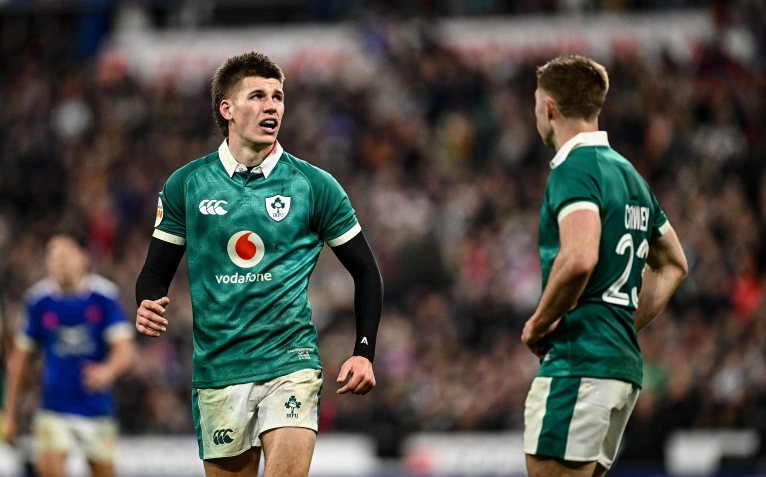 Paris , France – 5 February 2026; Ireland players Sam Prendergast, left, and Jack Crowley during the Guinness 6 Nations Rugby Championship match between France and Ireland at Stade de France in Paris, France. (Photo By Seb Daly/Sportsfile via Getty Images)
Then there is the issue at ten. Ireland have not replaced clarity with clarity. The fly-half position remains unsettled, searching for a conductor capable of dictating tempo against tier-one opposition. This is not to suggest that Sam Prendergast, Jack Crowley or Ciaran Frawley are incapable of producing the goods.
But to expect them to replicate the performances of Johnny Sexton, to methodically loop around the point of contact and serve as a metronome at the heart of a well-oiled machine is unrealistic. If Ireland are failing to get a tune out of their young generals, then the blame is not with a South Africa removed from the system, but with the Englishman in the driver’s seat.
Farrell has earned enormous credit. His tenure has, for the most part, elevated standards and sharpened belief. But leadership at this level is not a lifetime achievement award. It is a constant audit. And if TV pundits are keen to point fingers, perhaps they can direct one or two to the gruff man.
Farrell spent much of last year immersed in British & Irish Lions duties. That was an honour, rightly earned. But international rugby does not pause while its head coach broadens horizons. If cohesion dipped, if succession planning at ten feels rushed, if the attacking framework appears slightly stale against aggressive defences, those are issues of stewardship. Contrast Ireland’s regression in this time with the advances made by Steve Borthwick who used the tour of Argentina to take England to a higher plane.
If Ireland are in a state of transition, then Irish pundits ought to call it that. Frame it honestly. Manage expectations accordingly. But do not reach for lazy narratives about imported influence when the evidence points much closer to home.
France did not dismantle some South African experiment in Paris. They dismantled an Irish side that has looked half a step off the pace of the pack leaders for 18 months. If Farrell is unable to recalibrate the group that is on him, not on a domestic coach at the head of the country’s most dominant club.
Some balance in the discourse would not only redirect attention to where it needs to be, but would also facilitate some much needed improvement before the wheels truly fall off.