
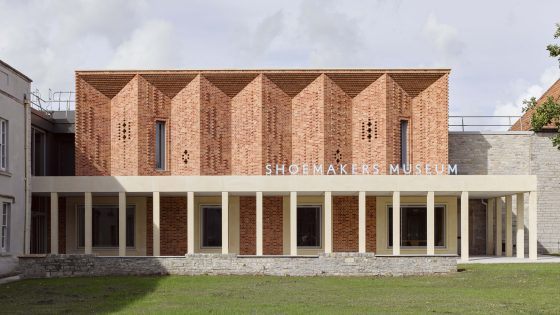
Purcell has completed the Shoemakers Museum for Clarks, in a project marking the Somerset-based company’s bicentenary.
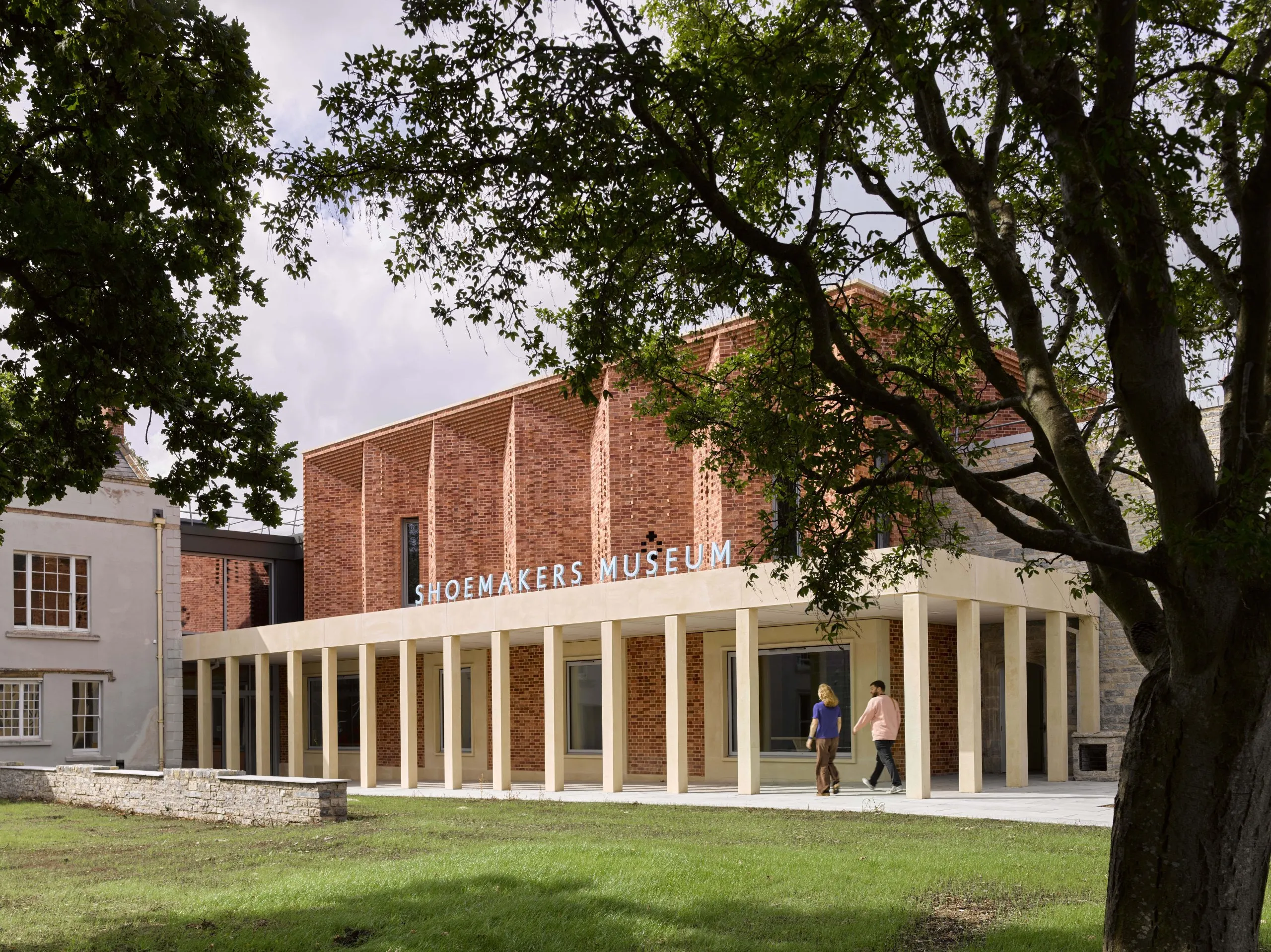
It sits on a constrained infill site between two listed buildings in Street, designed as a contemporary intervention mediating between conservation and commemoration.
The façades are composed of locally sourced brick detailed with patterns derived from classic Clarks’ shoe designs, creating textured façades that reference craft tradition and industrial process. Construction consists of a CLT structure and timber-concrete composite floors. Salvaged blue lias stone – the local Jurassic limestone – has been used to form a new link wall internally and externally, helping ground the building in its context.
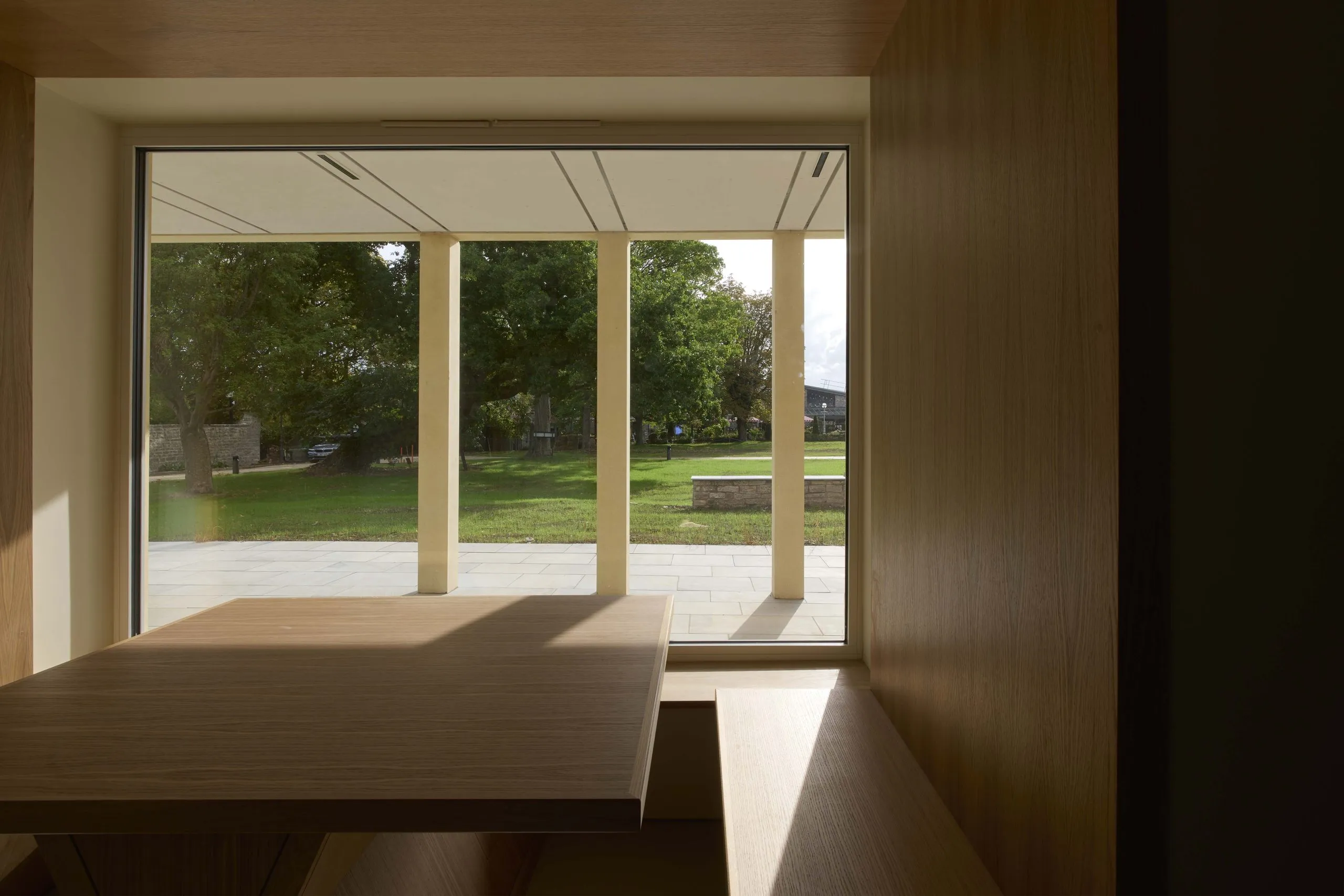
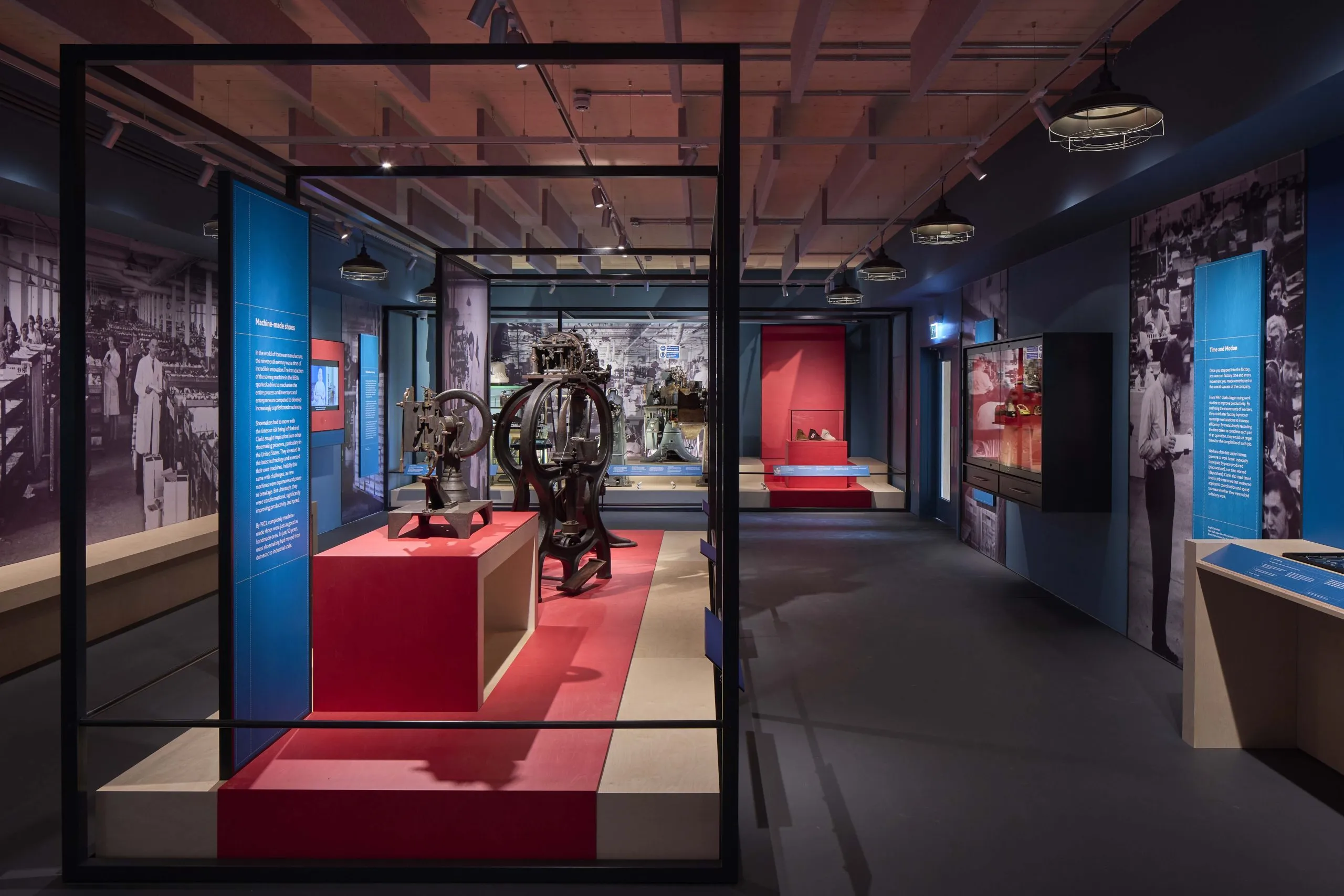
Inside, the museum and archive houses 25,000 pairs of shoes alongside ichthyosaur fossils excavated during the demolition of the original Victorian factory – creating an unusual juxtaposition of natural and industrial archaeology.
The project was developed with a fabric-first environmental strategy that aligns with the Quaker principles and ethical parameters that Clarks says shaped it as a company.
Architect’s view
How do you design a shoe and fossil museum on a 1,000-year-old site for a 200-year-old company displaying 250-million-year-old ichthyosaurs? That was the brief – and it needed delivering on a tight budget for a project of this significance.
The tight budget forced us to be clever – we salvaged 70 per cent of blue lias from the demolished link, reused slabs where we could, specified only standard brick types in lime mortar to ensure maximum future reuse and designed an efficient CLT superstructure. We hit LETI A without the usual sustainability premium – proving constraint breeds innovation rather than compromise.
I really enjoyed translating Clarks’ design language into architecture – perforations echoing brogue patterns, projections referencing visible stitching, pinked edges in brick. These details gave us depth and character in what’s essentially a black box for conservation purposes, while creating a façade that speaks directly to the collection inside. Watching bricklayers from Street itself execute those patterns – details that reference the shoes their grandparents might have made – felt like craft speaking across generations
Street lost its factories to outlet retail decades ago. Four million people visit Clarks Village annually, but had nowhere to connect with the actual story – the generations who worked those production lines, the millions who remember that childhood ritual of having their feet measured. This museum gives that back.
The building provides what Clarks shoes always did: quality without pretension, built to last, made properly.
Alasdair Ferguson, project architect, Purcell
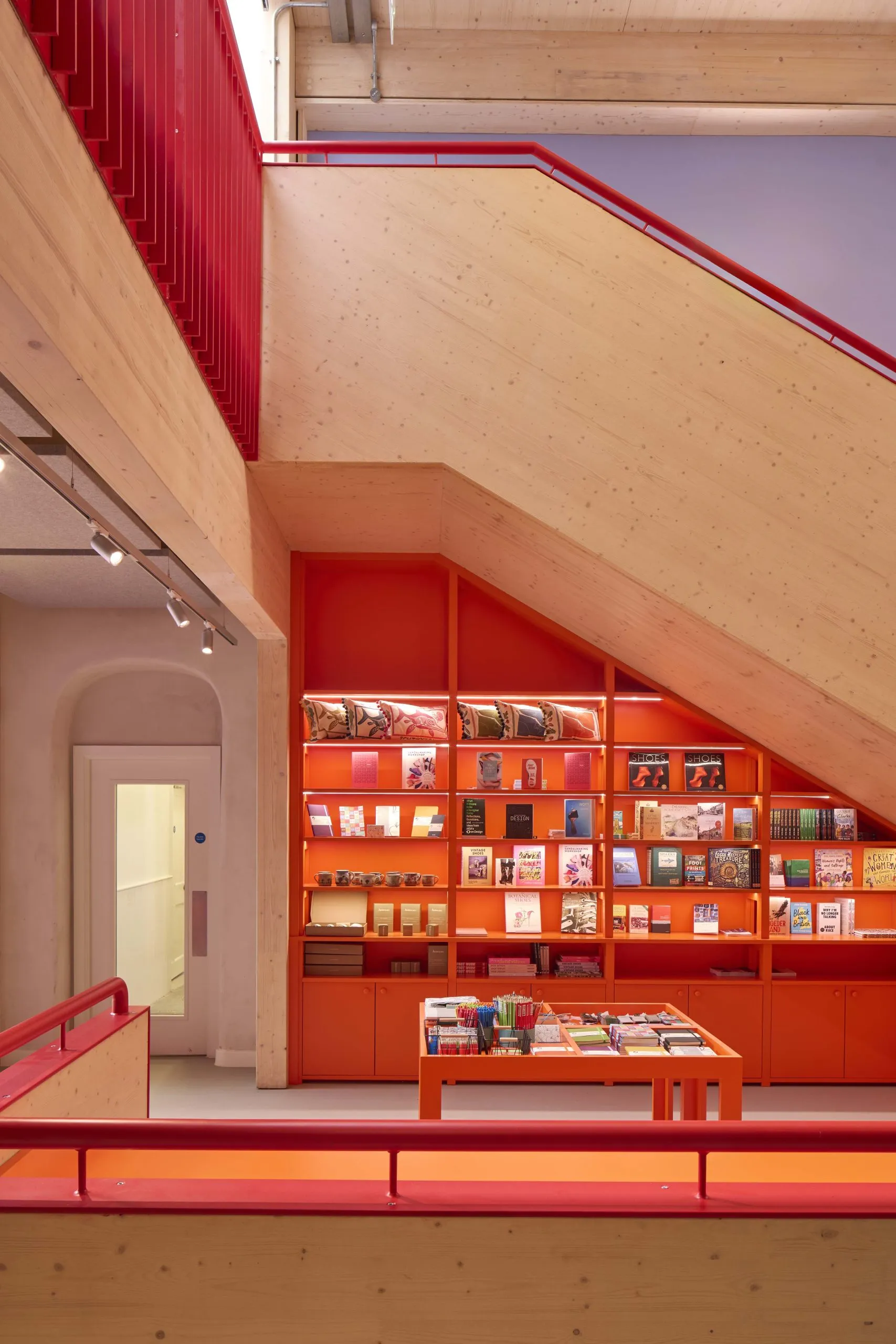
Client’s view
Thoughtfully designed by Purcell, Shoemakers Museum is housed in a unique and beautiful building. The exterior is striking, while the interior provides the ideal home for our collections. We are delighted to be open to the public and to have the opportunity to share the story of 200 years of shoemaking with the world.
Rosie Martin, director, Shoemakers Museum
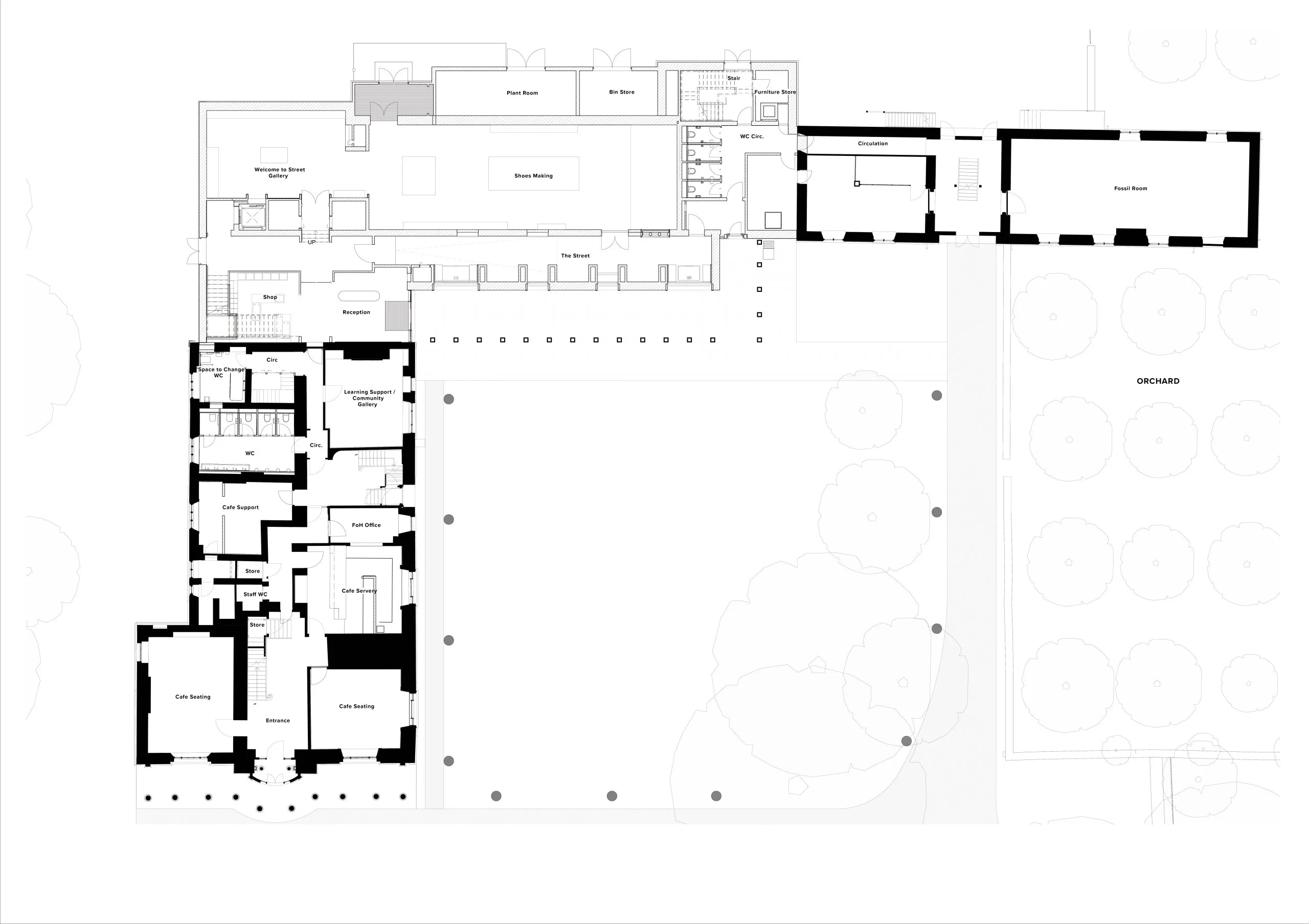
Project data
Location Street, Somerset
Start on site January 2024
Completion date September 2025
Gross internal floor area 2,210m2
Overall site area 91ha
Form of contract Traditional JCT SBC
Construction cost £4.25 million
Construction cost per m2 £2,000m2 (including refurb)
Architect Purcell
Client Alfred Gillett Trust
Exhibition designer Nissen Richards Studio
Structural engineer Mann Williams
M&E consultant QODA
Quantity surveyor Currie + Brown
Landscape consultant Studio Loci
Project manager MCMS
CDM Principal Designer Purcell
Approved building inspector LABC
Main contractor RIGG Construction
Fit-out contractor Realm
Shop and reception fit-out Resolution Interiors
CAD software used Revit
Environmental performance data
On-site energy generation 100% at peak
Annual mains water consumption 356m3/occupant
Airtightness at 50Pa 3.56 m3/h.m2
Heating and hot water load 10.79 kWh/m2/yr
Operational energy 31.19 kWh/m2/yr
Total energy load 5.97 kWh/m2/yr
Overall area-weighted U-value 0.16 W/m2K
Predicted design life 100 years
Upfront embodied carbon 212 kgCO2eq/m2 (A1-5)
Lifecycle embodied carbon 352 kgCO2eq/m2 (A1-5, B1-5 , C1-4)
Annual CO2 emissions 1.2 kgCO2eq/m2
Energy performance certificate rating A