
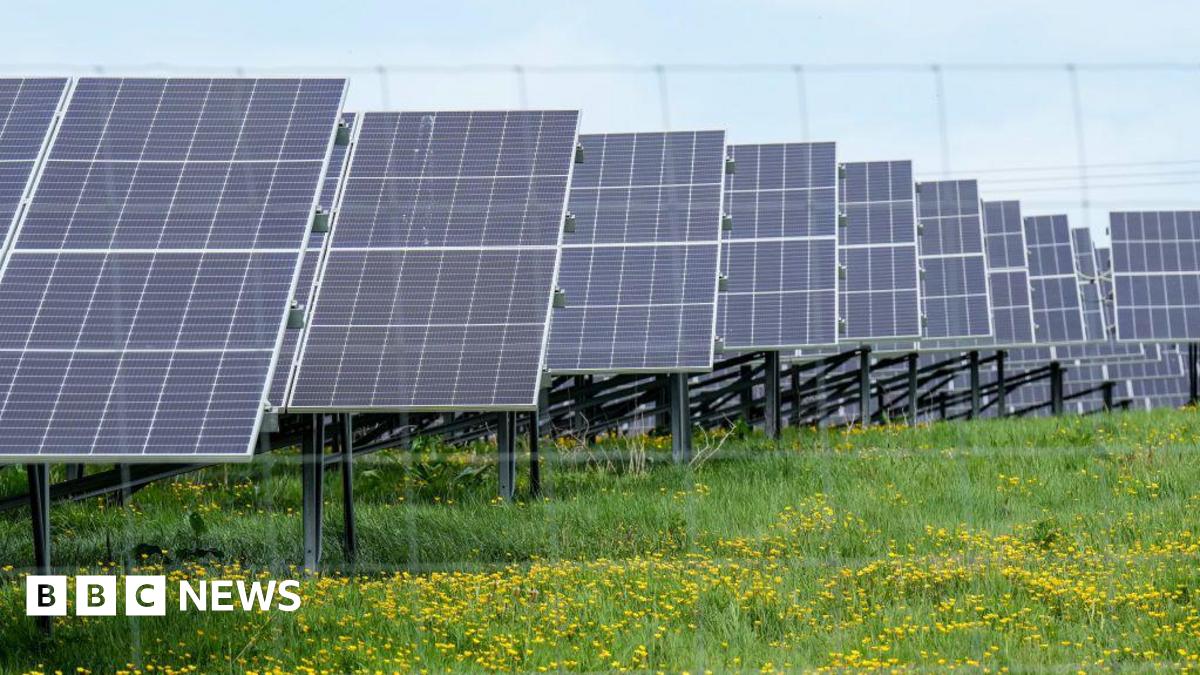
The solar and onshore wind projects awarded contracts are given a guaranteed price – for 20 years for solar and wind in this auction – and linked to inflation. That certainty is designed to reassure developers that they will get a return on their upfront investment.
The solar projects have been awarded a fixed price of £65 per megawatt-hour of electricity generated, in 2024 prices. That is down from the £70/MWh awarded at the last auction in 2024, also in 2024 prices.
About 1.3GW of onshore wind projects were also awarded contracts. They have risen slightly in price, to £72/MWh, up from £71/MWh in the last auction, both in 2024 prices.
These projects can end up raising or lowering household bills, partly depending on how they compare to the price of electricity on the wholesale market. Wholesale market prices are usually driven by gas today.
But the final impact on bills is difficult to calculate as it depends on future gas prices, grid upgrades and how much our demand for electricity rises, among other factors.
The government says that the solar and wind prices are much cheaper than the alternative of building and fuelling a new gas power plant.
Energy Secretary Ed Miliband said: “By backing solar and onshore wind at scale, we’re driving bills down for good and protecting families, businesses, and our country from the fossil fuel rollercoaster controlled by petrostates and dictators.”
But shadow energy secretary Claire Coutinho said: “Ed Miliband is loading more and more wind and solar on to the grid before the grid can handle it.
“The true cost of this power, once you add in network charges and back up is far higher, so all this will do is make our electricity even more expensive,” she claimed.
Reform UK has also questioned the need for net zero. Meanwhile the Lib Dems and the Greens want to see an expansion of renewables around the country to tackle the threat of climate change and boost green jobs. The SNP and Plaid Cymru have long argued for Scotland and Wales to have control over their energy resources.
A small number of contracts have also been awarded to tidal power projects. They are expensive but the government sees them as an investment in a technology which could become cost-effective in future, as well as boosting green jobs.