
Our current prospects for safety are not great, as the most powerful are harming and polluting the environment, exploiting people and hoarding their profits.
But we shouldn’t assume that we, ordinary people, have no power at all.
Looking back in history, we can see how positive change starts with just a few people.
This first story is about local efforts to tackle air pollution and how you can get involved.
I’ve been thinking about this because my breathing was affected when walking past drivers idling engines at school pick-up time.
This is illegal and significantly increases the concentration of toxic fumes in the air, affecting drivers and pedestrians alike.
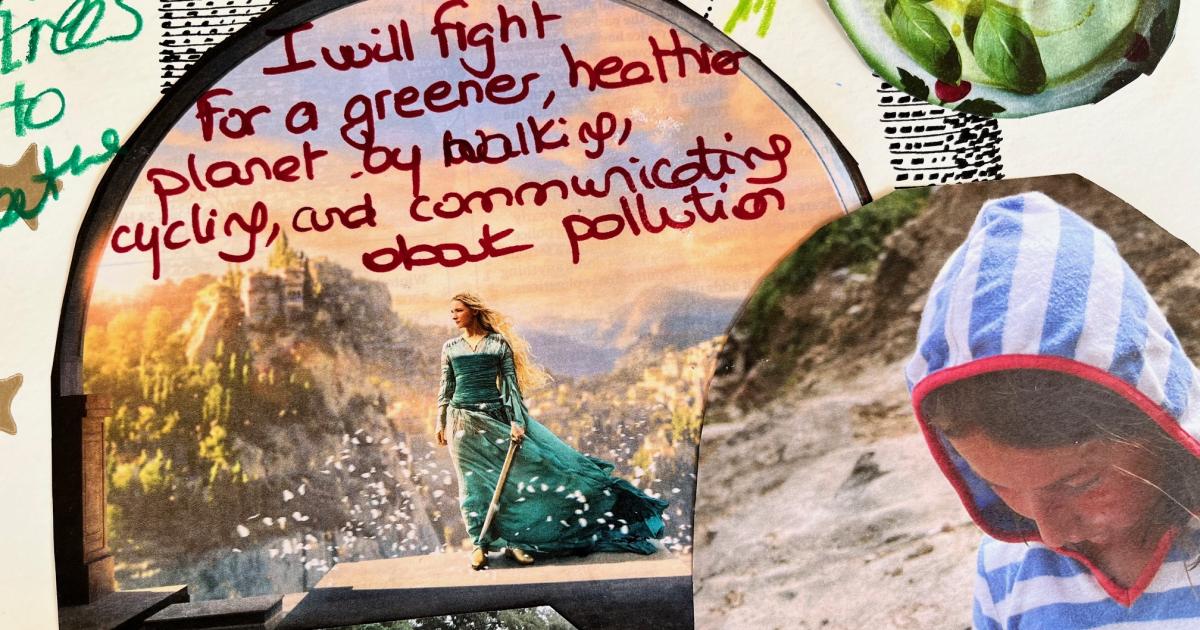
I ran a workshop with this local school, and the children shared fun ideas for explaining air pollution to parents and for Walk to School Week.
We explored the ‘what and why’ of air pollution, discovering that air contains too many particles and toxic chemicals, worsening respiratory and circulatory diseases.
It comes from: farming with pesticides and livestock, and over ploughing of soil; heating buildings with wood burners and gas boilers; factories emitting toxins like formaldehyde and lead; vehicles emitting noxious fumes; and increased wildfire smoke and storm dust due to global warming.
So, what are some local campaigns, and how can you help?
It was Clean Air Night on January 26, with a local action organised by Friends of the Earth Norwich.
They explained that even modern wood-burning stoves pollute the air, which is a problem in more built-up areas like Norwich.
Wood smoke contains fine particles and carcinogenic chemicals, and it may be worse than cigarettes at causing tumours.
The next day, Clean Air Norwich and the Green Party submitted a motion to the City Council, saying that clean air is a fundamental right, not a privilege.
It describes how air pollution is a silent killer, linked to serious illnesses, with the burden falling hardest on the young, the elderly, and the poorest residents.
The city’s pollution levels far exceed the World Health Organisation’s health-based guidelines.
Actually, this is the case for 99% of the global population, causing seven million premature deaths each year.
It is encouraging that the motion was unanimously passed and that the city’s air is getting cleaner due to the new zero-emissions buses, a 40% increase in cycling, and measures to reduce traffic congestion.
If you’re in a position to do so, changing your travel habits can be sociable and fun, for example, by sharing car journeys with friends, or with a service like Liftshare or Mobilityways.
If you want to get used to cycling, take part in a Critical Mass group ride, or Kidical Mass, when families gather to ride through Norwich.
If you’re concerned about safety, contact the Norwich Cycling Campaign for information, as they focus on tackling unsafe road areas and supporting people who feel vulnerable.
Another way to help is to plant up and extend green spaces, as plants remove pollutants and CO2, and release chemicals that benefit our health.
There are several routes to get involved, including the Outdoor Projects Network run by the council’s community enabling team.
Getting involved isn’t always easy, and progress can be slow.
Since I worked with my local school on air pollution last summer, cars with idling engines still clog the streets.
I really do sympathise.
Teachers and parents have very little time, and want children to be safe.
So many schools are built near busy roads, so they depend on infrastructure changes led by local authorities.
While I am pointing to actions we can try as individuals, I don’t mean to blame people for their behaviour when we are all caught up in a high-carbon, high-consuming society.
These examples focus on Norwich because it’s where I live, so do find out what groups or actions are relevant and local to you.
Whatever you choose to do, know that the chances of success are much higher if you try than if you give up.
And you are not alone; join in with others, and ask for their help.