
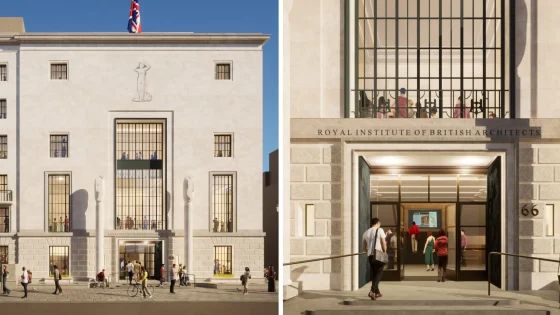
Yesterday (9 January), the institute announced that London-based Alex Cochrane Architects, Gundry + Ducker and Nissen Richards Studio had all been appointed to work on the refurbishment of the Grade II*-listed building.
Each studio will work on separate, specific elements of the project, which will improve accessibility at the 1930s building, introduce larger lifts, address inefficiencies in the plumbing and electrical systems, remove fossil-fuel-dependent systems, and restore heritage features.
Alex Cochrane Architects will design the institute’s architecture shop, Gundry + Ducker is designing the new café, and Nissen Richards Studio will be responsible for exhibitions and interpretations.
The scheme was originally designed by Benedetti, which won an RIBA-run competition in 2022, securing planning on the scheme last June.
Purcell was then appointed to lead on the revamp of the 91-year-old, George Grey Wornum-designed building last May, shortly after Westminster City Council approved the plans. The RIBA said at the time that Benedetti would remain the project’s design guardian.
The refurbishment includes replacing the revolving glass door on the main entrance with a more accessible entrance for blind visitors, as well as less steep wheelchair ramps and new steps. A separate entrance on Weymouth Street will be introduced for a new café – replacing the current bookshop – with pavement seating to encourage public use of the building.
The consented plans also relocate the bookshop to be more ‘public-facing’ towards Portland Place on the north-west corner of the ground floor. The main exhibition space moves upstairs, while the ground-floor gallery remains untouched.
The RIBA said the newly appointed architects would bring their ‘wide-ranging expertise and creative vision [to] shape our key visitor spaces’.
Alex Cochrane Architects recently worked on new retail areas at London’s National Portrait Gallery, while Gundry + Ducker oversaw design of Forza Wine at the National Theatre. Meanwhile, Nissen Richards Studio has previously designed schemes at the Imperial War Museum, the Courtauld Gallery, the National Portrait Gallery, and the British Museum.
RIBA shut its doors last year to allow for work to take place. In the meantime, it is operating from offices within the British Medical Association’s central London headquarters.
Speaking about the decision to bring Purcell on to the team last year, RIBA chair of board Jack Pringle said: ‘At the competition stage, RIBA was pleased to open the project to all architectural practices, including SMEs, to maximise the creative talent pool available to the institute.
‘We were delighted to appoint Benedetti Architects to that role, fresh from their triumph at BAFTA. Now, for Stage 4, we are pleased to retain Benedetti as our design guardian and to bring in the powerful team of Purcell with their in-depth knowledge of the renovation of historic buildings – not least the Palace of Westminster, the National Gallery in collaboration with Selldorf Architects, and Auckland Castle where they collaborated with Niall McLaughlin Architects.’
